Chez Nous

The French word chez [ʃe] is used to mean ‘to, at, in or into a home, office etc’. For example, chez moi means ‘at my house’, and chez le dentiste means ‘at the dentist’.

Saint-Jean-Pied-de-Port

It can also mean ‘to, at or in a country or other place’, e.g. une spécialité bien de chez nous = ‘a true specialty of our country’. In the title of this post I use chez nous to indicate we are in the world of Omniglot.

Other meanings include: ‘in or among a group of people or things of the same type’, e.g. chez les chiens = ‘among dogs’, or ‘in the work of an author or artisit’ – chez Baudelaire = ‘in Baudelaire’s work’ [source].

It has been borrowed into English and just means ‘at the home of’ [source].

Chez comes from the Middle French chez (in the house/home of), from the Old French chies (house), from the Latin casa (hut, cottage, cabin, small farm, dwelling, house), the origins of which are uncertain [source].

The French word case [kaz], which means a box or a square in a board game, and used to mean a hut, cabin or shack, comes from the same roots, as do words like casino in English (via Italian), and casa, which means house in most Romance languages [source].

Another word for house in Spanish is hogar [oˈɡaɾ], which appeared in my Spanish lessons today and inspired this post. It also means fireplace, hearth, fireside, furnace, home, home life, family life, housekeeping, homeland or household.

Is it used more in some Spanish-speaking countries than in others?

It comes from the Old Spanish fogar, from the Vulgar Latin focāris, from the Latin focus (fireplace, hearth, brazier, house, family), the origin of which is uncertain [source].

Related words in Spanish include hogareño (home, family, fireside; (of a person) home-loving, stay-at-home), hoguera (bonfire, blaze) and hogaraza (large loaf, cottage loaf).

Related words in other languages include focus and foyer in English, words for fire in Romance languages, such as fuego in Spanish and feu in French [source], and a Greek word for brazier, φουφού [fuˈfu], via Turkish and Italian [source].
Cupboards, Cabinets and Closets

A friend asked me about the difference between cupboards, cabinets and closets, so I thought I’d look into it and write a post about it.

Cupboards

A cupboard is

  • A storage closet either separate from, or built into, a wall.
  • Things displayed on a sideboard; dishware, particularly valuable plate(16th-19th century).
  • A board or table used to openly hold and display silver plate and other dishware; a sideboard; a buffet (14th-18th century).

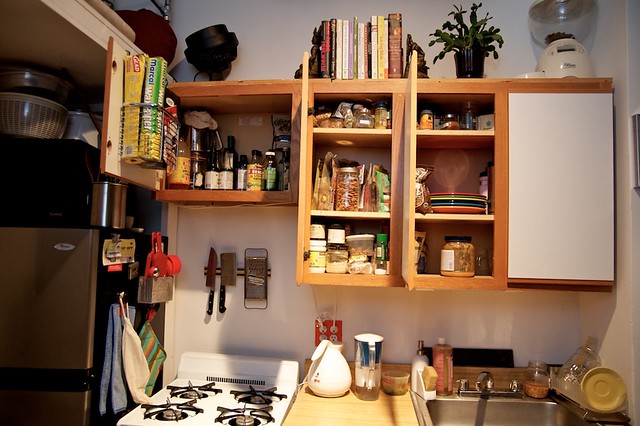
Note that kitchen cupboards are also known as kitchen cabinets. What do you call them?

It comes from Middle English cuppeborde (sideboard), from cuppe (cup) and bord (board, slab, table) [source].

If something is small, fusty or poorly lit, you could call it “cupboardy” [source].

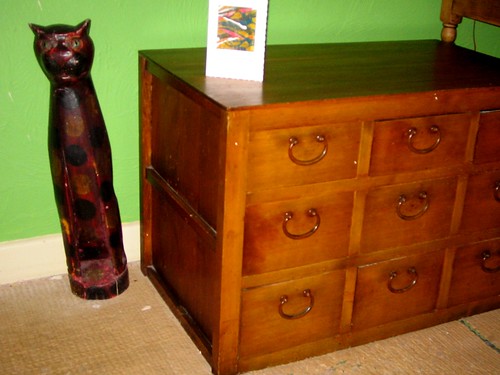
Japanese Cabinet

A cabinet is

  • A storage closet either separate from, or built into, a wall.
  • A cupboard.
  • A group of advisors to a government or business entity.
  • A group of government ministers responsible for creating government policy and for overseeing government departments.
  • A small chamber or private room (archaic) [source].

Originally it meant a secret storehouse, treasure chamber or case for valuables. It comes from Middle French cabinet (small room), a diminutive of the Old French cabane (cabin) [source], from Old Provençal cabana, from Late Latin capanna/cabanna (hut), which is of uncertain origin [source].

Rudin House, Mary Ellen's clothes

A closet is

  • A small room within a house used to store clothing, food, or other household supplies.
  • A secret or hiding place.
  • A small room or side-room (mainly in Scotland and Ireland)
  • A small room or side-room intended for storing clothes or bedclothes. (in the USA and Philippines)

Obsolete and archaic meanings of closet include:

  • Any private space, (particularly) bowers in the open air.
  • Any private or inner room, (particularly):
    – A private room used by women to groom and dress themselves.
    – A private room used for prayer or other devotions
    – A place of (usually, fanciful) contemplation and theorizing.
    – The private residence or private council chamber of a monarch.
  • A pew or side-chapel reserved for a monarch or other feudal lord.

An American-style closet (as in the photo above) might be called a built-in wardrobe in the UK. What would you call it?

It comes from Old French closet (a small enclosed area, such as a field or paddock), from clos (enclosed outdoor area, such as a field or a paddock), from Latin clausum (enclosed space, enclosure) clausus (shut, closed), from claudō (I shut, close, lock), from Proto-Italic *klaudō (I close), from Proto-Indo-European *kleh₂u- (key, hook, nail) [source].

English words from the same roots include cloister, clove, claustrophobia [source].

In Scotland and Ireland, a word used for cupboards and cabinets is press.

The Language Event

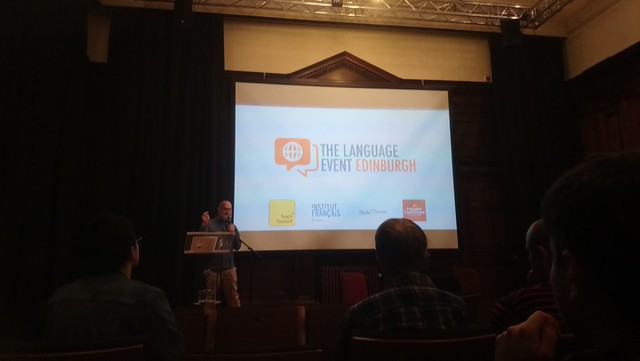
This weekend I’m off to Edinburgh for some polyglottery at The Language Event. There will be talks and discussions about language-related topics, and chances to talk about and in a variety of languages. It’s being held at the French Institute of Scotland on Saturday and Sunday. If you’re going, I’ll see you there.

Edinburgh Castle

I went to a simliar event four years ago in early 2020, just before lock-downs started. I haven’t been to any of the larger polyglot happenings since, such as the Polyglot Conference or the Polyglot Gathering, and have realised that I prefer smaller events.

The Language Event, Edinburgh

Holidays

Armadale

Last week I was on holiday. I spent most of the time learning Scottish Gaelic songs at a college on the Isle of Skye, and stopped at my mum’s in Lancashire for a few days on the way back. I had a wonderful time, met some interesting people, and learnt some beautiful songs.

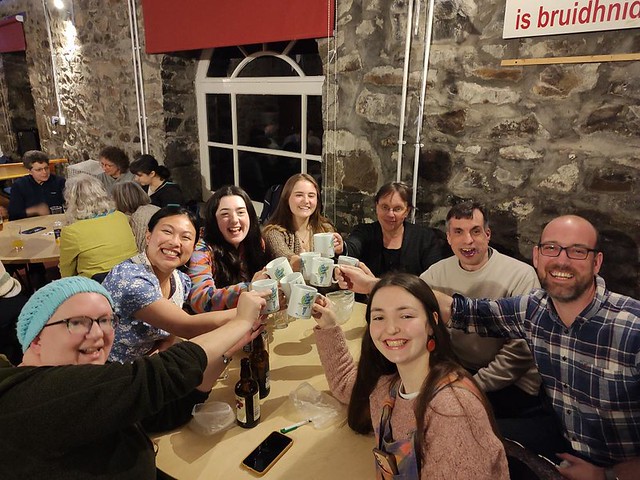
The winning quiz team

It was my 9th visit to the college since 2008 and certainly won’t be my last. When I first went there I used as much Scottish Gaelic as I knew, and filled in any gaps with Irish, which I speak more or less fluently. As the two languages are closely related, this sort of works, though differences in the pronunciation and meaning of words can lead to some misunderstandings.

A view from Sabhal Mòr Ostaig

Recently I’ve been learning a lot more Gaelic with Duolingo, and can now speak it fairly well. This makes understanding the songs easier, although they often use poetic and old-fashioned words that don’t usually appear in my lessons. As well as speaking Gaelic, I also spoke some Dutch, Japanese, Welsh and a bit of English.

Normally I try to add a certain number of pages to Omniglot each week, and to write blog posts, and make podcasts and videos. Last week I didn’t do any of that, apart from one Celtiadur post, and had a break from it all, which was great.

This got me thinking – do I really need to do so much every week? Did you miss the Adventure in Etymology last week, or the Celtic Pathways or Omniglot News podcast, or the new language and other pages that weren’t added to Omniglot? Were you aware of all of these?

Maybe I’ll start doing the Adventures in Etymology every other week, and alternating with the Celtic Pathways podcast.

Incidentally, here’s a little piece I wrote on the train from Glasgow to Mallaig. I was trying to write a train-related song, and came up with this. I haven’t thought of a tune for it yet.

The snake of steel
rattles and shakes
through steep glens
where eagles soar
past foaming fishpaths
where waterdogs play
through empty lands
where none do bide
to the ocean’s edge
where seals hide
and the water meets the sky

The threads of distraction
are loosened
and there’s time to see
beyond the wind’s eye
time to think and dream
to talk and rest
As the iron horse
clitters and clatters
Along the metal road

I’m also working on a song in Scottish Gaelic inspired by my lessons in Duolingo. It’s called Thoir an Aire (Watch out).

Thoir An Aire (Watch Out)
Seist (Chorus)
Thoir an aire, thoir an aire (Watch out, watch out)
Thoir an aire, tha Iain a’ tighinn (Watch out, Iain is coming)
Thoir an aire, thoir an aire (Watch out, watch out)
Tha Iain rùisgte is tha e a’ tighinn (Iain is naked and he’s coming)

Ghoid Màiri a drathais (Mairi stole his underpants)
Ghoid Màiri a briogais (Mairi stole his trousers)
Ghoid Màiri a geansaidh gorm is geal (Mairi stole his blue and white jersey)
Ghoid Màiri a lèine (Mairi stole his shirt)
Ghoid Màiri a brògan (Mairi stole his shoes)
Ghoid Màiri aodach Iain gu lèir (Mairi stole all his clothes)

Ruith air falbh, ruith air falbh (Run away, run away)
Ruith air falbh tha Iain a’ tighinn (Run away, Iain is coming)
Ruith air falbh, ruith air falbh (Run away, run away)
Tha guga aige is tha e a’ tighinn (He has salted gannet and he’s coming)

Càit bheil Calum? (Where is Calum?)
Càit a bheil Coinneach? (Where is Kenneth?)
Càit a bheil Ceiteag? (Where is Katie?)
Am faca tu iad? (Have you seen them?)
Càit a bheil Mairead? (Where is Margaret?)
Càit a bheil Mòrag? (Where is Morag?)
Ruith iad air falbh (They ran away)
oir tha Iain a’ tighinn (because Iain is coming)

All photos were taken by me. The videos are from the end-of-course cèilidh at SMO. I’m not sure who took them.

Skye

On Saturday (1st April), I’m going to Scotland for a week. I’m staying in Glasgow that night, then on Sunday I’ll travel by train to Mallaig along the West Highland Line – one of the most spectacular train journeys I know of. From Mallaig I’ll take a ferry over to Armadale on the Isle of Skye, then a bus to Sabhal Mòr Ostaig (SMO), the Gaelic college where I’ll be doing a course in Scottish Gaelic songs.

Glenfinnan / Gleann Fhionnain
Glenfinnan / Gleann Fhionnain – one of the places you pass by on the West Highland Line

I’ve been to SMO many times before to do simliar courses, and am looking forward to it very much. Although the course is taught in English, there will be plenty of opportunities to speak Scottish Gaelic, and probably other languages. So, for the past few months, I’ve been brushing up my Gaelic on Duolingo.

Sabhal Mòr Ostaig
Sabhal Mòr Ostaig

I’ll be travelling from Glasgow with a Dutch friend I met back in 2019 when we both did a Gaelic song course at SMO. We’ve kept in touch ever since, and she, her husband and daughter came to visit me in 2022. When we met, I had only a basic knowledge of Dutch – now I can understand and read it quite well, and speak and write it to some extent. My Dutch friend has learnt Welsh and Scottish Gaelic, with a little help from me, and Duolingo.

On the way home I’ll stay with my mum for a few days, and we’ll be celebrating my birthday on 9th April.

While I’m away, I probably won’t have much time to update Omniglot, or to write blog posts or make podcasts.

Rumbling Carts

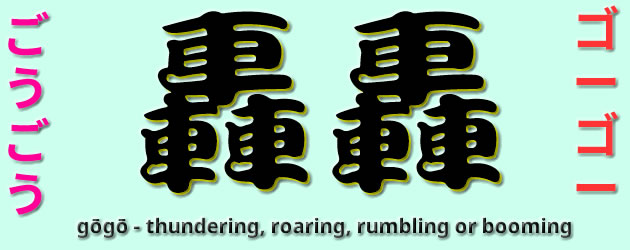
The Japanese word 轟々 / ごうごう / ゴーゴー (gōgō) means thundering, roaring, rumbling or booming. The kanji 轟 (gō/kō/todoro) is made up of three carts (車), and is also used as a surname, which is pronounced Kuruma, Gō or Todoroki.

Rumbling Carts 轟轟 (gōgō) - thundering, roaring, rumbling, booming

This kanji also appears in words like:

  • 轟音 (gō’on) = thunderous roar, roaring sound
  • 轟く (todoroku) = to roar, reverberate, be well-known, be famous, palpitate, throb
  • 轟かす (todorosu) = to make a thundering sound, to make (one’s name, etc.) widely known, to make (one’s heart) pound
  • 轟然 (gōzen) = roaring, thundering, thunderous, deafening, ear-splitting
  • 轟き (todoroki) = roar, peal, rumble, booming, beating, pounding

In Mandarin Chinese the character 轰 [轟] is pronounced hōng and means explosion, bang, boom, rumble, to attack, shoo away, expel.

It appears in words like:

  • 轰动的成就 [轟動的成就] (hōngdòng de chéngjiù) = a howling success
  • 轰动全世界 [轟動全世界] (hōngdòng quánshìjiè) = to set the world on fire
  • 轰隆 [轟隆] (hōnglōng ) = to rumble
  • 轰轰烈烈 [轟轟烈烈] (hōnghōnglièliè) = vigorously, grand and spectacular, fiery
  • 轰赶 [轟趕] (hōnggǎn) = to drive off, shoo away

I like these compound characters that are made up of several duplicated characters. Other examples include

  • 林 (hayashi – wood, forest), and 森 (mori – forest) which are made up of several 木 (ki – tree, shrub, bush, wood, timber). Put them together and we get 森林 (shinrin – forest, woods).
  • 炎 (honō – flame, blaze, passion), which are made up of two 火 (hi – fire)
  • 品 (hin – elegance, grace, article, item), which are made up of several 口 (kuchi – mouth)
  • 龖 (tà – flight of a dragon), 龘 (tà – the appearance of a dragon walking) and 𪚥 (zhé – verbose) which are made up of several 龍 [龙] (lóng – dragon).

The dragon examples are rare and in Mandarin, the rest are in Japanese.

Sources: jisho.org, mdbg.net, Line Dict CHINESE-ENGLISH

Script Families

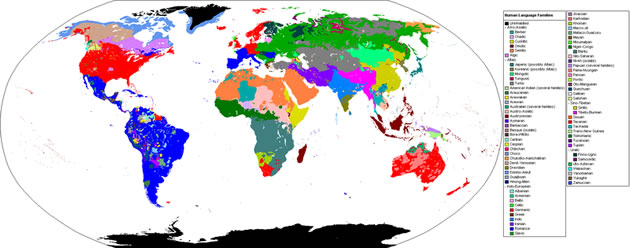
Languages are classified into families, meaning that all the languages within a particular family are known to have or thought to have developed from a common ancestor.

Language family

For example, the Romance languages, such as French, Spanish, Italian and Romanian, all developed from Latin. They are one branch of the Indo-European language family, along with Germanic, Slavic, Celtic, Baltic, Indo-Aryan and other languages. It is believed that they all developed from a common ancestor known as Proto-Indo-European, which has been reconstructed.

Some languages have no known relatives and are known as language isolates. Examples include Basque, Ainu and Hadza.

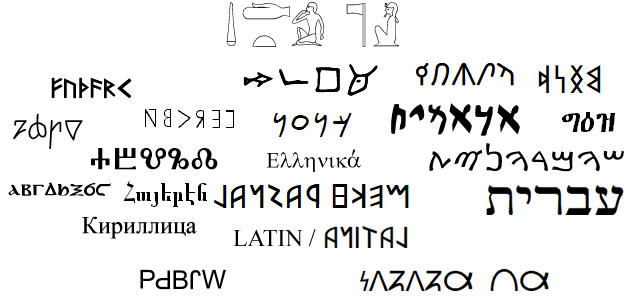
Writing systems can also be classified into families. For example the Latin, Greek and Cyrillic alphabets all developed from the Phoenician script, which developed from the Proto-Sinaitic / Proto-Canaanite script, which was based on the Ancient Egyptian Hieroglyphic and Hieratic scripts.

Language family

In fact, most alphabetic scripts in use today come from the same Ancient Egyptian roots, or were inspired by or based on scripts from those roots.

Sometimes there is some debate about which family writings systems belong to, and whether they can be considered separate scripts, or variants forms of one script.

For example, there are many variants of the Latin script, such as Roman Cursive, Rustic Capitals, Basque-style lettering, Carolingian Minuscule, Fraktur, Irish Uncial, Merovingian and the Visigothic Script.

There are also many different scripts that are or were used in the Philippines. Some are considered regional variants of the Baybayin / Tagalog script, while others are considered separate scripts. For example, variants of Baybayin include Badlit, Kulitan and Basahan.

Are they separate scripts, or different versions of the Latin/Baybayin script? Does it matter? Who decides?

I’m putting together an index of writing systems on Omniglot arranged into families. It’s not quite finished yet though.

Kiki

Have you ever been to a kiki? If you live in Florida or Hawaii, maybe you have. The rest of us, probably not.

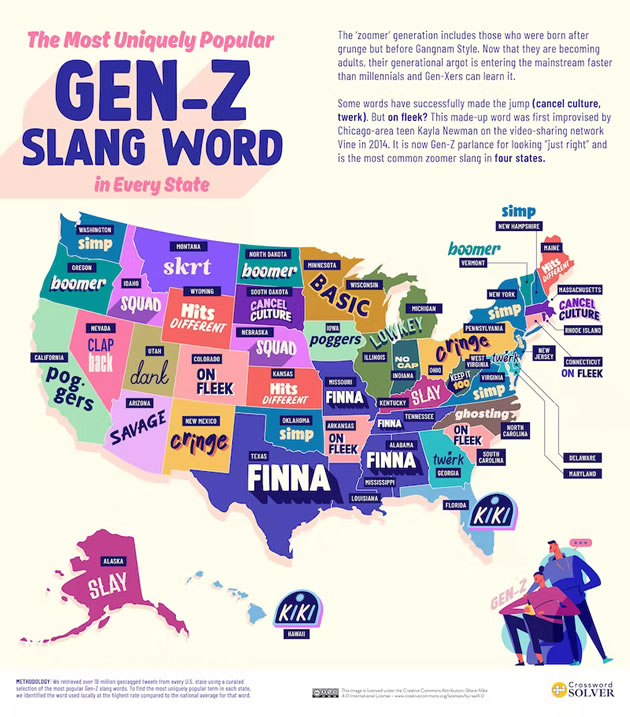
According to a post on Crossword Solver about slang words in the USA, kiki is the most popular slang word among members of Gen-Z (those born between about 1997 and 2012) in Florida or Hawaii.

Gen-Z slang

The Urban Dictionary defines kiki as:

A party including good music and good friends, held for the express purpose of calming nerves, reducing anxiety and stress and generally fighting ennui. May involve locked doors, tea and salacious gossip.

Sounds like fun! More details about the origin of this word.

Another slang word popular with Gen-Z that I’ve never heard of is finna, which apparently is an abbreviation of “fixing to” and means “going to” or “about to or in the process of doing something”. For example “I’m finna go da’ sto” (I’m going to go to the store) [source]. More details about the origin of this word.

Then there’s poggers, which is apparently popular in California and Iowa and means:

A twitch emote typically used to express enthusiasm, enthrawlment or other sophisticated emotions of happiness and dopamine.

Other definitions include: “a word to describe excitement, joy, or to hype”, “A word to describe something as good” and “something/someone that you find absolutely amazing” [source]. The related word pog is apparently “used as an exclamation of approval, especially in video game chat” and means “excellent, cool, awesome” [source].

An emote is “A term used in MMORPG’s such as World of Warcraft which describes an action your character can perform which is usually accompanied by sound and sometimes even an animation”. Examples include /poke, /cheer, /moo and /insult [source].

Have you heard/read any of these words? Do you use any of them?

Falling Apples

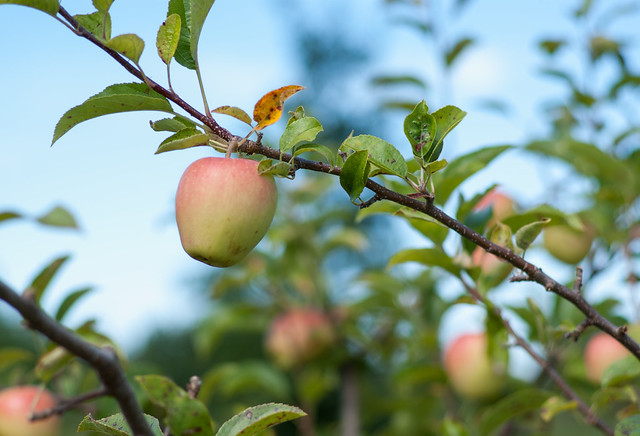
A friend asked me to look into the origins of the saying An acorn doesn’t fall far from the tree. I can only find a few examples of this saying online, but lots of examples of the apple never falls far from the tree and similar sayings. It refers to the idea that people inevitably share traits with or resemble their parents or family.

Apple Tree

According to The Phrase Finder, the origins of this saying are uncertain. The earliest known example of its use in English appears in 1830 in Benjamin Thorpe’s translation of Rasmus Rask’s Grammar of the Anglo-Saxon Tongue:

Traces still exist in the daily language of the Icelanders, for instance in the proverb, eplit fellr ekki lánt frá eikinni the apple falls not far from the tree (the oak!).

In a letter by Ralph Waldo Emerson published in 1839, he quotes the German proverb ‘der Apfel fällt nicht weit von Stamm’ – “As men say the apple never falls far from the stem.”

In 1843, The Bible in Spain by George Henry Borrow includes the line:

“The apple”, as the Danes say, “had not fallen far from the tree;” the imp was in every respect the counterpart of the father, though in miniature.

According to English Language & Usage, a Welsh version of this saying appears in A Dictionary of the Welsh Language, Explained in English:

Ni fell zygwyz aval o avall
The apple will not fall far from the tree

The spelling here is unusal and non-standard: z = dd and v = f, so in modern standard spelling it would be “Ni fell ddygwydd afal o afall”, I think.

There are also versions of this saying from Turkish – Iemisch agatsdan irak dushmas (The apple does not fall far from the tree), and Old English – Se æppel næfre þæs feorr ne trenddeð he cyð hwanon he com. (The apple never rolls so far that it does not make known whence it came.)

子狐

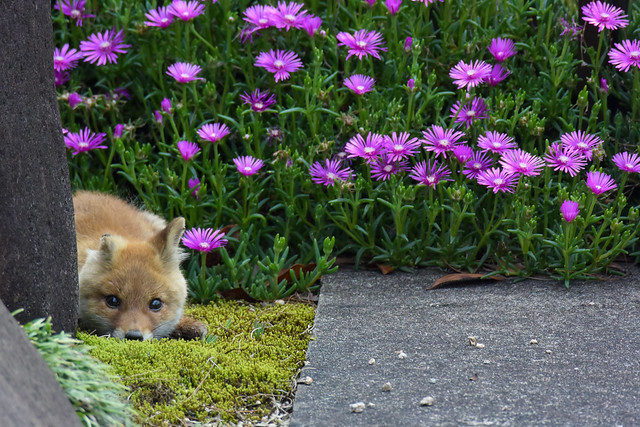
I also found an idiom with a similar meaning in Japanese: 狐の子は頬白 (kitsune no ko wa tsurajiro), which means “fox cubs have white cheeks” [source].

Do you know of examples of this saying in other languages?

Ietsiepietsie

I learnt a cute Dutch word today – ietsiepietsie. It means a little, a little bit, teeny tiny or a teeny tiny bit, and is also written ietsie pietsie, ietsje pietsje or ietsjepietsje [source].

Itsy Bitsy Katydid

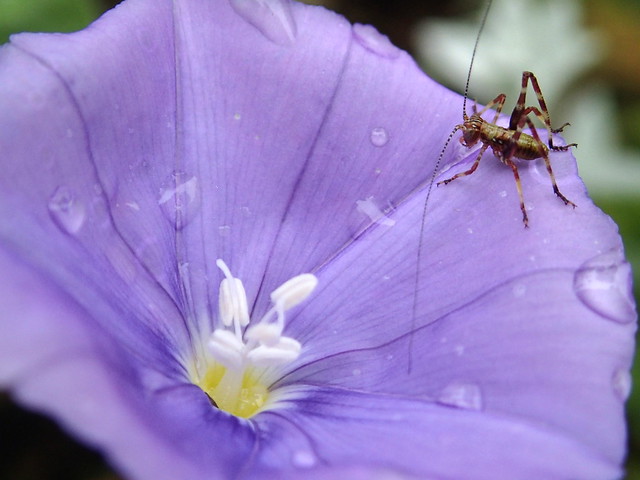
You could also translate it as itsy-bitsy, itty-bitty or teensy weensy Do you know any similar expressions in English or other languages.

It is a reduplication* of ietsje (somewhat, a little bit), a diminutive version of iets [its] (something, anything), which comes from the Middle Dutch iet (something, anything, to any degree, a little, somewhat, sometimes, perhaps), a contraction of iewet, from the Old Dutch *iowiht, from the Proto-Germanic *ne (not) plus io (ever) plus *wiht, from *wihtą (thing) [source].

*Reduplication is “a morphological process in which the root or stem of a word (or part of it) or even the whole word is repeated exactly or with a slight change.” They’re not very common in Dutch. Other examples include taaitaai (gingerbread), tamtam (fanfare, grapevine) and bla-bla (blah-blah, talk) [source].

They’re more common in English. Examples include easy-peasy, hoity-toity, hurdy-gurdy, raggle-taggle, tut-tut, chit-chat and knick-knack [source].