
Sorbian, or Wendisch, is a member of the West Slavic subgroup of Indo-European languges spoken by about 55,000 people in Upper and Lower Lusatia in the German Länder of Saxony and Brandenburg. The Sorbs are descendents of the Wends, the German name for the Slavic tribes who occupied the area between the Elbe and Saale rivers in the west and the Odra (Oder) River in the east during the medieval period.
Sorbian first appeared in writing during the 16th century. The first Sorbian texts include a fragment of a liturgy (1543) from Zossen and the translation of the New Testament (1548) by M Jakubica from Laubnitz. In the mid-19th century, written Upper Sorbian based on the dialect spoken around Bautzen was introduced as the compulsory standard in the Sorbian-speaking area in Upper Lusatia, while written Lower Sorbian based on the Cottbus dialect was introduced as the standard written form in Lower Lusatia.
Sorbian is taught as a subject in a number of secondary schools and used as a medium of instruction for some subjects. There are a number of nursery and primary schools which teach through the medium of Sorbian.
There is one daily paper, Serbske Nowiny, entirely in Upper Sorbian and one weekly paper, Nowy Casnik, half in Lower Sorbian and half in German. There are also a few journals and magazines in Sorbian. Each week about 10 hours of Sorbian programmes are broadcast on German radio stations. There are also a couple of hours of Sorbian on German TV
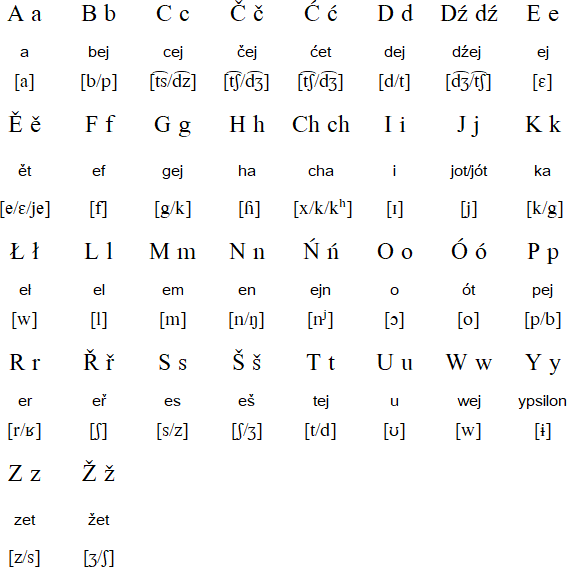
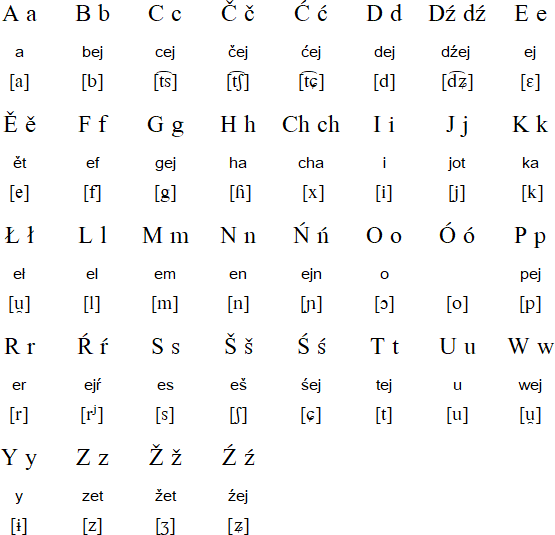
Prounciation details and notes provided by Grzegorz Jagodziński
Wšitcy čłowjekojo su wot naroda swobodni a su jenacy po dostojnosći a prawach. Woni su z rozumom a swědomjom wobdarjeni a maja mjezsobu w duchu bratrowstwa wobchadźeć.
Wšykne luźe su lichotne roźone a jadnake po dostojnosći a pšawach. Woni maju rozym a wědobnosć a maju ze sobu w duchu bratšojstwa wobchadaś.
All human beings are born free and equal in dignity and rights. They
are endowed with reason and conscience and should act towards one another
in a spirit of brotherhood.
(Article 1 of the Universal Declaration of Human Rights)
Information about Sorbian | Phrases (Upper Sorbian) | Phrases (Lower Sorbian) | Numbers (Upper Sorbian) | Numbers (Lower Sorbian) | Tower of Babel | Books about Sorbian on: Amazon.com and Amazon.co.uk [affilate links]
Information about Sorbian
http://www.uoc.edu/euromosaic/web/document/sorab/an/i1/i1.html
http://en.wikipedia.org/wiki/Sorbian_languages
https://ru.wikipedia.org/wiki/Верхнелужицкий_язык
https://ru.wikipedia.org/wiki/Нижнелужицкий_язык
Sorbian radio
http://www.mdr.de/mdr1-radio-sachsen/sorbisch/
News in Sorbian
http://www.serbske-nowiny.de
Project Rastko - Lusitia (Electronic library of Sorbian-Serbian cultural ties)
http://www.rastko.rs/rastko-lu/index_l.html
Belarusian, Bosnian, Bulgarian, Croatian, Czech, Goral, Kashubian, Knaanic, Macedonian, Montenegrin, Old Church Slavonic, Polish, Russian, Rusyn, Serbian, Silesian, Slovak, Slovenian, Sorbian, Ukrainian, West Polesian
Languages written with the Latin alphabet
Page last modified: 06.05.24
[top]

Note: all links on this site to Amazon.com


You can support this site by Buying Me A Coffee, via PayPal or Patreon, or by contributing in other ways.
If you find all the adverts annoying, there is now an Ad-free version of Omniglot which you can access for a small monthly or annual donation.

This website and its content is copyright of Simon Ager - © Simon Ager 1998-2026. All rights reserved. All images were created by me, unless otherwise indicated. More details

[top]


