
Silesian or Upper Silesian is a West Slavonic language with about 1,250,000 speakers in Upper Silesia, a region that is partly in Poland and partly in the Czech Republic. Silesian is closely related to Polish and is considered a dialect of Polish by some linguists.
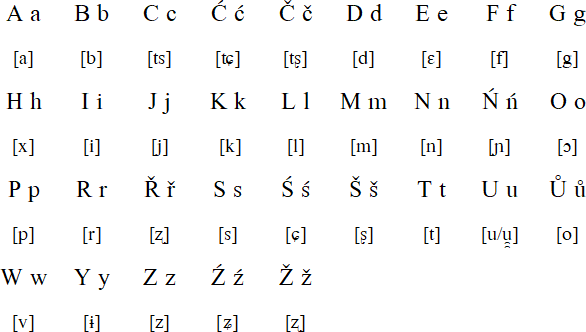
Silesian is used to some extent in literature, films, radio and television and newspapers. Although the language currently has no official status, moves are being made to change this. A new Silesian alphabet was created in 2006 and is quite widely used on the internet and also on the Silesian Wikipedia.
Wšyjske ludźe rodzům śe swobodne a růwne we swojim werće a prawach. Sům uůne uobdařůne filipym a sůmńyńym a majům powinność wzglyndym inkšych jak brat s bratym postympować.
All human beings are born free and equal in dignity and rights. They
are endowed with reason and conscience and should act towards one another
in a spirit of brotherhood.
(Article 1 of the Universal Declaration of Human Rights)
Information about the Silesian provided by Tymoteusz Puławski
Information about Silesian | Numbers
Information about Silesian
http://en.wikipedia.org/wiki/Silesian_language
http://szl.wikipedia.org/wiki/Wikipedyjo:Zasady šrajbůngu
Online Silesian lessons
http://en.wikibooks.org/wiki/Silesian
Belarusian, Bosnian, Bulgarian, Croatian, Czech, Goral, Kashubian, Knaanic, Macedonian, Montenegrin, Old Church Slavonic, Polish, Russian, Rusyn, Serbian, Silesian, Slovak, Slovenian, Sorbian, Ukrainian, West Polesian
Languages written with the Latin alphabet
Page last modified: 23.04.21
[top]

Note: all links on this site to Amazon.com


You can support this site by Buying Me A Coffee, via PayPal or Patreon, or by contributing in other ways.
If you find all the adverts annoying, there is now an Ad-free version of Omniglot which you can access for a small monthly or annual donation.

This website and its content is copyright of Simon Ager - © Simon Ager 1998-2026. All rights reserved. All images were created by me, unless otherwise indicated. More details

[top]


