Podcast: Play in new window | Download
Here’s the latest news from the world of Omniglot.
New language pages:
- Noni (Nponi), an Eastern Beboid language spoken in the North West Region of Cameroon.
- Katë (كمكاتاويرى), a Nuristani language spoken in Afghanistan and Pakistan.
- Saari (Sari), an Eastern Beboid language spoken in the North West Region of Cameroon.
- Lotha, a Kuki-Chin-Naga language spoken in Nagaland in northeastern India.
New numbers pages:
- Kogi (Kággaba), a Chibchan language spoken in the Sierra Nevada de Santa Marta mountains in northern Colombia..
- Lotha, a Kuki-Chin-Naga language spoken in Nagaland in northeastern India.
New constructed script: Methwendi, a script developed by Angga Perdana to write his constructed languages, Savlandic and Lwendic.
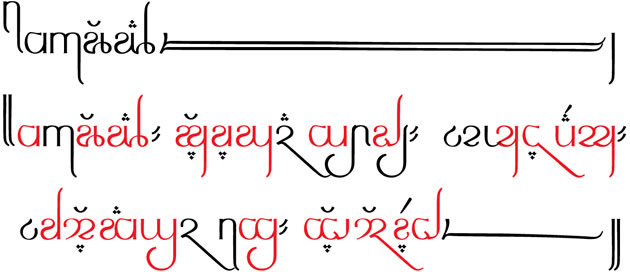
New constructed script: NAVLIPI, a universal phonemic alphabet designed to write any and all languages.

New Tower of Babel translation: Lak (Лакку маз), a Northeast Caucasian language spoken in Dagestan in the Russian Federation.
In this week’s Adventure in Etymology, Tongues, we find out what links the words tongue and language.
It’s also available on Instagram and TikTok.
On the Omniglot blog this week there’s a new post entitled Polyglottery in Brno about my experiences at the Polyglot Gathering in Brno in the Czech Republic, and there’s the usual language quiz. See if you guess what language this is:
Here’s a clue: this language is spoken in New Ireland Province in Papua New Guinea.
The mystery language in the last language quiz was Rangpuri (অংপুরি), an Eastern Indo-Aryan language spoken in northern Bangladesh and northeastern India.
On the Celtiadur blog this week there’s a new post entitled Fasting Fridays, about words for fast(ing), abstinence and Friday and related things in Celtic languages.

As I mentioned, last week I went to the Polyglot Gathering, which took place at Mendel University in Brno in the Czech Republic. There were 827 participants from 67 countries who know over 200 different languages to varying degrees. Apart from English, the most spoken languages were German, Spanish, French, Italian, Russian, Polish and Portuguese.

I got to speak and practice many of the languages I know, including German, French, Spanish, Mandarin Chinese, Cantonese, Japanese, Welsh, Irish, Esperanto, and also bits of Czech, Slovak, Russian, Swedish, Italian, Portuguese, Taiwanese and Scottish Gaelic.
It was very well organized., and there were talks about language, linguistics, culture and related topics; introductions to languages; language practice tables; workshops on various things like comedy, dance, capoeira, juggling, etc; games, quizzes, karaoke, a talent show, a food fair, and tours of local attractions.
For more Omniglot News, see:
https://www.omniglot.com/news/
https://www.facebook.com/groups/omniglot/
https://www.facebook.com/profile.php?id=100046466483286

You can also listen to this podcast on: Apple Podcasts, Amazon Music, TuneIn and Podchaser.
If you would like to support this podcast, you can make a donation via PayPal or Patreon, or contribute to Omniglot in other ways.
Radio Omniglot podcasts are brought to you in association with Blubrry Podcast Hosting, a great place to host your podcasts. Get your first month free with the promo code omniglot.