Da mad math

In Welsh and Cornish the usual word for good is da [daː], while in the other Celtic languages words for good are: Breton – mat [maːt˺], Irish – maith [mˠa(ɪ)(h)], Manx – mie [maɪ], and Scottish Gaelic – math [ma]. I’ve wondered for a while whether there were cognates in Welsh and Cornish for these words.

Last week I found that there are: mad in Welsh and mas in Cornish. The Welsh word, which means good, seemly, lucky, appears in the phrase: a wnêl mad, mad a ddyly (one good turn deserves another), but isn’t otherwise used, as far as I can discover. The Cornish word doesn’t appear in the Cornish dictionaries I’ve checked so I think it is probably not used any more.

These words all come from the Proto-Celtic *matis (measure), possibly from the Indo-European (measure, consider) [source], which is also the root of the Irish word meas (judgement, opinion, respect) [source], and possibly of the Welsh meddwl (to think), and the English mete (measure).
Churches and Cells

Today I discovered that the Welsh word llan (church, parish), which is used mainly in place names, such as Llanfairpwllgwyngyll, has cognates in the other Celtic languages: lann in Irish, Scottish Gaelic, Cornish and Manx, and lan in Breton. These words all come from the Proto-Indo-European root *lendʰ- (land, heath) [source].

Another word church-related word that is used mainly in Irish and Scottish place names is kil(l), as in Kildare (Cill Dara), Kilkenny (Cill Chainnigh) and Kilmarnock (Cill Mheàrnaig). It means church or graveyard and comes from the Irish cill (cell (of a hermit), church, burial place), from the Old Irish cell (church), from the Latin cella [source] (a small room, a hut, barn, granary; altar, sanctuary, shrine, pantry), which comes from the Proto-Indo-European *ḱelnā, which is made up of *ḱel- (to cover) and a suffix -nā.

The Welsh word cell (cell); the Scottish Gaelic cill (chapel, church yard, hermit’s cell); the Manx keeill (church, cell); and the Breton kell (cell) all come from the same root.

The more commonly-used words for church in the Celtic languages are: eglwys (Welsh), eaglais (Irish and Scottish Gaelic), eglos (Cornish), iliz (Breton) and agglish (Manx). These all come from the Latin ecclēsia (church), from the Ancient Greek ἐκκλησία (ekklēsía – church).

Cruite, cláirseacha a chrythau

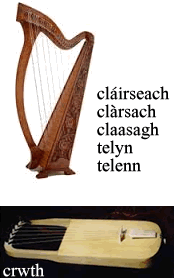
Cláirseach / Clàrsach / Claasagh / Telyn / Telenn, & Crwth

I discovered last week in Ireland that one word for the harp in Irish is cruit [krutʲ], which sounds similar to the Welsh word crwth [kruːθ], a type of bowed lyre that was once popular in Wales and in other parts of Europe, but which was largely displayed by the fiddle during the 18th century.

The word crwth from a Proto-Celtic word *krotto- (round object) and refers to a swelling or bulging out, of pregnant appearance, or a protuberance. The Irish word cruit comes from the same root and refers to small harps or lyres. The equivalent English word, which was borrowed from Welsh is crowd, which is also written crwd, crout or crouth, and in Medieval Latin such an instrument was called a chorus or crotta. The English surnames Crowder and Crowther, which mean a crowd player, and the Scottish names MacWhirter and MacWhorter also come from the same root [source].

The more common word for harp in Irish is cláirseach. In Scottish Gaelic the words cruit and clàrsach are used, with the latter being the most common, and in Manx we have claasagh and cruitçh. The Welsh word for harp is telyn, which has an equivalent in Manx – tellyn (Welsh harp). The Cornish word for harp is the same as the Welsh, and the Breton word is telenn.

Archerien

An interesting word that came up in my Breton lesson today is archerien, which means police. It caught my attention because it has no obvious connection to the word police, and because it is completely different to the equivalent words in other Celtic languages:

– Welsh: heddlu (“peace force”)
– Cornish: kreslu (“peace host”)
– Irish: gardaí (síochána) (“guards of peace”); póilíní
– Manx: meoiryn shee (“peace keepers/stewards”); poleenyn
– Scottish Gaelic: poileas

The English word police comes from the French police (public order, administration, government), from the Latin polītīa (state, government), from the Greek πολιτεία (politeia – citizenship, government, administration, constitution). It is shares the same root as policy, politics, politician and various other words [source].

Many languages use variants on the word police, e.g. Politsei (Estonian), პოლიცია (polits’ia – Georgian), Polizei (German), पुलिस (pulis – Hindi), پلیس (pulis – Persian), Booliis (Somalia), Policía (Spanish), Pulis (Tagalog), but some do their own thing:

– Bavarian: Kibara
– Chinese: 警察 (jǐngchá); 公安 (gōng’ān)
– Faroese: Løgregla
– Greek: Αστυνομία (Astynomía)
– Hungarian: Rendőrség
– Icelandic: Lögregla
– Japanese: 警察 (keisatsu)
– Korean: 警察 (gyeongchal)
– Thai: ตำรวจ (tảrwc)

Are there other examples of languages with a word unrelated to police for police?

Goel Peran Lowen!

St Piran's Flag

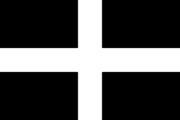
Today is St Piran’s Day and a special day in Cornwall as Piran is regarded as the patron saint of Cornwall (and of tin miners), along with Saint Michael and Saint Petroc. Piran or Perran was an abbot of possibly Irish origin who lived in Cornwall in the early 6th century and later became a saint. His flag (see top right) is a symbol of Cornwall.

Here are a few Cornish phrases related to today (provided by Sam Brown)

– Goel Peran Lowen – Happy Saint Piran’s Day;
Gŵyl Peran Llawen (Welsh); Gouel Peran laouenn (Breton)

– Dydh da ha goel Peran lowen dhis! = Hello and happy Saint Piran’s day!
– A vynnydh ta pasti kernowek? = Would you like a Cornish pasty?
– Gwell yw genev pasti keus hag onyonenn = I’d prefer a cheese and onion pasty.

I haven’t started learning Cornish yet, put have picked up odd bits and pieces of the language and can understand it to a limited extent thanks to my knowledge of Welsh and Breton.

Are any of you learning Cornish?

Bulhorn

The subject of snails came up this week at the polyglot conversation group and I discovered that the Cornish word for snail is bulhorn /ˈbʊl.hɔɾn/ (pl. bulhornes), which I particularly like, and which conjures up images of bullhorn (megaphone) wielding snails.

We were also talking about slugs and didn’t know the Cornish or Welsh words for them. I suggested malwoden heb dŷ (“a snail without a house”) or malwoden digatref (“a homeless snail”) in Welsh, and bulhorn heb chy (“snail without a house”) was suggested for the Cornish version. I now know that a Welsh slug is a gwlithen or a malwen ddu (“black snail”) and that a Cornish slug is a gluthvelhwenn or a melhwenn. The gwlith and gluth in these words, which mean dew.

I later discovered that the German word for snail is Schnecke – isn’t that a great sound? Definitely a cellar door word for me. A German slug is a Nacktschnecke or “naked snail”.

Bangor Polyglots

Last night the Bangor Polyglot conversation group met for the first time. I’ve been wanting to set up a group like this for a while as a way to practice my languages and to meet other polyglots. Last month it finally started to come together: first I found a suitable place and time for it to take place – I chose the Ship Launch Inn near Bangor pier because it’s quiet on a Monday night, the only night I have free at the moment. Then I posted about the group on the Bangor couchsurfing group, and set up a Facebook group.

I wasn’t sure if anyone would be interested or would turn up, but was reassured when a number of people have joined the Facebook group and/or have expressed an interest on the Couchsurfing group. In the end two others came last night – a Welsh lass who speaks Welsh and is learning Cornish; and a Cornish lad who speaks German, and is learning Cornish, Welsh, Dutch and Finnish. They are both interested in language and languages in general, and in conlangs, and are frequent visitors to Omniglot – surprisingly, even though over 50,000 people a day visit Omniglot, I rarely meet people who know the site well. We talked mainly in English and Welsh, with a bits of German, Dutch, Breton, French, Irish, Finnish, Japanese in the mix.

Have you taken part in any similar groups?

Cars, carts and chariots

Last week I was told that the English word car originally comes from the Irish word carr (donkey cart). Apparently when cars came to Ireland Irish speakers thought it was better to come up with a new word for them than to name them after the humble donkey cart, so the term gluaisteán (‘moving thing’) was coined. I hadn’t heard about this before, so thought I’d check it.

Chariot

According to the Online Etymology Dictionary the English word car has been used to refer to a wheeled vehicle since 1300 and comes from the Old Northern French word carre, from the Latin carrum/carrus, which originally referred to a two-wheeled Celtic war chariot, from Gaulish karros (wagon), from Proto-Indo-European *krsos, from *kers- (to run).

There are related words in Welsh carr (cart, wagon), and in Breton: karr (chariot, cart), in Cornish: karr (car), in Manx: carr (car), in Spanish and Italian: carro (cart, wagon) and probably in other languages.

The word chariot comes from the same root as car, but cart probably comes from the Old Norse word kart-r (cart), according to the OED.

Another vehicle-related word we discussed last week is carbad (chariot), from the Old Irish carpat (war-chariot, waggon). It is related to the Welsh cerbyd (vehicle, car, carriage, coach), the Old Breton cerpit, the Gaulish carpentoracte, from the Latin corbis (basket), from carpentum (two wheeled chariot), which was probably borrowed from Gaulish. The root idea is ‘wicker’, referring to the basket character of the body of these chariots.

Gleann Cholm Cille

I returned to Bangor from the Isle of Man yesterday after a very enjoyable week at Yn Chruinnaght. I spoke and sang lots of Manx, and heard all the other Celtic languages, except Breton, being spoken and/or sung. I also spoke a bit of French and German, and even some English.

I was even inspired to write a new song while I was there, which is even sillier than my previous efforts.

Today I arrived in Gleann Cholm Cille for the Summer School in Irish language and Culture at Oideas Gael, so am now switching to Irish mode. During the week I’m here blog posts, up-dates on Omniglot and replies to emails might become somewhat sporadic.

Yn Chruinnaght

Tomorrow I’m off to the Isle of Man for Yn Chruinnaght (‘the gathering’) – a celebration of Manx and Celtic music and culture featuring performers and participants from the Isle of Man, Scotland, Ireland, Wales, Cornwall and Brittany. I’m really looking forward to it as it’s a great opportunity to see old friends and make new ones, and to hear, speak and/or sing in quite a few different languages – last year at Yn Chruinnaght I heard all six modern Celtic languages being spoken and sung, and spoke in four of them, and also in French and English.

I’ll be in the Isle of Man for a week, then I’m off to Gleann Cholm Cille in Donegal in Ireland for a summer school in Irish language and culture.