A bit of a breeze

One of the words that came up at the French conversation group this week was brise (breeze), which appears in the following expressions:

– pare-brise = windscreen / windshield
– brise matinale = early breeze
– brise insulaire = island breeze
– brise de mer = sea breeze
– brise de terre = land breeze

The French word brise and the English word breeze come possibly from the Old Spanish briza (cold northeast wind), which was used from the 1560s in West Indies and the Spanish Main to mean a “northeast trade wind”, and then a “fresh wind from the sea”. Breeze came to mean a “gentle or light wind” from the 1620s, and something easy from the 1920s in the USA.

Alternatively the English word breeze might come from is from East Frisian brisen (to blow fresh and strong), or the Saterland Frisian briese ‎(breeze) or the Dutch bries ‎(breeze).

Apparently as well as being a light, gentle wind, a breeze can be:

– Any wind blowing across a cricket match, whatever its strength.
– Any activity that is easy, not testing or difficult.
– Ashes and residue of coal or charcoal, usually from a furnace.
– An excited or ruffled state of feeling; a flurry of excitement; a disturbance; a quarrel.

Sources: Online Etymology Dictionary, Wiktionary and Reverso

Joskins, bumpkins and yokels

Last week a friend asked me about the origins of the word joskin [ˈdʒɒskɪn], which I hadn’t come across before. According to the Urban Dictionary it is defined as follows:

North-Walian term used in both English and Welsh to describe anyone from a rural or farming background. It is used both affectionately and in a derogatory way depending on the audience.

Example: He’s a right joskin – he’s got a tractor and everything.

According to the Collins English Dictionary joskin is a slang word meaning “a country bumpkin; hick”.

Wiktionary suggests that is comes from the dialect word joss (bump) and (bump)kin. Alternatively it comes from the name Joseph + (bump)kin [source].

Bumpkin, a clumsy, unsophisticated person or a yokel, apparently comes from the Dutch boomken ‎(shrub, little tree) [source]. Or it might come from the Dutch bommekijn (small cask), from the Middle Dutch bomme (cask) [source], and was also used as a derogatory reference to short and dumpy Dutch people [source].

Yokel possibly comes from German dialect word Jokel, a diminutive of Jakob, or an English dialect word meaning woodpecker [source].

What other words are there for joskins?

Unions and alliances

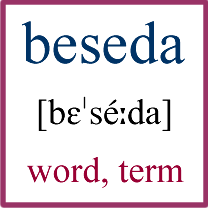
While listening to Russian language radio yesterday I finally worked out the meaning of a word that kept on coming up: союз (soyuz) [sɐjˈʉs] , which is often used in the expressions Европейский союз and Евросоюз (European Union, EU).

It was obvious once I realised they were talking about Europe, and the word Soyuz is familiar as the name of the Russian spacecraft, and of the Russian version of the USSR, though I didn’t recognize it at first with it’s Russian pronunciation.

Союз means union, alliance, league or conjunction, and appears in expressions like:

– союзник = ally
– союзный = allied; conjunctive
– профсоюз = trade / labor union
– студенческий союз = students’ union
– Союз композиторов = Musicians’ Union
– Союз Советских Социалистических Республик (СССР) = Union of Soviet Socialist Republics (USSR)

Could you care less?

Which sounds right to you?

– I couldn’t care less about sport.
– I could care less about sport.

To me the first makes sense and sounds right. It also applies to me – I have no real interest in sport. So I couldn’t care any less about it, because I don’t care about it at all.

The second one sounds a bit strange to me. I would interpret it as meaning that I’m not really into sport, but do care at least a little about it.

Do you use one or both of these expressions? If not, what would you say instead?

How do you express these ideas in other languages?

A few tips about tips

TIPS box - not genuine

I heard some discussion on Radio Cymru this about the origin of the word tip(s). They said that in 18th century England there were boxes in pubs with the letters T.I.P.S. on them, which stood for “To Insure Prompt Service”. Gratuities were put into the boxes and became known as tips.

According the Snopes.com, a fact checking website, this is folk etymology, i.e. wrong. No such boxes existed, and the first appearance in writing of the word tip, meaning gratuity, dates back to the early 18th century, and the word tip, meaning to give a small sum of money intelligence on horse races or the latest silly joke dates back to 1610, and was used in thieves cant (slang).

The Online Etymology Dictionary suggests that the word tip, meaning to knock down or overturn, is of uncertain origin, and possibly comes from Scandinavian languages – in Swedish tippa means to tip or dump.

The word tip, as in the end or point of something, comes from Middle Low German or Middle Dutch tip (utmost point, extremity, tip).

The story about tip being an acronym for “To Insure Prompt Service”, “To Insure Promptitude” or “To Insure Promptness” comes from Inns, Ales and Drinking Customs of Old England by Frederick W. Hackwood, which was published in 1909.

There is more fact checking of popular sayings on Snopes.com.

Irish Tongue-Twisters

Last week I learnt some new tongue-twisters (rabhlóga) in Irish. To those not familiar with Irish, almost an sentence in Irish might appear to be a bit of a tongue-twister, but these ones are particularly tricky.

Seacht sicín ina seasamh sa sneachta lá seaca.
Seven chickens standing in the snow on a frosty day.

Fear feargach ag faire na farraige fuaire.
An angry man watching the cold sea.

Cheannaigh cailín cliste ceanúil císte.
A clever, affectionate girl bought a cake.

Cearc ag piocadh piobair de phláta Pheadair.
A chicken is picking peppers from Peter’s plate.

Bhí bean bheag bhocht breoite bruite leis an bhfuacht.
The poor little sick women was scaled with the cold.

Rinne Máire gáire gan náire ag an fhaire i nDoire anuraidh.
Mary laughed shamelessly at the look-out in Derry last year.

I have made recordings of my attempts to say them. If you can do better, please contact me.

You can see more of these on: http://www.omniglot.com/language/tonguetwisters/irish.htm

A Hooley of Ukeists

Ukulele Hooley

I’m having a great time at the Ukulele Hooley this weekend, so I thought I’d look into some ukulele-related words.

There are various possible words for people who play the ukulele:

– Ukulele player
– Uker
– Ukist
– Ukeist
– Ukulist
– Ukulelist
– Ukuleleist
– Ukulelian
– Uke-phreak
– Ukester
– Ukestrator
– Ukeleler

There are also words for things ukulele-related: ucal (based on duke/ducal), or ukel (based on yokel).

Sources: forum.ukuleleunderground.com and MetaFilter

Then there are some words, which I just made up, for what ukulele players do, i.e. play the ukulele: uke, ukelize, ukify. Can you come up with any others?

Me playing one of my songs in the open mic at the 2016 Ukulele Hooley

I sang one my songs, Spollagyn son tey / Chips for tea, in the open mic session last might (see photo above). I usually sing it unaccompanied, and messed it up a bit at the start, but it went okay after that. I was also singing it from memory, which is fine when I’m just singing, but when I’m play the ukulele at the same time, it’s a lot more challenging, and definitely needs more practice.

So what would you call a group of ukulele players?

A strum, a hooley, or something else?

Suggestions welcome.

Other collective words for musician can be found at: https://thesession.org/discussions/27892

If you’re in the Dublin area today, why not come along to a free concert in the People’s Park in Dún Laoghaire this afternoon from 12pm.

Eating sideways

An interesting Japanese word I came across today in an article on ‘untranslatable’ words is 横飯 (yokomeshi) which is used to describe the stress of speaking a foreign language.

It comes from 横 (yoko – horizontal) and 飯 (meshi – boiled rice, a meal, food), and could be translated as ‘a meal eaten sideways’. This refers to the fact that Japanese is often written vertically, while most other languages are written horizontally.

Are there words of expressions in other languages that have a similar meaning?

Singluarity

I learnt an interesting new French word today – célibataire. When I first saw it I guessed that it meant celibate, but when I checked in a dictionary I found that while it does mean celibate, it is more commonly used to mean single. So un célibataire is a single man or bachelor, and une célibataire is a single woman or spinster. A confirmed bachelor un célibataire endurci and une mère célibataire is a single / unmarried mother – the male equivalent is un père célibataire.

Célibataire comes from célibat (celibacy), from the Latin caelebs (unmarried, single), from the Proto-Indo-European *kaiwelo- ‎(alone) and *libʰs– ‎(living) [source].

Single comes from the Middle English sengle, from the Old French sengle, from Latin singulus, a diminutive of simplex (simple or literally “onefold”*, from sim- ‎(the same) and plicare ‎(to fold) [source].

*Duplex = twofold, double

When is a blog not a blog?

When I meet people who are familiar with my website, some of them say how much they like my blog. When I ask them what they like about it, they mention things that are on my website, rather than on this blog, so I soon realise that they’re using the word blog to refer to my website, and possibly this blog, although not all of them are aware of the blog’s existence.

To me the distinction between my website and my blog(s) is clear. They may be on the same server, but they look different and have different functions. I’ve noticed that on some other websites though there isn’t such a clear distinction between blogs and other pages, especially on ones that have grown from blogs. Maybe that’s why people get confused.

Sometimes people tell me about mistakes on other sites which are linked to on Omniglot, thinking that I have something to do with them and can make changes on them. I understand why this happens as they might not realise that they’re on a different site.

None of these things are particularly important, but it’s interesting, to me at least, to notice them.

Is there a distinction between the words for website and blog in other languages?