I’ve been thinking about my language and travel plans for this year and have decided to spend a few weeks in Russia – probably in July – at a Russian language school. Every year for the past ten years I’ve gone to Ireland to do courses in Irish language, singing and music in July, but this year I fancy a change. I plan to learn as much Russian as I can before going to Russia and to focus mainly on Russian throughout this year, while keeping my other languages ticking over.
Apart from the trip to Russia, I’m going to the Polyglot Gathering in Berlin at the beginning of May, and on a choir trip to Oloron Sainte Marie in the south west of France at the end of May. I also plan to do a course in Scottish Gaelic song in Scotland in August and will probably go to the Polyglot Conference in New York in October.
Can any of you recommend a Russian language school?
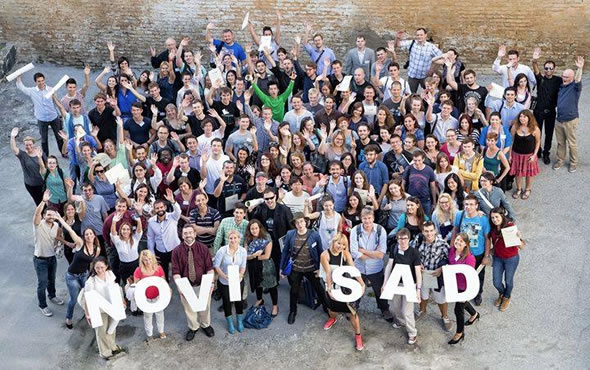
Here’s an interview I did at the Polyglot Conference in Novi Sad last month with Lindsay Dow of Lindsay Does Languages. I talk about how Omniglot came into being, and about learning languages, particularly Welsh.
Yesterday morning I shared a taxi to Belgrade airport with two other conference participants. We had some lunch while waiting for our flights, and came across quite a few other polyglots. I flew via Zurich and had a short connection time there – only 20 minutes. There was a bit longer to wait for my train from Manchester airport, so I had something to eat.
It was warm and sunny for the whole time I was in Serbia, but it was cold, wet and windy back in the UK. In fact we were flying over solid cloud cover across most of France and England. Fortunately there were some good views for the rest of the flights.
The announcements on the planes were in Swiss German, English and Serbian. I also heard a number of other languages on the journey, including Hindi, Italian, Spanish and possibly Yiddish.
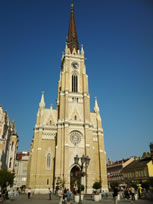
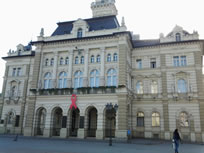
Yesterday morning I met up with other conference participants and after a bit of a wander around the city, we had lunch then went to the opening ceremony a reception. In the after we had a little guided tour of Novi Sad seeing some interesting buildings, including the Catholic or Orthodox Cathedrals, and the fortress. There are some rather attractive buildings here, wide, pedestrianised café-lined streets, some nice parks and generally a relaxed kind of atmosphere.
In the evening we all went to a restaurant about 4 or 5km from the city centre for dinner. I walked there with a few others, and the rest went by bus or taxi. We had a nice dinner with lots of polyglot chat, then some people started dancing, and others carried on chatting.
Today there were lectures and talks on a variety of topics including sound symbolism, the magic of metaphors, language coaching, and acting and humour in a foreign language.
So far I’ve had conversations in about 10 languages and spoken bits and pieces of maybe 10 others. In some cases this was only a few words (all I know), in others it was a bit more. There are even two guys here who are learning Scottish Gaelic, one of whom also speaks a bit of Manx, and another who is learning Irish.
There are various polyglot activities scheduled for this afternoon and evening, and talks and lectures start tomorrow, so I have this morning free. I plan to do a bit of work on Omniglot, and will try to meet up with other people who are here for the conference.
Unlike in Berlin, where most people stayed in a large hostel and the polyglot gathering was in the same place, here in Novi Sad things are a bit more spread out – we are staying in various hotels around the city and the conference is taking place in a cultural centre. My hotel doesn’t have a restaurant and breakfast is available at a café round the corner.
It seems that smoking is permitted inside in some places here – ugh! Since the smoking ban came into force in the UK I’ve tried to avoid visiting places where indoor smoking is still allowed. I didn’t check before coming here and might not have come if I’d known. At least the weather is warm and sunny so I can sit outside and avoid most of the smoke.
I’ve spoken a bit of Serbian so far, and found that some people in hotels and restaurants speak English as well. Last night I shared a taxi from Belgrade to Novi Sad with one of the other conference participants – a Polish guy with Vietnamese roots. We talked mainly in French, with a bit of Spanish, English and Russian thrown in for good measure. The taxi driver spoke only Serbian, plus a bit of Russian and German, and I struggled to explain to him that one of the people who was supposed to be with us had missed his connection in Zurich, due to a delayed flight from London, and would be arriving later.
Thàinig mi air ais dhan a’ Chuimrigh oidhche Shathairne an déidh seachdain math dha rìreabh ann an Sabhal Mòr Ostaig. Rinn mi cùrsa Òrain Ghàidhlig ri Christine Primrose, agus bu mhór a chòrd e rium. Bha tri duine deug anns a’ chlas à Alba, ‘nam Ghearmailt, às na Stàitean Aonaichte, agus à Sasann. Chan robh Gàidhlig ag na mór-chuid aca, agus bha i doirbh dhaibh na faclan a fhuaimneachadh mar bu chòir. Dh’ionnsaich sinn naoi òrain ar fhichead ré cóig latha, no timcheall sia gach latha. Anns an oidhche bha sinn a’ seinn, a’ dannsa, a’ bruidhinn agus bha sinn gu sona sunndach.
I got back to Wales on Saturday night after a great week at Sabhal Mòr Ostaig. I did the Gaelic Song course with Christine Primrose and really enjoyed it. There were thirteen of us in the class from Scotland, Germany, the USA and England. Most of the others did not speak Gaelic, and it was difficult for them to pronounce the words correctly. We learnt 29 songs in five days, or about six a day. In the evening we sang, made music, danced, chatted and had a wonderful time.
Here are recordings from the cèilidh on Thursday night when we sang a some of the songs we learnt:
E ho leagain (Hi ho my pet one) – a milking song which praises a long-haired heifer who gives plenty of milk and never kicks.
Tha Sneachd air Druim Uachdair (There is Snow on Druim Uachdair) – a song from the 17th century by Fearchair Mac Iain Oig from Kintail about a man who is on the run from the law and is hiding out in the hills where it’s cold and lonely. I sang solo for parts of this.
Carson a’ bhios sinn muladach (Why should we be down-hearted) – a song about young men going off to war together, and how they’re worried, but hope things will turn out well and that they’ll return.
Siud mar chaidh an càl a dholaidh & Cuir a nall Mor-a-Bhitheag (That is how the kale was ruined & Send on over Marion-a-Bhitheag) – two puirt à beul or pieces of mouth music, the first of which tells how the kale was ruined by the lowland men and the emperor of France, and the second concerns Marion-a-Bhitheag – the meaning of Bhitheag in this context is uncertain.
Tomorrow I’m off to Oideas Gael in Gleann Cholm Cille in Donegal in the north west of Ireland to do a course in harp playing. This will be the tenth time I’ve been there, though the first time I’ve done the harp course. Normally I go for a summer school in Irish language and culture where I do Irish language classes in the mornings and sean-nós singing in the afternoons.
The Irish language classes, at least the advanced level ones I do, tend to focus on using Irish to learn about and discuss things such as culture, politics, religion, and so on, which is interesting, though as my main interest is Irish music and songs, I’d prefer to concentrate on the singing, or singing and making music. Unfortunately they don’t offer sean-nós courses on their own, so I thought I’d do the harp course this year.
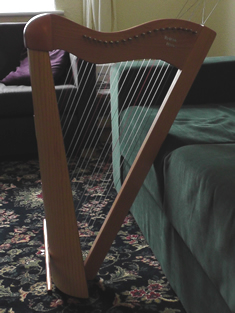
At the summer school last year a number of people mentioned the harp course and said how good it was, or that they were planning to take it, and this got me thinking about trying it myself. I’ve wanted to learn the harp for a long time, and earlier this year I bought myself a small harp from Pedran Harps (pictured top right), which I really enjoy playing.
Each time I go to Ireland my Irish (Gaelic) gets a bit better. I rarely get to speak it at other times, but keep it ticking over by listening to Irish language radio and reading Irish books and other material. I think the harp course will be taught in English, unless all the participants speak Irish, so I won’t use much Irish in class. Outside class I’ll speak Irish as much as possible. I’ll probably get to speak a few other languages as people from all over the world do the courses in Gleann Cholm Cille.
It takes place in Florence in Italy from 13-14 November 2014, and will bring together teachers, researchers, practitioners and project managers from all over the world to share findings, expertise and experience about integrating innovative technologies and solutions into language teaching and learning.
The conference will also be an opportunity for sharing results achieved in language learning projects funded by the European Commission and by other sources.
Topic areas are intentionally broad to encourage a wide range of backgrounds, ideas, and discussions.
They are currently calling for papers, and the deadline for submission is the 4th August.
Mi wnes i gadael Leeds tua deg o’r gloch bore ddoe ac mi ddes i yn ôl i Fangor ar y trên trwy Manceinion a Crewe. Roedd rhaid i mi aros am fron awr yn Manceinion, ac yn ffodus ro’n i’n medru dod â cysylltiad wifi rhydd ac mi wnes i tipyn bach o waith. Mi wnes i cyrraedd ym Mangor tua dau o’r gloch ac roedd hi’n wyntog ac oer. Mi wnes i aros gatref neithiwr yn darllen ac yn gwylio rhagleni teledu ar y we.
I left Leeds at about 10am yesterday morning and came back to Bangor on the train via Manchester and Crewe. I had to wait for nearly an hour in Manchester, and fortunately I was able to find a free wifi connection and did a bit of work. I arrived in Bangor at about 2pm and it was windy and cold. I stayed in last night reading and watching TV programmes online.
Bore ddoe mi wnes i tipyn bach o waith ar Omniglot – wi wnes i ateb e-byst yn bennaf, fel arfer. Tua hanner dydd mi es i i’r prifysgol i weld perfformiadau gan myfyrwyr presennol yr adran Astudiaethau Asia Dwyrain. Mi wnaethon nhw perfformio tipyn bach o opera Beijing yn Mandarineg a Saesneg, ac mi wnaethon nhw adrodd sonedau Shakespeare yn Saesneg a Thai, ac mi wnaeth ferch yn canu cân pop yn Siapaneg. Mi wnaeth athrawes Thai dawns Thai traddodiadol hefyd. Mi wnes i crwydro o gwmpas Leeds am sbel yn y prynhawn, a gyda’r nos roedd pryd o fwyd yn nhŷ bwyta Tsieineaidd efo cynfyfyrwyr ac athrawon. Ro’n i ar fwrdd efo cynfyfyrwyr o 1995. Roedd y bwyd yn flasu iawn, ac mi wnes i mwynhau’r noson yn fawr.
Yesterday morning I did a bit of work on Omniglot – I mainly answered emails, as usual. At about midday I went to the university to see performances by current students in the East Asian Studies department. They performed bits of Beijing opera in Mandarin and English, and they recited some of Shakespeare’s sonnets in English and Thai, and one lass sang a Japanese pop song. A Thai lecturer also did a traditional Thai dance. I had a wander around Leeds in the afternoon for a while, and in the evening there was a meal in a Chinese restaurant with alumni and staff. I was on a table with alumni from 1995. The food was delicious, and I really enjoyed the evening.