Gaeilge

I found an online Irish test on ranganna.com today – it contains 100 questions of ever increasing difficulty and gives you a idea of your level of Irish. It’s available with instructions in Irish and English and has a seven-level marking scheme ranging from beginner to advanced.

I just took the test and got 69/100 or level 5 (Advanced) – I could understand almost all the questions, but my knowledge of the finer points of Irish grammar and orthography could be better. I’m happy with this as my main focus with Irish is understanding, speaking and reading it well.

After you have taken the test it shows you your answers with the incorrect ones highlighted and the correct ones indicated – a useful feature. It also has some suggestions for learning more Irish.

Lightbulb moments

Light bulb

Yesterday while we were singing La Bamba at the ukulele club the words started to make sense to me. I’d picked up some of them through repeated listening, but had never bothered to learn them before this week. Now I not only know the words, but also what they mean. Often with songs in languages other than English I might know the meaning of at least some of the words, but I don’t always grasp their exact meaning.

In the case of La Bamba, the lyrics that started to make sense to me last night were:

Para bailar la bamba (in order to dance the bamba)
Se necesita una poca de gracia (you need a little bit of grace)
Una poca de gracia para mi para ti (a little bit of grace for me for you)
Y arriba y arriba – wasn’t sure about this bit – have now discovered that it means “faster, faster” or “higher, higher”
Ay arriba y arriba
Por ti sere, por ti sere, por ti sere (for you I will be, for you I will be)

Yo no soy marinero (I’m not a sailor)
Yo no soy marinero, soy capitan (I’m not a sailor, I’m a captain)
Soy capitan, soy capitan (I’m a captain, I’m a captain)

Source: http://www.lyricsmania.com/la_bamba_lyrics_los_lobos.html

This happens with songs in Welsh and Irish, and occasionally other languages as well, especially with songs I’ve heard many times – the meaning of a word, a line or even a whole verse suddenly becomes blindingly obvious and I wonder why I never realised what it meant before. It doesn’t help that it can be tricky to hear the words of songs clearly and that I don’t always listen to them very attentively, but sometimes when a word I’ve heard and understood in another context pops up in a song, it might help me understand some of the other parts of the song.

I think that the brain works away subconsciously trying to make sense of things, and when it has a solution, the conscience lights up like a light bulb. It’s moments like that that make language learning an exciting and rewarding adventure.

Flame of the woods

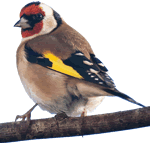
Gold finch from: http://www.flickr.com/photos/sheedypj/4176105819/in/photostream

Lasair choille or ‘flame of the woods’ is the Irish name for the goldfinch (carduelis carduelis), two of which I saw on my apple tree this morning. I like to know the names of birds and other creatures in the my languages, and particularly liked the Irish version when I discovered it.

The Irish word lasair means flame or blame comes from las (to light, inflame, ignite, blush). It probably shares the same root as the English word lamp, which comes from the French word lampe, from the Latin lampas, from the Greek λαμπάς (to shine).

In Welsh the goldfinch is known as nico, but has many other names, including jac nico, teiliwr llundain (London tailor), peneuryn (head gold jewel?), eurbinc (gold pink), pobliw (every colour), soldiwr bach y werddon (little soldier of the green place/oasis), cnot, ysnoden felen (yellow band) and asgell aur (gold wing).

The English word finch comes from the Old English finc, possibly from the Old Germanic *finki-z or finkjon, which is thought to be of echoic origin.

Names for the goldfinch in many other languages can be found on the avibase.

The worm that turned

cartoon worm

While working in my garden this afternoon I dug up lots of worms, so I thought it might be interesting to find out more about the word worm.

Meanings of worm (/wɜːm/ /wɝm/) include:

– a member of the genus Lumbricus; a slender, creeping, naked, limbless animal, usually brown or reddish, with a soft body divided into a series of segments; an earthworm. More widely, any annelid, terrestrial, aquatic, or marine;
– any animal that creeps or crawls; a reptile; an insect;
– serpent, snake, dragon;
– four-footed animals considered noxious or objectionable.

Some of these meanings are archaic or obsolete.

There have been many variant spellings, including wirm, wrim, wyrme, weorm, werm, werme, wurm, wurem, orm, wrm, wourme, woirme, woorme, worme, and it finally settled on worm.

Worm comes from the Old English wyrm (a serpent, snake, dragon), from the Proto-Germanic *wurmiz (serpent, worm), from the Proto-Indo-European *wrmi-/*wrmo- (worm), possibly from *wer- (to turn). *wrmi-/*wrmo- is also the root of the Irish and Scottish Gaelic word gorm (blue/black), the Welsh gwrm (dusky), the Danish/Norwegian/Swedish orm (snake), the Latin vermis, which is the root of the English words vermilion and vermin, and quite a few other words in various languages.

Some interesting worm factoids

– there are some 2,700 different types of worms
– an acre of land can contain over a million worms
– Cleopatra VII made the export of worms from Egypt a capital crime as she realized the important roll they play in keeping soil fertile
– Charles Darwin studied worms for many years and concluded that they are one of the most important creatures on earth.

Sources: Oxford English Dictionary, Online Etymology Dictionary, Wikipedia, Word-Origins.com, Eartworm Farming, Worm Facts

Levees and ganseys

Last night the words levee and gansey came up in conversation and while I’d heard both of them before, I wasn’t entirely sure of the meaning of the former, or the origins of the latter. I did know that a levee had something to with flood prevention and was something you drive your chevy to, and that gansey sounded similar to the Irish word, geansaí (jersey, jumper), though I hadn’t heard it used in English before.

A levee, /lɪˈviː/ or /ˈlɛviː/, is a natural embankment along a river formed by sedimentation, or a man-made embankment along a river or around a field designed to prevent flooding. It is also a landing place or quay; a formal ceremony held when a sovereign gets up in the morning, or an afternoon reception for men at court [source].

Levee in the sense of a man-made flood-prevention embankment is apparently used mainly in American English (especially in the Midwest and Deep South), and was first used in English in New Orleans in around 1720. Other words for levee include levée, dike/dyke, embankment, floodbank and stopbank.

Etymology: the feminine form of the past participle of the French verb lever (to raise), from the Latin levare (to raise), from levis (light in weight), from the Proto-Indo-European root *le(n)gwh- (light, easy, agile, nimble) [source].

According to the Oxford English Dictionary, gansey, /ˈgænzɪ/, is a jersey or pullover and is a dialect variant of Guernsey, one of the Channel Islands famous for its knitted sweaters. It is also written gansy, ganzee, ganzey, ganzie & ganzy. This dictionary also has a Guernsey coat, “a thick, knitted, closely-fitting vest or shirt, generally made of blue wool, worn by seamen”, which is also known as a Garnesie, Garnsey or Gernsey.

Another source claims that the word gansey comes from “a word of Scandinavian origin meaning ‘tunic'”. This sounds plausible as the Norwegian word for such a garment is genser [source], though it’s possible that the Norwegian word comes from Britain or Ireland.

The Art of the Fishing Communities website, “Ganseys (Guernseys), Jerseys, Aran and Fair Isle are names given to fishermen’s knitted pullovers that were universally popular in the 19th and early 20th century. Each fishing village had its own pattern and within the local pattern there were small variations, and sometimes names, that identified the family and individual.”

The Irish word for jersey or sweater, and also the island of Guernsey, is geansaí /gʲansiː/, sounds similar to gansey and possibly comes from the same source. The word is also found in Manx – gansee and in Scottish Gaelic – geansaidh.

What do you call a knitted woollen top?

Jumper, sweater, pullover and jersey, and indeed gansey, are all used in the UK, and I normally say jumper.

Bellies, bags and bellows

Yesterday a friend asked me whether bellyache was considered rude or vulgar, and whether tummy ache or stomach ache were preferable in formal conversation. I thought that the word belly might be seen as vulgar and/or informal by some; that stomach ache might be better in formal situations, and that tummy ache tends to be used by and with children. Would you agree?

Belly comes from the Old English belg (bag, purse, bellows, pod, husk), from the Proto-Germanic*balgiz (bag), from the PIE base *bhelgh- (to swell), which is also the root of the Old Norse belgr (bag, bellows) and bylgja (billow); the Gothic balgs (wineskin), the Welsh bol (belly, paunch), the Irish bolg (abdomen, bulge, belly, hold, bloat), and the Latin bulga (leather sack). The English words bellows, billow, bolster, budget and bulge also come from the same root [source].

In English belly came to refer to the body during the 13th century, and the abdomen during the 14th century. By the late 16th century its meaning had been extended to cover the bulging part or concave convex surface of anything. In the late 18th century some people in England decided that belly was vulgar and banished it from speech and writing – replacing it with stomach or abdomen. [source].

Christmas

Nadolig Llawen
Joyeux Noël
聖誕快樂
Nollaig shona doibh
¡Feliz Navidad!
Nollick Ghennal
Bo Nadal
Nollaig chridheil
メリークリスマス
Buon Natale
Frohe Weihnachten
Bon Nadal
Veselé vánoce
and Merry Christmas!

Irish language strategy / Straitéis don Ghaeilge

According to an article I found today, the Irish government has a strategy, launched yesterday, to increase the number of regular speakers of Irish in Ireland by a factor of three over the next 20 years. Apparently there are currently about 83,000 who speak Irish on a daily basis, and the government would like this number to increase to 250,000 by 2030.

Their aims are:

  • – to increase the number of families throughout Ireland who use Irish as the daily language of communication
  • – to provide linguistic support for the Gaeltacht as an Irish-speaking community
  • – to ensure that in public discourse and in public services the use of Irish or English will be, as far as practical, a choice for the citizen to make
  • – to ensure that Irish becomes more visible in society, both as a spoken language by citizens and also in areas such as signage and literature.

Details of the strategy can be found at:
http://www.pobail.ie/en/IrishLanguage/Strategy/Strategy.pdf (English)
http://www.pobail.ie/ie/AnGhaeilge/Straiteis/Strait%C3%A9is.pdf (Irish)

I haven’t read it all in detail, but it looks like there are plenty of good ideas in there. Whether they can all be implemented and how well is another matter. Reversing a language shift that has been going for centuries is a difficult process.

Colds, streams and rivers

A snow-covered Siliwen Road in Bangor

It’s rather cold here at the moment with daytime temperatures not much above freezing, and nighttime dropping to -10°C (14°F) or even -20°C (-4°F) in places. As a result, some of the snow that fell last week has frozen solid and been trampled down on pavements and ungritted back streets making them decidedly icey and slippery.

I also have a cold at the moment, so I thought I’d look into how to say “I have a cold” in a number of languages. In French it’s “Je suis enrhumé” or “I am enrhumed”. Enrhumé comes from rhume (cold), which comes from the Old French reume, from the Latin rheuma, from the Greek rheuma (stream, current, a flowing), from rhein (to flow), from the Proto-Indo-European *sreu- (to flow). The Proto-Indo-European *sreu- is also the root of the Irish sruth (stream, river), the Welsh ffrwd (stream) and the Polish strumyk (brook). [source].

The Czech word for cold rýmu appears to be spring from the same source – mám rýmu is “I have a cold” by the way – as does the English word rheumatism. You can also say jsem nachlazený for “I have a cold” in Czech, which has a similar structure to the French phrase – “I am colded” or something like that.

In Welsh you don’t have a cold but rather a cold is on you: mae annwyd arna i, and the other Celtic languages use the same structure, “Is cold on/at me”: tá slaghdán orm (Irish), tha ‘n cnatan orm (Scottish Gaelic), ta feayraght/mughane aym (Manx).

In German “I have a cold” is Ich bin erkältet (“I am becolded?”), with erkältet coming from kalt (cold).

In Mandarin Chinese you say 我感冒了 (wǒ gǎnmào le) or “I catch cold [change of state particle]”.