Long Time

If you haven’t seen someone for a while, you might greet them by saying “long time no see”. Have you ever wondered where that phrase comes from?

Long time no see

According to NPR, if was first used in print in 1900 in a book by William F. Drannan called Thirty-One Years on the Plains and in the Mountains, Or, the Last Voice from the Plains An Authentic Record of a Life Time of Hunting, Trapping, Scouting and Indian Fighting in the Far West – a nice snappy title. In the book the phrase is used in the following context:

“I knew he had recognized me. When we rode up to him he said: ‘Good morning. Long time no see you,’ and at the same time presented the gun with breech foremost.”

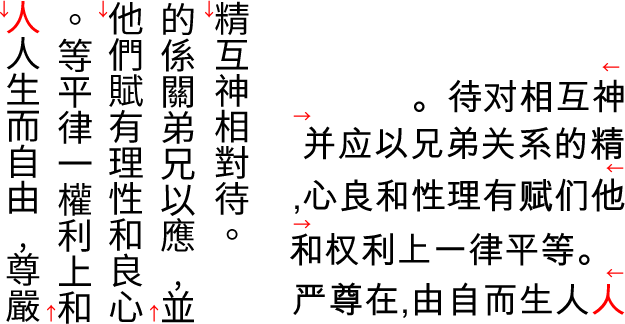
Another idea is that it is comes from Chinese phrase 好久不见 [好久不見] (hǎojǐu bújiàn), which means “quite a while, not see/meet”.

The character (jǐu) means ‘(long) time’, and appears in Japanese equivalents of the phrase: 久しぶり (hisashiburi) and お久しぶりですね (o hisashiburi desu ne). In this context, the ぶり (buri) part, which can also be written 振り, means after (a period of time), again or for the first time in (a period of time) [source].

always appears in expressions like:

  • 久しい (hisashii) = long (time that has passed), old (story)
  • 久々 (hisabisa) = (in a) long time, long time (ag), while (ago)
  • 久しく (hisashiku) = for a long time, for ages, for a good while
  • 久懐 (kyūkai) = long-cherished hope
  • 久闊 (kyūkatsu) = not having met or contacted someone for a long time; neglect of friends​ [source]

There’s a nice equivalent of this phrase in Russian: Сколько лет, сколько зим! (Skol’ko let, skol’ko zim!), which means literally “How many years, how many winters!”.

How to say ‘long time, no see’, or something similar, in many languages: https://omniglot.com/language/phrases/longtimenosee.htm.

Good Pickaxes

In French when you make a good guess or choice, you are said to be making une bonne pioche or literally “a good pickaxe” [source].

Claes Oldenburg

The word pioche [pjɔʃ] means pickaxe, and also a stock or pile of undealt cards in a card game, and chance or luck. It comes from pic (woodpecker, pick), from the Vulgar Latin *piccus (sharp point, peak, spike, pike), from the Latin pīcus (woodpecker, griffin), from the Proto-Italic *pikos, from the Proto-Indo-European *(s)peyk- (woodpecker; magpie), or from the Vulgar Latin *pīcca (pickaxe, pike), possibly from the Frankish *pikkōn (to peck, strike), from the Proto-Germanic *pikkōną (to pick, peck) [source].

Here are some examples of how pioche and related words are used:

  • faire une mauvaise pioche = to pick the wrong card
  • manche de pioche = pickaxe handle
  • pioche de jardinage = garden hoe
  • piocher = to dig up, to take from the pile, to take a card
  • piocher dans = to dip into
  • piocher pour qch = to cram for sth

Are there any interesting equivalents of this phrase in other languages, or any pickaxe-related phrases?

Together Living

A Dutch word I learnt recently is samenleving [‘samənlevɪŋ], which means society or community. It comes from samenleven (to live together, co-exist), from samen (together) and leven (to live), and could be literally translated as “together-living” [source].

Wonder All Around

Some related words include:

  • anderhalvemetersamenleving = ‘one and a half meter society’, in which (almost) everyone keeps a distance of one and a half meters where possible to prevent the spread of an infectious disease (especially Covid-19)’ [source]
  • wegwerpsamenleving = ‘throw away society’, in which using things once then throwing them away is normal [source]

The English word society comes from the Middle French societé (society), from the Old French societé (association, council, group, society, club), from the Latin societās (fellowship, association, alliance, union, community), from socius (associated, allied, partner, companion, ally), from the Proto-Indo-European *sokʷ-yo- (companion), from *sekʷ- (to follow) [source].

English words from the same PIE root include associate, consequence, obsequious, persue and sequel [source].

The English word community comes from the Old French comunité (community), from the Latin commūnitās (community; public spirit), from commūnis (common, ordinary, universal, public, democratic) [source].

In Old English a community was a gemænscipe [ˈjeˌmæːnˌʃi.pe], which is cognate with the Dutch word gemeenschap (community, society, fellowship) and the German word Gemeinschaft (community, group, company, sense of community). These come from the Proto-West Germanic *gamainiskapi (community), from *gamainī (common, shared, communal) and *-skapi (forms nouns denoting state) [source].

Dawning

A Dutch I learnt recently is uitdaging [ˈœy̯tˌdaː.ɣɪŋ], which means a challenge. It comes from uitdagen (to challenge), from uit (out, off, over), and dagen (to dawn, light, rise, start, call).

Dagen comes from the Middle Dutch dāgen (to dawn, rest (a horse), delay, summon), from the Old Dutch *dagon, from the Proto-Germanic *dagāną [ˈdɑ.ɣɑː.nɑ̃] (to dawn, to become day) [source].

dawn

The Scots word daw [dɑ:] (to dawn) comes from the same Proto-Germanic root, via the Middle English dawen and the Old English dagian (to dawn), as does the obselete English word daw [dɔː], which means to dawn, wake up, daunt or terrify [source].

The word dawning, a poetic word for dawn or the first beginnings of something, comes from the same Proto-Germanic root, and from it we get the word dawn (to begin to brighten with daylight, to start to appear) [source].

Jackdaw

The unrelated word daw is an old name for the jackdaw (Coloeus monedula), and also means idiot, simpleton or fool. It comes from the Middle English dawe, from the Old English dāwe, from the Proto-Germanic *dēhǭ (jackdaw), from the Proto-Indo-European *dʰākʷ- (jackdaw, starling, thrush) [source].

Daw is also found in Scots, and means a sluggard; a lazy, idle person; a slattern, a drab or an untidy woman, and comes from the jackdaw sense of daw [source].

Rush Reeds

The French word for daffodil is jonquille [ʒɔ̃.kij], which comes from the Spanish word junquillo (jonquil, rattan, strip of light wood, gold necklace), from junco [ˈxunko] (rush, reed, junk), from the Latin iuncus (rush, reed) [source].

Jonquilles

The English word jonquil [ˈdʒɑŋkwəl/ˈdʒɒŋkwəl] refers to a fragrant bulb flower (Narcissus jonquilla), a species of daffodil, or a shade of yellow, and comes from the same Latin root, via French and Spanish [source].

The English word junk also comes from the same Latin root, via the Middle English junke (old cable, rope) and the Old French jonc (rush) [source].

In Danish and Norwegian a daffodil is a påskelilje, which means literally “Easter lily” [source]. In German they are called Osterglocke (“Easter bell”) or Narzisse (narcissus) [source].

By the way, I wrote a post about words for daffodil in English, Welsh and other Celtic languages a while ago.

Unapologetic Accents

According to a story on the BBC News, a performance of Shakespeare’s As You Like It wasn’t to the taste of one member of the audience at the Theatre Royal in York, who objected to Yorkshire accents being used, left during the performance and later asked for a refund.

The company responsible for the play, Northern Broadsides, said that its performances contained “unapologetic northern voices”, and the manager of the theatre apparently said “That’s Yorkshire accents, right here in Yorkshire”.

Here’s a trailer for the performance:

What is the world coming to when a theatregoer is subjected to northern accents in a Shakespeare play?

As everybody knows, Shakespeare should be performed with Received Pronounciation (RP), not with any other accent. After all, that’s how actors in Shakespeare’s time spoke, isn’t it?

Well no, English sounded it bit different back then, and many rhymes and puns in Shakespeare work in reconstructed Original Pronunciation (OP), but not in RP. Here’s an example of the differences between RP and OP:

The actor here is Ben Crystal, and his father, David Crystal, reconstructed the Original Pronunciation of Shakespeare, and is a honorary professor of linguistics at Bangor University, where I studied.

More about OP:

Sleeve Monkeys

There’s an interesting idiom in Dutch – Nu komt de aap uit de mouw – which means ‘now the monkey comes out of the sleeve’ and is roughly the equivalent of the English idioms to let the cat out of the bag and to spill the beans. They mean to reveal a secret, or to reveal one’s true intentions.

opdracht 10 De aap komt uit de mouw DSC_1804

Other versions of the Dutch idiom include:

  1. De aap springt uit de mouw = The monkey jumps out of the sleeve
  2. De aap kijkt uit de mouw = The monkey looks out of the sleeve
  3. De aap uit de mouw schudden = To shake the monkey out of the sleeve
  4. Toen kwam de aap uit de mouw = Then the money came out of the sleeve = Then the true meaning became clear
  5. Hij heeft de aap in de mouw = He has the monkey up his sleeve = He’s sneaky (hides his true nature)

The origins of the idiom to let the cat out of the bag are uncertain, although we do know it was first used in writing in The London Magazine in 1760 [source].

The origins of the idiom to spill the beans are also uncertain. It was first used in American in the early 20th century, so it’s unlikely to have come from the Ancient Greek practice of using coloured beans to vote, as many sources claim [source].

The Dutch idioms come from the practice of performers hiding an actual monkey up their sleeves which would appear unexpectedly at a certain moment. Alternatively they might refer to our inner ape/monkey or mischievous character which is usually hidden metaphorically up our sleeve [source].

Are there any similar idioms in other languages?

Sources: Reverso, Ensie

Enlisted Fathers

As today is St Patrick’s Day, I thought I’d look into the origins of the name Patrick.

Happy St Patrick's Day / Lá ḟéile Pádraig sona ḋuit! / Dydd Gwyl Padrig Hapus

Patrick comes from the Latin name Patricius, which comes from the word patricius (patrician, noble), from patrēs cōnscrīptī (Roman senators, or literally “enlisted fathers”) [source].

patrēs is the plural of pater (father, head of household, parent, forefather, priest), which comes from the Proto-Italic *patēr (father), from the Proto-Indo-European *ph₂tḗr (father), from *peh₂- (to protect, shepherd) and‎ *-tḗr (agent suffix) [source].

Another word that comes from pater is patronus, which in the magical world of Harry Potter is a spirit guardian that can be summoned with the charm Expecto Patronum [source]. This is genunine Latin and means “I await my protector” [source].

cōnscrīptī is the plural of cōnscrīptus (senator, counsel(l)or; enrolled, enlisted, composed), which comes from conscrībō (I enroll, enlist, draw up, compose), from con- (with), and‎ scrībō (I write) [source].

The English word conscript (One who is compulsorily enrolled, often into a military service) comes from the same Latin root [source].

Charlatan Snake Oil

The term snake oil is used to refer to a scam, a fraudulent medicine or remedy, or deceptive marketing. It was first appeared in writing in 1858 in the USA. In Georgia, for example, snake oil was sold as a folk remedy for rheumatism and gout, and it was said to be a cure for deafness in parts of Pennsylvania.

Snake Oil

Some such remedies contained oil made from the fat of snakes, especially rattlesnakes, but many didn’t. In the early 20th century such products started to be condemned in professional pharmacy journals as they didn’t contain any snake oil at all. As a result the term snake oil became associated with phony remedies and quackery [source].

In French snake oil is known as remède de charlatan (charlatan medicine) or poudre de perlimpinpin (perlimpinpin powder).

The word charlatan (quack (doctor), charlatan), comes from the Italian ciarlatano (charlatan, quack), from ciarlatore (chatterer) and cerretano (hawker, quack). The latter term means literally a “native of Cerreto”, and is the root of this word because the Italian village of Cerreto di Spoleto in Umbria in the province of Perugia was once widely known for its quacks.

Arrived in Umbria. Some views from our rental in the hills of Cerreto di Spoleto in de Valnerina valley. Lovely nature, birds and cicadas as background music.

Perlimpinpin [pɛʁ.lɛ̃.pɛ̃.pɛ̃] is one of the French names for Rumpelstiltskin, a company that makes children’s clothes, a restaurant in Paris, and probably others things. The origins of the word are uncertain. According to one theory, it’s a combination of prêle (horsetail – Equisetum hyemale) and pimpin (Pandanus montanus – a type of tree from the island of Réunion), two plants that were used as in a herbal medicine in 17th century France [source].

Perapera

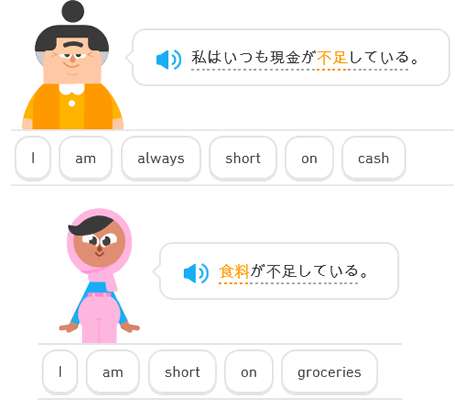
In Japanese if you speak a language fluently you can say that it is ペラペラ (perapera). This is one of the many onomatopeic or mimetic words used in Japanese, and it has come up in some of the Japanese lessons I’ve been studying on Duolingo recently, so I thought I’d write about it.

Erigeron karvinskianus  ペラペラヨメナ

ペラペラ, which is also written ぺらぺら, can also mean speaking incessantly, glibly, garrulously or volubly; flipping through pages one after the other or thin, flimsy or weak paper, cloth, etc.

For example:

  • 日本語がペラペラになりたいです。 (Nihongo ga perapera ni naritai desu) = I want to be fluent in Japanese.
  • 彼は英語がペラペラだ。(Kare wa eigo ga perapera da) = He has a good command of English / He speaks Englsh fluently.
  • ペラペラしゃべり続ける (perapera shaberi tsudzukeru) = to rattle on
  • ペラペラまくしたてる (perapera makushitateru) = to talk a mile a minute
  • ペラペラという音 (perapera to iu oto) = a fluttering sound, flip-flap
  • ペラペラとうそをつく (perapera to uso o tsuku) = to lie glibly/fluently
  • ペラペラの段ボール (perapera no dan bōru) = flimsy / corrugated cardboard

ペラペラヨメナ (perapera yomena) is a type of flower (see photo above), which is known in English as a Latin American fleabane, Karwinsky’s fleabane or Mexican daisy. In Latin it is Erigeron karvinskianus: erigeron comes from the Ancient Greek ἠριγέρων (ērigérōn “groundsel”), from ἦρι (êri, “early in the morning”) and γέρων (gérōn, “old man”), and karvinskianus is named after Wilhelm Friedrich Karwinsky von Karwin (1780-1855), who was a Bavarian naturalist who collected plants and animals in Brazil and Mexico.

Sources: Duolingo, Jisho.org, 英辞郎 on the WEB, Wiktionary