Patois

One of the things we talked about last night at the French conversation group was patois, specifically Jamaican (Jimiekn / Patwah).

In French patois means

“Système linguistique essentiellement oral, utilisé sur une aire réduite et dans une communauté déterminée (généralement rurale), et perçu par ses utilisateurs comme inférieur à la langue officielle.” [source]

or

“an essentially oral linguistic system, used in a small area and in a particular community (usually rural), and perceived by its users as inferior to the official language.”

In English patois means “an unwritten regional dialect of a language, esp. of French, usually considered substandard; the jargon of particular group.” [source].

Another definition of patois from Wiktionary is:

1. A regional dialect of a language (especially French); usually considered substandard.
2. Any of various French or Occitan dialects spoken in France.
3. Creole French in the Caribbean (especially in Dominica, St. Lucia, Trinidad and Tobago and Haiti).
4. Jamaican Patois, a Jamaican Creole language primarily based on English and African languages but also has influences from Spanish, Portuguese and Hindi.
5. Jargon or cant.

It comes from the Middle French patois (local dialect), from the Old French patois (incomprehensible speech, rude language), from the Old French patoier (to gesticulate, handle clumsily, paw), from pate (paw), from Vulgar Latin *patta (paw, foot), from the Frankish *patta (paw, sole of the foot), from the Proto-Germanic *pat-, *paþa- (to walk, tread, go, step), of uncertain origin [source].

Patois was first used in written French in 1643 to refer to non-standard varities of French, and to regional languages such as Picard, Occitan, Franco-Provençal and Catalan. Such varities and languages were assumed to be backward, countrified, and unlettered. Use of the word was banned by king Louis XIV in 1700.

There is no standard linguistic definition of patois, and to a linguist it can refer to pidgins, creoles, dialects, or vernaculars [source].

Are there similar words in other languages?

Blesk a hrom

Lightning

Two interesting words that came up in my Czech lessons recently are blesk (lightning) and hrom (thunder).

Blesk also means a flash, thunderbolt or flashlight / torch, and sounds like a flash of lightning to me. Hrom could be to a clap of thunder.

I’m not sure which of them usually comes first – is it blesk a hrom or hrom a blesk?

In English it’s always thunder and lightning, even though the lightning comes first. Lightning and thunder just sounds wrong.

In Welsh it’s mellt a tharanau (lightning and thunder).

Is thunder and lightning or lightning and thunder in other languages?

Ungrammaticality

When learning a new language, it helps if you learn how to use its grammar. There is much debate about how to do this.

Some people might advise you just to speak a language as soon as you know anything, and not to worry about making mistakes. In fact, they might encourage you to make mistakes. You will eventually pick up the grammar through extensive use of and exposure to the language, and maybe occasional glances at grammar books.

A ‘traditional’ approach to language learning involves concentrating more on learning the grammar before you try to use the language.

A combination of these approaches might be most effective. This is something I discussed on my latest podcast.

Last night one of the people at the French conversation group seems to have taken the first approach – he knows quite a bit of French vocabulary, but is not very good at putting words together into coherent sentences, or at using the grammar. As a result, it was rather difficult to work out what he was trying to say. I imagine native speakers of French might have less patience than us when trying to understand him.

So while it is possible to speak a language without knowing much of the grammar, you might find it difficult to make yourself understood.

Instrumental Idioms

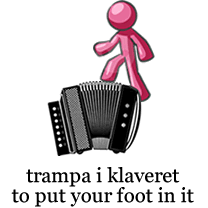
trampa i klaveret

The other day I learnt an interesting Swedish idiom – nu trampade jag verkligen i klaveret, which means “I really put my foot in it” or literally “now I really stepped (heavily) on the accordion / piano / keyboard”.

According to the Svenska Akademiens Ordböcker, trampa i klaveret means “göra en social tabbe” (to make a social mistake). Apparently it comes from the phrase “Det låter, sa bonden/klockaren, trampade i klavere” (It sounds, said the farmer / watchman, like trampling on the keyboard” [source].

To put one’s foot in it means “to say or do something tactless or embarrassing; commit a blunder or indiscretion.” [source]. The origins of this phrase are not known.

Other idioms involves musical instruments, or instrumental idioms, include:

  • rhoi’r ffidl yn y to = to give up / throw in the towel (“to put the fiddle in the roof)
  • to play second fiddle = to take a subordinate position to someone was is more important
  • to blow one’s own trumpet = to boast about your own sucesses
  • to blow the whistle (on sth/sb) = to report illegal / unacceptable activities

Do you know any more?

Thatched Stegosauruses!

What do togas, stegosauruses and thatch have in common?

Stegasaurus

These words all come from the Proto-Indo-European root *(s)teg- (cover, roof) [source].

Toga comes from the Latin togategō (I clothe) , from the Proto-Indo-European *togéh₂ (cover), from *(s)teg- (to cover) [source].

Stegosaurus comes from the Ancient Greek words στέγος (stégos – roof) and σαῦρος (saûros – lizard) [source], and στέγος comes from the Proto-Indo-European root *(s)teg- (cover, roof) [source]. The origins of σαῦρος are uncertain. So a stegosaurus is a “roof lizard”.

Thatch comes from the Old English þæc (roof-covering), from the Proto-Germanic *þaką (covering), from the Proto-Indo-European *(s)teg- (to cover) [source].

Words for house in the Celtic languages also come ultimately from the same root – (Welsh) chi (Cornish), ti (Breton), teach (Irish), taigh (Scottish Gaelic) and thie (Manx). More details.

Wise Clocks

city hall from Hantverkargatan Stockholm

The Swedish word klok [kluːk] means wise, sensible or intelligent. It doesn’t sound quite like the English word clock, but looks like it should. In fact it sounds more like cluck.

Some examples of how it’s used, and of related words:

  • klok gubbe = wise old man
  • klok gumma = wise woman
  • klok som en bok/pudel/uggla = as wise as a book/poodle/owl
  • En sådan politik skulle inte vara klok = Such a policy would be ill-advised
  • Detta är en klok rekommendation = This is a sensible recommendation
  • det verkar klokt = that seems wise
  • Är du inte klok? = Are you out of your mind?
  • Är du inte riktigt klok? = Are you crazy? Are you completely out of your mind?
  • Jag blev inte klok på det = I cannot make it out, It didn’t make sense to me
  • klokhet = wisdom, prudence, sense, wit
  • klokskap = cleverness
  • klokt = wisely, judiciously, sagely

Owls are also seen as wise in English, and although we don’t say ‘as wise as a book’, reading books can help on the road to wisdom. Poodles are not usually associated with wisdom in English, as far as I know, but it seems they are in Swedish.

In other languages, what is the equivalent of the phrase ‘as wise as an owl’?

Klok comes from the Old Norse klókr (arch, cunning, clever), from Middle Low German klôk.

The Swedish word for clock is klocka [klɔkːa], which comes from the Old Swedish klockæ, from Old Norse klokka (bell, clock), from Late Latin clocca (o’clock), probably from the Proto-Celtic *klokkos (bell), from the Proto-Indo-European *klēg-/*klōg- (onomatopoeia).

Sources: bab.la, Linguee, Ord.se, Svenska Akademiens Ordböcker, DinOrdbok, Wiktionary

Cheeky faces

Face

In my Czech lessons this week I learnt two words that can mean face – obličej [ˈoblɪt͡ʃɛj] and tvář [tvaːr̝̊], which also means cheek. I couldn’t work out why one was used to mean face in some contexts, and the other in other contexts. Can any of you enlighten me?

Obličej comes from the Proto-Slavic ob + lice (face, cheek), which is also the root of the Czech líc (front, face, right side, face side) and líce (cheeks).

Cognates in other Slavic languages include: Polish oblicze (face, character), Russian обличье (image, character, look), and Ukrainian обли́ччя (face, character) [source].

Tvář comes from the Proto-Slavic *tvarь (creation, creature) [source]. Cognates in other Slavic languages include: Polish twarz (face), Russian тварь (creature, being, animal, beast, monster; mean, vile, worthless), and Croatian tvar (substance, material) [source].

Another Czech word for face is ksicht, from the German Gesicht (face).

Det knallar!

One of the Swedish phrases I learnt this week was Det knallar!, which means “it’s okay; it’s business as usual” [source] or literally “it bangs / crashes / pops”. I like the sound of it, so thought I’d write about it.

The verb knalla means to bang, crash or pop [source], and knall means bang, crash, pop [source]

Related words and expressions include:

  • knalleffekt = bombshell, sensation, sensational effect
  • knallgul = bright yellow
  • knallröd = bright / vivid red
  • knallhatt = percussion cap
  • knallskott = jumping jack / quockerwodger
  • det knallar och går = I’m jogging along, I’m managing

Is it used in any other interesting expressions?

Asterix and the King

Have you ever wonder why the names of the Gauls in the Asterix books all end in -ix?

Asterix & Obelisk

There were genuine Gauls with names ending in -ix, or rather rix, which means king in Gaulish. They include Vercingetorix (see photo), Dumnorix, Albiorix, Adgennorix and Dagorix [source]. Asterix and friends have joke names with the -ix suffix to make them sound Gaulish.

The word rix comes from the Proto-Celtic *rīxs (king), from Proto-Indo-European *h₃rḗǵs (ruler, king). Words for king in Irish (), Scottish Gaelic (rìgh), Manx (ree) and Welsh (rhi) come from this root [source].

The Welsh one is in fact rarely used – the usual Welsh word for king is brenin, which comes from the Proto-Celtic *brigantīnos ((someone) pre-eminent, outstanding), from the Proto-Indo-European *bʰerǵʰ- (to rise, high, lofty, hill, mountain) [source], which is also the root of such English words as barrow, burrow, bury, borough, burgher and fort [source].

Words for realm or kingdom in Germanic languages come from this root, including Reich (empire, realm) in German, rike (realm, kingdom, empire, nation) in Swedish, and rik (realm, kingdom) and kinrick / kin(g)rik (kingdom) in Scots.

We also get the English suffix -ric from this root – as in bishopric (a diocese or region of a church which a bishop governs), and in the obsolete English word for kingdom – kingric, which means “king king” [source].

The words for king in the Romance languages also come from *h₃rḗǵs, via the Latin rēx (king, ruler) [source].

Les mots de la semaine

Some words that came up this week in the French conversation group I go to.

français English
le truc stuff, substance
les trucs stuff (things)
les affaires stuff (belongings)
les choses personnelles personal stuff
bourer (qch de qch) to stuff (sth with sth)
bourer un sac de qch to stuff a bag with sth
rembourrer to stuff (a cushion, mattress, etc)
s’empiffrer to stuff oneself (with food)
s’en mettre plain la lampe to stuff one’s face
étre bouré(e) à craquer to be stuffed full (person)
je suis repu I’m stuffed
animal en peluche stuffed animal / toy
bouché(e) stuffed up (nose)
j’ai le nez bouché my nose is stuffed up
farcir to stuff (food)
farci stuffed (food)
des tomates farcis stuffed tomatoes
fourré à la ricotta stuffed with ricotta
empailler to stuff (taxidermy)
empaillé stuffed