Fields and Warriors

The expression “it takes two to tango” means that two people are needed for certain activities, or that both people involved in a particular activity or situation share equal responsiblity for it.

It apparently comes from the 1952 song Takes Two to Tango by Al Hoffman and Dick Manning [source].

In Russian an equivalent idiom is один в поле не воин (odin v pole ne boin), or “one in the field is not a warrior”. Perhaps this comes from the idea that a warrior with nobody to fight againt on a battle field is not really a warrior. Does anybody know the origins of this phrase?

This idiom is also translated as “one man is an island”, “safety in numbers”, “you don’t have to do this alone” or “you never get far on your own”. Some examples of how it’s used include:

Один в поле не воин, как бы кому-то этого не хотелось.
No man is an island however much they want to be.

Мне они тоже не нравятся, но один в поле не воин.
I don’t like them either, but this war is bigger than us.

Но ты же прекрасно понимаешь, что один в поле не воин.
But right about now, my army-of-one situation is not cutting it.

Source: Reverso.

Are there interesting equivalent idioms in other languages?

Little Hillock of Glory

At the Welsh conversation group I went to tonight we had a quiz, part of which involved matching Welsh names for places in England to their English equivalents. I knew quite a few of them, but some were new to me.

My favourite was Twmpyn y Glori (“Little Hillock / Knoll of Glory”), which is apparently what you call Dewsbury in Welsh. I haven’t yet discovered why. Twmpyn is a diminutive of twmp, which means hillock, knoll, mound, pile or lump.

Northgate, Dewsbury

Dewsbury is a town in West Yorkshire in the north of England. The English name is thought to come from the Welsh name Dewi, an equivalent of David, and the Old English word burh (fort). The name was recorded as Deusberie, Deusberia, Deusbereia or Deubire in the Doomsday Book of 1086. Perhaps a better Welsh name for it would be Caerddewi (Dewi’s fort).

Nottingham

Another interesting name that came up was Tre’r Ogof (“Town of the Cave”), which is the Welsh for Nottingham. Apparently an old Brythonic name for that area was Tig Guocobauc, (Place of Caves). The name Nottingham comes from Snotingaham – Snot’s people’s (inga) homestead (ham). Snot was a Saxon chieftain.

Registering the Matrix

Language quiz image

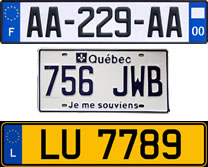
Yesterday I learnt that the French for a number plate / license plate / vehilce registration plate is une plaque d’immatriculation [source].

The word immatriculation means registration, and comes from the word immatriculer (to register), which comes from the Medieval Latin immatriculare (to join) [source]. This comes from the Latin mātrīcula (public register), a diminutive of mātrīx (uterus, womb, source, origin, list, register) [source].

Mātrīx comes from Latin māter (mother, woman, nurse, motherland), from the Proto-Italic *mātēr (mother), from Proto-Indo-European *méh₂tēr (mother), which is the root of words for mother in many languages [source].

The English word matrix comes from the Latin mātrīx, either directly, or via the Old French matrice (pregnant animal) [source].

I never know what connections I’ll find when I set off on an etymological adventure like this. Yesterday I found that matriculation and mātrīx were connected, which inspired me to write this, but I wouldn’t have guessed that mātrīx and māter were also connected.

Ignorance and Sleep

An interesting Russian expression I learnt recently is меньше знаешь – лучше спишь (men’she znayesh’ – luchshe spish’), which means “the less you know, the better you sleep”, and is equivalent to the English expression ignorance is bliss.

Ignorance is bliss comes from Ode On A Distant Prospect Of Eton College, a 1742 poem by Thomas Gray, an Englsh poet, in which he wrote “where ignorance is bliss, ‘Tis folly to be wise.” [source]

While it might be true that you sleep better if you have less to worry about, I don’t agree with Thomas Gray about the value of ignorance and the folly of being wise.

Similar sayings include out of sight, out of mind, and what you don’t know can’t hurt you.

What about in other languages? Are there similar sayings?

Gibberish

When someone is talking in a way that doesn’t make sense to you, is using specialist jargon, is speaking a foreign language you don’t know, or is using made-up words, you might say they’re talking gibberish.

Other words for gibberish include gobbledygook, claptrap, jibber, jabber, jibber-jabber, folderol, twaddle, hogwash, bunkum, blabla, humbug, mumbo-jumbo, jargon, babble, double Dutch and nonsense [source].

Gibberish is possibly onomatopoeic in origin, imitating to the sound of chatter, or from the the Irish word gob (mouth) [source].

In French equivalents of gibberish include charabia, galimatias, amphigouri, blabla and foutaise. To talk gibberish is dire du charabia, baragouiner or bredouiller [source].

You can hear a bit of gobbledygook in the latest episode of the Radio Omniglot Podcast, which I recorded yesterday, and edited today. My friends and I sometimes talk in gobbledygook just for a laugh. Maybe I should add a page about it to Omniglot.

Do you know any other words of gibberish in English or other languages?

Elephants & Camels

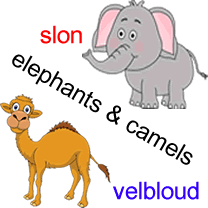
Elephants and camels

What do elephants and camels have in common?

Well, words for camel in Slavic languages like Czech and Russian possibly come from an Ancient Greek word meaning elephant.

In Czech the word for camel is velbloud [ˈvɛlblou̯t], which comes from the Proto-Slavic *velьb(l)ǫdъ / vъlьb(l)ǫdъ (camel), from the Gothic 𐌿𐌻𐌱𐌰𐌽𐌳𐌿𐍃 (ulbandus – camel), from the Latin elephantus (elephant), from the Ancient Greek ἐλέφας (eléphas – elephant) [source].

Words from camel in other Slavic languages come from the same root: верблюд (verbljúd) in Russian and Ukrainian, вярблюд (vjarbljúd) in Belarusian, wielbłąd in Polish, and so on [source].

These all come from the Gothic 𐌿𐌻𐌱𐌰𐌽𐌳𐌿𐍃 (ulbandus), but from there the etmological trial gets a bit hazy, as they quite often do. Traditionally this word is thought to derive from the Greek ἐλέφας, via the Latin elephantus.

Another theory is that the Gothic word comes from the Proto-Germanic *elpanduz (elephant, camel), which possibly comes from the Hittite word hu(wa)lpant (humpback), or from another ancient language of Anatolian such as Luwian [source].

The word for elephant in Czech (and also in Slovak, Serbian, Croatian and Slovenian) is slon [slon], which comes from the Proto-Slavic *slonъ (elephant) [source], which comes either from the Turkish aslan (lion), or from *sloniti (to lean against), relating to the medieval story of an elephant sleeping leaning on a tree [source].

So now we know where the name of the lion in The Lion, The Witch and The Wardrobe probably comes from.

Do you tartle?

An interesting word I heard the other day is tartle. It’s a Scots word that means “To hesitate, to be uncertain as in recognising a person or object; to boggle, “as a horse does”; to hesitate about clinching a bargain.” or “To recognise, esp. after some uncertainty, to discern”.

An example of how it is used is: “I tartled at him, I could not with certainty recognise him.”

The related adjective, tartlesome, means “disposed to start objections, captious*”.

*Captious [ˈkæpʃəs] = “apt to notice and make much of trivial faults or defects; faultfinding; difficult to please.” [source].

Source: Dictionary of the Scots Language / Dictionar o the Scots Leid.

I heard tartle on the Something Rhymes with Purple podcast, where it’s defined as “to hesitate when introducing someone because you’ve forgetten their name”.

To avoid tartling, I just don’t use people’s names, except when necessary. Although I find that if I repeat someone’s name several times after being introduced to them, I’m more likely to remember it.

Do you have any good ways to remember name, and to avoid tartling?

Grab it and run!

One of the Russian words I learnt this week is грабить [ˈɡrabʲɪtʲ], which sounds like ‘grab it’ and means to rob, burgle or pillage.

An example of how it’s used is: Нельзя же грабить банк в платье (You can’t rob a bank in a dress) – is this something that often comes up in Russian conversation? [source].

I wondered if this word is related to the English word grab, so decided to find out.

According to Wiktionary, грабить comes from the Proto-Slavic *gràbiti (to grab, seize). This comes either from the Proto-Balto-Slavic *grāˀb-, from Proto-Indo-European *gʰreb (to rake). Or from the Proto-Indo-European *gʰrebʰ- (to seize).

Grab comes from the Middle Dutch grabben (to grab), or from the Middle Low German grabben (to snap), from the Proto-Germanic *grab-, from Proto-Indo-European *gʰrebʰ-, which is one possible root of грабить, so they might be related [source].

Even if the two words are not related, their similar sound will help me remember the Russian one.

Standard Writing for Inuit

According to an article I came across today, the Inuit Tapiriit Kanatami / ᐃᓄᐃᑦ ᑕᐱᕇᑦ ᑲᓇᑕᒥ (ITK), an organization the protects and advances the rights and interests of Inuit people in Canada, have agreed on a standard way of writing the Inuit languages of Canada.

There are currently nine different ways to write these languages, using either the Roman alphabet (qaliujaaqpait) or the Inkutitut syllabary (ᖃᓂᐅᔮᖅᐸᐃᑦ / qaniujaaqpait).

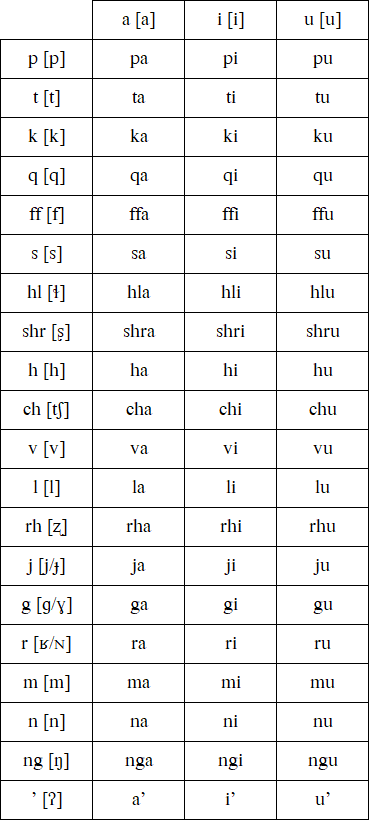
On 10th September 2019 the ITK decided to adopt a standardised way of writing all the Inuit languages and dialects of Canada using the Roman alphabet known as the Inuktut Qaliujaaqpait writing system. It includes ways to write the sounds found in all these languages, even though some are only used in a few of the languages. More information.

Inuktut Qaliujaaqpait writing system

I’m not entirely sure how all the consonants are pronunced – the illustrations of the orthography don’t include pronuciation.

The intention with the new orthography is to provide an alternative, auxiliary writing system that can be used as well as, or instead of, the existing systems. The new writing system will make it easier to produce learning resources and other written material. It is also hoped that more speakers of Inuit languages will write in them, rather than using English.

Eskimo-Aleut languages on Omniglot
Aleut, Alutiiq, Greenlandic, Inuktitut, Iñupiaq, Yup’ik (Central Alaskan), Yupik (Central Siberian)

When is a gate not a gate?

In a Russian lesson I did yesterday, I learnt that a word for gate is ворота (vorota). Then it gave me a phrase using a different word for gate – Где гейт? (Gde gejt?), which means “Where is the gate?”, and refers to the kind of gate you get at an airport. Slightly confusing. So I wondered what kind of gate is a ворота.

Apparently a ворота is a (double) gate, gateway, portal, goal or sluicegate.

Other Russian words for gate include:

  • выход (vychod) = egress, exit, gate, orifice, outcome
  • вход (vchod) = embouchure, entrance, entry, gate, gateway, ingress, inlet
  • шлагбаум (shlagbaum) = gate (of lock, level crossing), tollbar
  • калитка (kalitka) = (single) gate, wicket
  • шлюз (shlyuz) = flood-gate, gate, lock, sluice
  • гейт (gejt) = gate (at an airport)

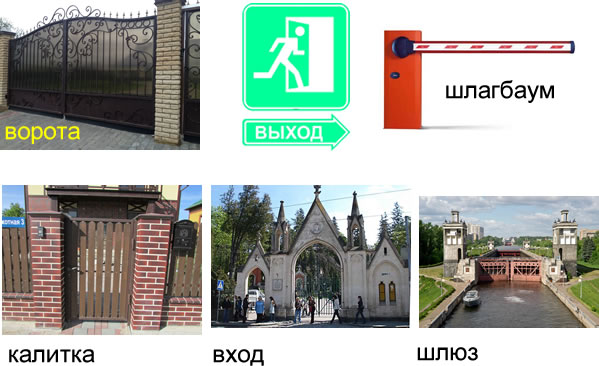
Below are some illustrations on different kinds of gates I found via Google:

Some different kinds of gates and the words for them in Russian

Searching for images of words like this seems is interesting, and may help me to remember them.

Sources: Reverso Dictionary & bab.la