Tykki Duw

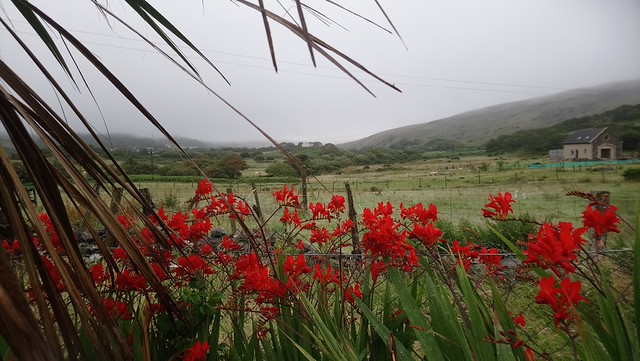
Last week I learnt that a butterfly in Cornish is a tykki Duw [tɪkˑi’dyˑʊ / tɪkˑi’diˑʊ], or literally “God’s pretty thing”. A moth is a tykki Duw nos or “God’s pretty thing of the night”).

The word tykki comes from teg (pretty, attractive), and Duw comes from the Proto-Celtic *dēwos (god), from the Proto-Indo-European *deywós (god), from *dyew- (sky, heaven).

Butterfly

Names for butterflies are interesting in other languages as well:

  • Welsh: glöyn byw (glowing ember); iâr fach yr haf (little hen of the summer); pili-pala; plufyn bach yr haf (little feather of the summer), colomen fyw (lively pigeon); glöyn Duw (god’s ember/coal); eilir (spring).
  • Scottish Gaelic: féileagan; dealan-dé (god’s lightning); sglapaid; teine-dé (god’s fire); teillean-dé (god’s bee); tormachan-dé (god’s ptarmigan); dealman-dé; strainnsear (stranger); gogag
  • Manx: foillycan, follican
  • Irish: féileacán; guagóg; uallán
  • Breton: balafenn; barbellig; bobelan; aelig
  • Swedish: fjäril
  • Danish: sommerfugl (summer bird)
  • Spanish: mariposa
  • German: Schmetterling
  • French: papillon
  • Italian: farfalla
  • Russian: бабочка (babochka)

What about in other languages?

Sources: Gerlyver Kernewek, Wiktionary, Geiriadur Prifysgol Cymru, Geiriadur yr Academi, Am Faclair Beag On-line Manx Dictionary, Dictionnaire Favereau, bab.la

Leaving and departing

Departures board in Berlin's Hauptbahnhof

I learned today that there are several words for leave in Danish, so I thought I’d investigate.

Forlade means to leave, abandon, depart, forsake, quit, desert or vacate. For example: Elvis har forladt bygningen (Elvis has left the building).

Afrejse means to leave, depart or departure. For example, Jeg afrejse i morgen (I’m leaving tomorrow). Is this different from forlade?

Efterlade means to leave or leave behind, for example: Vi forlod Elvis i bygningen (We left Elvis in the building).

Overlade means to leave or entrust. For example: Overlad sangen til Elvis (Leave the singing to Elvis).

Løslade means to release, let, free, leave, allow. For example, Løslad Elvis nu! (Release Elvis now!).

Lade on its own means to let, allow, reload; or shed, shack or barn.

Do other languages have different words for different kinds of leaving?

Sources bab.la, Globse

The photo is one I took in Berlin Hauptbahnhof. You can see a larger verison on Flickr.

Pronunciation is fun

The other day I realised that one reason I like languages is because I enjoy just saying foreign words and phrases, especially ones that contain sounds and combinations of sounds not used in English. I imitate native speakers as best I can – not just the sounds of the words, but the intonation, and even pitch of their voices as well.

At the moment I’m learning Swedish, Danish, Russian and Slovenian. I started learning Swedish out of interest in the language, and because I like the sound of it, and have fun pronouncing it. I started learning Danish and Slovenian in preparation for trips to Denmark and Slovenia, but also enjoy pronouncing them. I’ve been learning Russian on and off for years for various reasons, and enjoy pronouncing it.

Maybe I’ll learn some other languages just to have fun pronouncing them. Languages with clicks, like Zulu and Xhosa, or with ejectives, like Georgian. I already know some songs in these languages, so it would be quite useful to know a bit more about them. It would also be interesting to visit places where they’re spoken, and to use them, but that would not be a priority.

If I do this, I would search for the most interesting-sounding words and phrases, and also tongue twisters, rather than focusing on the most common words and grammatical patterns. I probably wouldn’t learn to speak and understand the languages, but would have fun anyway.

Here are some tongue twisters to play with:

And here’s a tongue twister in Xhosa:

Have you learnt, or are you learning, any languages because you like the sound of them and enjoy pronouncing them?

Speech recognition & pronunciation

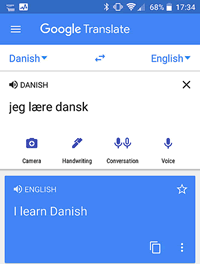
Screen shot of Google Translate

Memrise language lessons sometimes test your pronunciation. You hear a phrase, then repeat it and record it. If your recording is close enough to the original, you move on to the next phrase. It’s actually a very useful exercise, and it’s interesting to compare you pronunication to that of native speakers.

It’s based on Google Translate’s voice function, and I thought I’d try that for other languages. Google Translate doesn’t record your voice, but you have to speak clearly for it to recognise the words. It doesn’t always recognise what I say to it in English, so getting it to recognise things I say in other languages is even more of a challenge.

I’ve tried it for all the languages I know that have the voice function. For most I can get it to recognise individual words and short phrases, though I find it easier for some languages than others. For French, Swedish, Russsian and German, for example, it’s usually fine. For Danish, however, it may recognise only a few words I say to it, even when I speak as clearly as I can. This suggests to me that my Danish pronunciation needs improving.

Have you used Google Translate or a simliar app in this way?

Did you find it useful?

Happy shining people

Smiley face

One of the Swedish lessons I did today was about words for emotions and related words. So I thought I’d find out more about some of them.

There are several words for happy in Swedish:

glad [ɡlɑːd] = delighted, glad, happy, pleased, jolly, lively, bright, bubbly, cheerful, elated, merry, pleasant, sprightly, vivid, gleeful, joyful, joyous, jubilant.

It comes from the Old Swedish glaþer (glad, cheerful), from Old Norse glaðr (glad), from Proto-Germanic *gladaz (shiny, gleaming, radiant, happy, glossy, smooth, flat), from Proto-Indo-European *gʰladʰ-, derivation of *gʰel- (to shine). The English word glad comes from the same root, though via Old English.

nöjd [nøjd] = content, happy, pleased, satisfied, contented, sated.

lycklig [lʏkːlɪɡ] = happy, fortunate, lucky, blessed, bright, upbeat, blissful.

This word comes from lycka (joy, happiness, luck, fortune, fate), which is related to the English word luck. These words are thought to come from the Middle High German lücke, gelücke, possibly from the Frankish *galukki [source].

belåten = content, contented, happy, satisfied

Some words for fun include:

kul [kʉːl] = fun, nice, enjoyable, amusing
roligt = fun
rolig = fun, amusing, diverting, droll, witty, hilarious

One ‘useful’ phrase that came up today was tjejer vill bara ha kul or girls just want to have fun.

In Norwegian rolig means calm, quiet, peaceful or leisurely, and in Danish it means calm or quiet [source]. It comes from the Old Swedish roliker (calm, quiet), from Old Norse róligr.

Other emotional words include:

le [leː] = to smile (related to the English word laugh)
småle = to smile
skratta = to laugh
entusiastisk = enthusiastic, cheerful
hoppingivande = hopeful
ledsen = sad
olycklig = unhappy
arg = angry
rädd = afraid
orolig = worried

Sources: bab.la, Wiktionary

When is a moose not a moose?

Moose

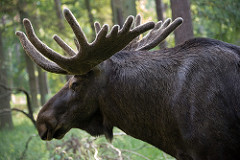
In North America a moose is a large member of the deer family, also known by its Latin name alces alces. The word moose comes from Algonquian languages, such as the Naragansett moos or the Eastern Abenaki mos. These words are thought to come from moosu (“it strips”), from the Proto-Alonquian mo.swa.

The same animal is known as an elk in British English, and is called something similar in quite a few other European languages: elc in Welsh, Elch in German, elg in Icelandic, Danish and Norwegian, älg in Swedish, alce in Italian, Portuguese and Spanish, and alnis in Latvian [source].

Elk

The word elk refers to a different species of deer in North America, however, which is also known as the wapiti or cervus canadensis in Latin [source]. The name wapiti comes from the Cree or Shawnee waapiti (elk; white rump) [source].

In French a moose or elk is élan [eɪˈlɑːn], wapiti [wa.pi.ti] or orignal [ɔ.ʁi.ɲal]. Élan probably comes from Lativan [source]. Orignal refers to the Canadian moose and comes from the Basque word oreinak, plural of orein (deer) [source].

Moose is also a way to write mouse in Scots – it’s pronouned [mus], and features in the famous saying “there’s a moose loose aboot this hoose”, which comes from the song Hoots Mon by Harry Robinson [source].

So a moose is a moose, except when it’s an elk or a mouse.

Here’s a tune I wrote called The Loose Moose / Yr Elc Rhydd:

Photos by Faris Algosaibi and Andrew E. Russell. Found on Flickr.

Angelic voices

Yesterday morning I studied some more Swedish, Danish and Russian, did a bit of work, and went for a walk around the misty glen.

Glenn Cholm Cille

In the afternoon we saw an interesting film in Irish – Ag Lorg Annie (Searching for Annie), which was made for the BBC by Kevin Magee, who is studying Irish here this week. The film is about a painting of a local girl, Annie McGinley, that was painted in the 1920s by the American artist, Rockwell Kent, who spent quite a bit of time in this area. Kevin wanted to find out more about the painting and where the original is now. He found the painting in a private collection in New York, and other paintings by Rockwell Kent in St Petersburg.

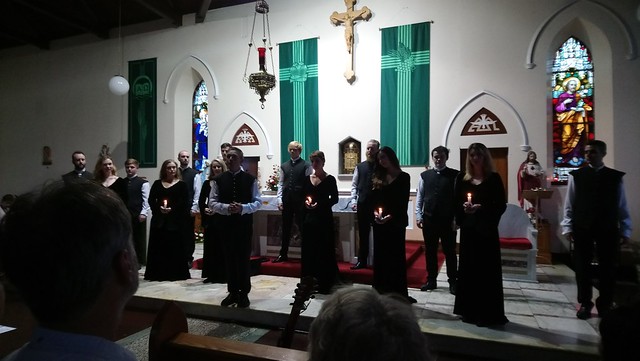
In the evening the local chapel was packed for a concert by Anúna, an Irish choir who sing beautiful arrangements of songs in Irish, English, Latin, Spanish. They specialize in old songs, and the oldest they sang last night was written in the 9th century, and sounded angelic.

Anúna

There was another concert after that in Oideas Gael featuring Sean Mac Corraidh from Belfast, his daughter, and a singer from Tory island. They sang traditional Irish songs, and told some interesting stories.

In the Irish language class we talked about verbs and other things this morning, and in the sean-nós class this afternoon we learnt four songs, three of which were already familiar to me. This evening there is a talk about Féiniúlacht agus Teanga (Identity and Language) by a lecturer in psychology from Dublin.

Aarhus

I had a great time in Aarhus. I arrived on Friday afternoon, and am currently on a train on my way to Copenhagen. I’ll be flying back to Manchester this evening, and should arrive back in Bangor late tonight.

In Aarhus I stayed with a Czech friend who teaches linguistics at the local university. She introduced me to some of her colleagues and friends, and showed me round the city. We also went for walks in the woods, round a nearby lake – Årslev Engsø – and to the beach.

Aarhus is quieter and smaller than Copenhagen – easy to explore on foot, and it seems like a friendly place, and its nickname is the ‘City of Smiles’.

I spoke a bit of Danish, though found it difficult to understand what people said to me in Danish. I also spoke some Welsh and a fair bit of English – all the locals I talked to speak English well, and they didn’t all switch to English when they heard my less than perfect attempts to speak Danish.

Here are some photos:

https://flic.kr/s/aHsmdEppBj

Can you learn a language just with Duolingo?

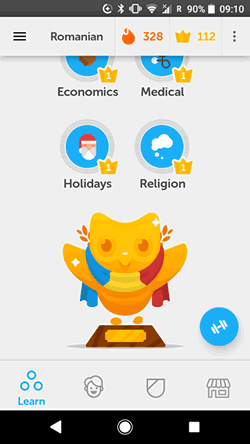
A screen shot of my Duolingo Romanian course

For the past year I’ve been learning Romanian with Duolingo. I wanted to see if I could learn a language entirely with that course, and chose Romanian because it was the only major Romance language I haven’t studied, and I have some Romanian-speaking friends.

Although I can understand Romanian to some extent now, especially when it’s written, I can’t speak it very well as I haven’t used it with real people much yet.

Compared with the other Romance languages, the grammar of Romanian is more complex, with four noun cases, like Latin. If you just use the Duolingo app, you have to try to work out the grammar for yourself, which isn’t easy. The online version includes some notes on grammar, but I’ve been mainly using the app. So my knowledge of the grammar is somewhat limited.

I do have a Colloquial Romanian course, which should help me to learn the language more thoroughly, but I’ll probably have a break before learning more.

I’ve also been learning Swedish and Russian on Duolingo for just over a year, and started learning Danish a few months ago. I had dabbled with Swedish a bit before, mainly with Babbel, and have studied Russian on and off for quite a while using various courses.

I can have conversations in Swedish, and Russian, though still have quite a way to go before I consider myself fluent in either language. I can read and understand quite a bit of Danish, though can’t say a lot yet. I find Swedish and Danish relatively easy as they have quite a lot in common with English, German and each other, and relatively simple grammar. Russian is more of a challenge – the grammar is more complex and there are a lot of unfamiliar words to learn.

For the past few months I’ve also been using Memrise to learn Swedish, Danish and Russian. In some ways I prefer it to Duolingo as Memrise focuses more of phrases you’re likely to use in everyday life, and the recordings are made by real people rather than robots.

I do like some of the ridiculous phrases that pop up on Duolingo though, such as:

– Sköldpaddan har en gul hatt = The turtle has a yellow hat
– Han går som en älg = He walks like a moose
– Jag hör inte dig eftersom jag har kanelbullar i öronen = I don’t hear you because I have cinnamon rolls in my ears
– Skildpadden drikker te = The turtle is drinking tea
– Anden læser avisen = The duck is reading the newspaper
– Ca caută ursul în șifonier? What is the bear doing in the wardrobe?
– Am un cuptor plin cu pui = I have an oven filled with chickens
– Eu am văzut o bufniță răzând = I saw an owl laughing
– Моя лошадь не художник а архитектор = My horse is not an artist but an architect
– Этот человек говорит, что он волшебник, но я ему не верю = This person says he’s a wizard, but I don’t believe him
– У меня есть говорящая лошадь = I have a talking horse

So, is it possible to learn a language just with Duolingo?

You can learn a lot, but it’s unlikely you’ll be speaking the language well by the end of the course. For me it works best for languages related to ones I know with grammar you can pick up as you go along (Swedish & Danish), and not quite so well for more distant and grammatically complex languages (Russian & Romanian).

I am now on a 328 day streak on Duolingo, and before that I was on a 96 day streak, but didn’t get enough points one day last summer to maintain it. So that’s 14 months of studying every day. When I’ve studied languages before, I would sometimes miss a few days, or even weeks. Now I don’t want to miss a single day.

Have you learnt any languages entirely or mainly with Duolingo?

Exploring Copenhagen / Udforskning af København

Today I am in Copenhagen on the way to see a friend in Aarhus. I left Bangor at way-too-early o’clock this morning, and arrived in Copenhagen early this afternoon. I’m staying in an AirBnB in Sydhavn, not far from the centre of the city. One of my hosts is from Moldova, and the other is a Dane, who I haven’t met yet. I spoke a bit of Russian and Romanian with my Moldovan host, which she seemed pleased to hear.

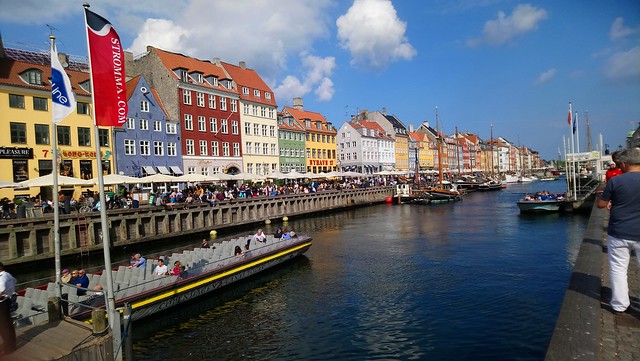
This afternoon I explored the touristy part of Copenhagen, and saw some nice parks, a castle, lots of boats, including a tall ship, a little mermaid, and some interesting buildings. I heard quite a few different languages being spoken, including Dutch, Spanish, Italian, Portuguese, Mandarin, Cantonese and other flavours of Chinese, English, French and even a bit of Danish. My knowledge of Danish is limited – I can read Danish quite well, and speak and understand it a little.

Cycling seems to be a popular way to get around here, perhaps because Copenhagen is so flat. There are plenty of cycle paths, and even traffic lights for cyclists. There are also many cargo bikes – three-wheeled contraptions with a large container on the front for shopping, children, pets or other things. Some cyclists indicate they’re stopping by raising their arm, as if asking a question, which is practical, but looks quite funny to me.

Here are a few photos:

Copenhagen / København

Tomorrow I’m off to Aarhus to see a Czech friend who teaches Linguistics at the university there. We usually speak a mixture of Czech, English and Welsh, and now we can add some Danish to the mix.

Later addition – I’ve met both my hosts now – the guy is actually from the Faroe Islands, and we’ve just had a very interesting conversation about Faroese and other languages. He told me that they used to borrow a lot of words into Faroese, especially from Danish, but now tend to create new words from Faroese roots. He finds it hard to understand some of the new words, as he’s not used to using them. They speak English to each other, by the way, as he doesn’t speak Russian or Romanian, and she speaks only a little Danish, and no Faroese.