Here’s a recording in a mystery language.
Do you know or can you guess the language?
A Japanese word I learnt recently that made me smile is 微笑む (ほほえむ) [ho.ho.e.mɯ], which means to smile 😃.

The character 微 (kasu / bi) means delicate, minuteness, insignificance, and 笑 (wara / e / jō) means laugh, laughter, smile or sneer. So 微笑 could be translated literally as a “delicate laugh”.
Some related words include:
The existence of 微笑み返す suggests to me that answering smiles with smiles is a common thing in Japan. That makes me smile. Are there words in other languages that mean something similar?
笑 (wara) [ɰaɺa] on it’s own is apparently used as internet slang to mean LOL (laugh out loud) or haha.
Some related words include:
Source: jisho.org
If you haven’t seen someone for a while, you might greet them by saying “long time no see”. Have you ever wondered where that phrase comes from?
According to NPR, if was first used in print in 1900 in a book by William F. Drannan called Thirty-One Years on the Plains and in the Mountains, Or, the Last Voice from the Plains An Authentic Record of a Life Time of Hunting, Trapping, Scouting and Indian Fighting in the Far West – a nice snappy title. In the book the phrase is used in the following context:
“I knew he had recognized me. When we rode up to him he said: ‘Good morning. Long time no see you,’ and at the same time presented the gun with breech foremost.”
Another idea is that it is comes from Chinese phrase 好久不见 [好久不見] (hǎojǐu bújiàn), which means “quite a while, not see/meet”.
The character 久 (jǐu) means ‘(long) time’, and appears in Japanese equivalents of the phrase: 久しぶり (hisashiburi) and お久しぶりですね (o hisashiburi desu ne). In this context, the ぶり (buri) part, which can also be written 振り, means after (a period of time), again or for the first time in (a period of time) [source].
久 always appears in expressions like:
There’s a nice equivalent of this phrase in Russian: Сколько лет, сколько зим! (Skol’ko let, skol’ko zim!), which means literally “How many years, how many winters!”.
How to say ‘long time, no see’, or something similar, in many languages: https://omniglot.com/language/phrases/longtimenosee.htm.
In French when you make a good guess or choice, you are said to be making une bonne pioche or literally “a good pickaxe” [source].
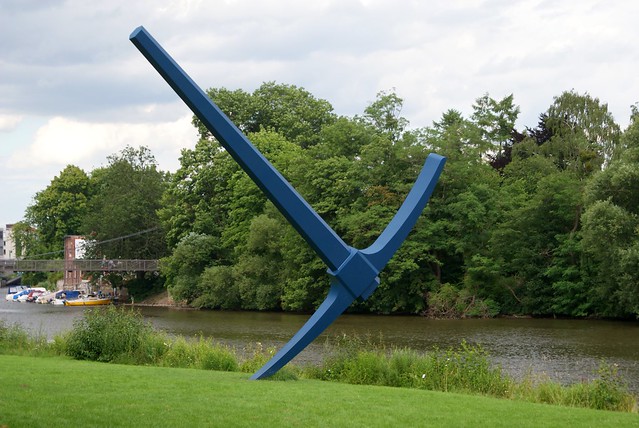
The word pioche [pjɔʃ] means pickaxe, and also a stock or pile of undealt cards in a card game, and chance or luck. It comes from pic (woodpecker, pick), from the Vulgar Latin *piccus (sharp point, peak, spike, pike), from the Latin pīcus (woodpecker, griffin), from the Proto-Italic *pikos, from the Proto-Indo-European *(s)peyk- (woodpecker; magpie), or from the Vulgar Latin *pīcca (pickaxe, pike), possibly from the Frankish *pikkōn (to peck, strike), from the Proto-Germanic *pikkōną (to pick, peck) [source].
Here are some examples of how pioche and related words are used:
Are there any interesting equivalents of this phrase in other languages, or any pickaxe-related phrases?
A Dutch word I learnt recently is samenleving [‘samənlevɪŋ], which means society or community. It comes from samenleven (to live together, co-exist), from samen (together) and leven (to live), and could be literally translated as “together-living” [source].

Some related words include:
The English word society comes from the Middle French societé (society), from the Old French societé (association, council, group, society, club), from the Latin societās (fellowship, association, alliance, union, community), from socius (associated, allied, partner, companion, ally), from the Proto-Indo-European *sokʷ-yo- (companion), from *sekʷ- (to follow) [source].
English words from the same PIE root include associate, consequence, obsequious, persue and sequel [source].
The English word community comes from the Old French comunité (community), from the Latin commūnitās (community; public spirit), from commūnis (common, ordinary, universal, public, democratic) [source].
In Old English a community was a gemænscipe [ˈjeˌmæːnˌʃi.pe], which is cognate with the Dutch word gemeenschap (community, society, fellowship) and the German word Gemeinschaft (community, group, company, sense of community). These come from the Proto-West Germanic *gamainiskapi (community), from *gamainī (common, shared, communal) and *-skapi (forms nouns denoting state) [source].
A Dutch I learnt recently is uitdaging [ˈœy̯tˌdaː.ɣɪŋ], which means a challenge. It comes from uitdagen (to challenge), from uit (out, off, over), and dagen (to dawn, light, rise, start, call).
Dagen comes from the Middle Dutch dāgen (to dawn, rest (a horse), delay, summon), from the Old Dutch *dagon, from the Proto-Germanic *dagāną [ˈdɑ.ɣɑː.nɑ̃] (to dawn, to become day) [source].

The Scots word daw [dɑ:] (to dawn) comes from the same Proto-Germanic root, via the Middle English dawen and the Old English dagian (to dawn), as does the obselete English word daw [dɔː], which means to dawn, wake up, daunt or terrify [source].
The word dawning, a poetic word for dawn or the first beginnings of something, comes from the same Proto-Germanic root, and from it we get the word dawn (to begin to brighten with daylight, to start to appear) [source].

The unrelated word daw is an old name for the jackdaw (Coloeus monedula), and also means idiot, simpleton or fool. It comes from the Middle English dawe, from the Old English dāwe, from the Proto-Germanic *dēhǭ (jackdaw), from the Proto-Indo-European *dʰākʷ- (jackdaw, starling, thrush) [source].
Daw is also found in Scots, and means a sluggard; a lazy, idle person; a slattern, a drab or an untidy woman, and comes from the jackdaw sense of daw [source].