Would you like a zarf with that?

Zarf / ظرف‎

If you bought a hot drink and were offered a zarf to go with it, would you know what that was?

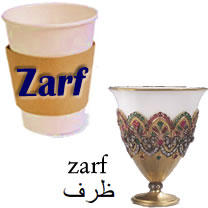
According to the podcast Something Rhymes with Purple, a zarf is the cardboard sleeve that goes around a cup of hot drink so you don’t burn your fingers when holding it. Or it’s any holder for a cup without a handle.

According to Wiktionary, a zarf is “An ornamental container designed to hold a coffee cup and insulate it from the hand of the drinker.”

It comes from the Ottoman Turkish ظرف‎ (zarf), from the Arabic ظَرْف‎ (ẓarf), which has a variety of meanings, including vessel, container, receptacle, metal saucer, box, pasteboard box, purse, bag, egg cup, envelope, case or cover [source].

More information about zarfs: https://en.wikipedia.org/wiki/Zarf

Modern zarfs are also known as coffee cup sleeves, coffee sleeves, coffee clutches, coffee cozies, hot cup jackets, paper zarfs, coffee collars, or cup holders. They were invented by Jay Sorensen in 1991, patented in 1995, have the trademarked name of Java Jacket and were first used in 1995 at the Seattle Coffeefest [source].

A useful word, and a great one for Scrabble.

Do you have any other names for zarfs?
Matutolypea

Matutolypea

Do you suffer from matutolypea?

If you do, then you are in a bad mood and easily annoyed, especially in the morning, or ill-humoured and downright obnoxious first thing in the morning [source].

An example of how to use it: “The secret is not to talk to him at all until he’s been awake for at least an hour. Wait till the matutolypea subsides.” [source]

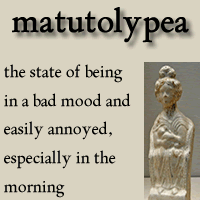
Matutolypea comes from the Latin Mātūta, the Roman goddess of morning or dawn [source] (pictured above), and the Greek λῠ́πη – lúpē (sadness, suffering, affliction) [source], so could also be translated as “dawn saddness”.

I learnt this word from an episode of the podcast Something Rhymes with Purple.

Those you suffer from matutolypea might be said to have got up on the wrong side of the bed or woken on the wrong side of the bed. According to a superstition that dates back to the Romans, the wrong side of the bed is the left side, as the left is associated with bad luck and is decidely sinister in Latin. The Roman emperor Augustus Caeser apparently always got up on the right side of bed beacuse of this superstition [source].

According to the Grammar Monster, “an ancient superstition that evil spirits lay on a certain side of the bed. A person who wakes up and gets out the “wrong” side of the bed disturbs the evil spirits and attracts their wrath, putting the person in a foul mood.”

Even though I get up on the left side of my bed every morning, as the right side is against a wall, I rarely suffer from matutolypea.

Are there any words, phrases or sayings in other languages about being miserable in the morning?

Up North & Out West

Directions

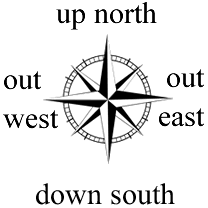
This week I learnt some interesting weather-related phrases in Swedish on Memrise, including norrut (up north / northward), söderut (down south / southward), österut (out east / eastward) and västerut (out west / westward).

Examples of how they are used include:

  • Upproret blir mer allmänt och går norrut = The rising is spreading and moving northwards
  • Enandet, som skedde i rätt tid, jämnar vägen för utvidgningen österut = This prompt agreement paves the way to enlargement eastward
  • Det blir regn västerut = There will be rain out west
  • Det klarnar nog upp söderut = It’ll probably clear up down south

Sources: bab.la, Memrise

In Swedish they all have the ut (out) in them, so more literal translations of norrut and söderut would be “out north” and “out south”, or even “north out” and “south out”.

These sound wrong in English, at least to my ears. To me north is up and south is down, so it makes sense to say up north and down south, although I’m not sure why we say out east/west. Does anybody know? Are there other ways to refer to directions?

In Irish, and other Gaelic languages, the words for directions change depending on whether you’re in the north, going north, coming from the north, and so on. For example:

  • tuaisceart = north, northern, ó thuaidh = north of / going north, aduaigh = from the north
  • deisceart = south, southern, ó dheas = south of / going south, aneas = from the south

More details

Do you scurryfunge?

Scurryfunge definition

If someone accused you of scurryfunging, would you have any idea what they were talking about?

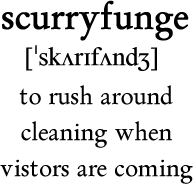
Scurryfunge is apparently an American dialect word meaning cleaning and tidying your house frantically before visitors arrive. That is according to the podcast Something Rhymes with Purple, which I discovered today. It’s a podcast about words and language by Gyles Brandreth and Susie Dent.

According to Definition Of, scurryfunge is an Old English word meaning “to rush around cleaning when company is on their way over”.

According to the Urban Dictionary, scurryfunge means “A hasty tidying of the house between the time you see a neighbor and the time he/she knocks on the door”, and comes from John Gould’s Maine Lingo: Boiled Owls, Billdads, and Wazzats, 1975.

According to Haggard Hawks, scurryfunge means “to hastily tidy a house”. It first appeared in written English in the late 18th century, and originally meant to beat or lash, and later to rub or scrub clean. By the early 20th century it was only used in a few regional dialects, and the meaning had changed a bit.

According to Wordfoolery, back in the 19th century scurryfunge meant “to scour for marine curiosities”, and is still used in Newfoundland.

According to Dictionary of Newfoundland English, scurryfunge means “to lash tightly; to do anything briskly; to work or walk hurriedly; to scrounge, cadge or wheedle; to clean thoroughly, scour; to scold, reprove”.

So now we know what it means, do you scurryfunge?

I do sometimes when I’m expecting visitors, but my house is usually reasonably tidy. Or at least any mess is confined to certain areas.

Are there similar words in other languages?

Spread

Imagine you’re driving through the English countryside and you get a bit lost. You might spread out a map to find out where you are, and when you reach your destination, you might decide to have a picnic, or a nice spread (meal).

After spreading out a rug, or even a bedspread, on the ground to sit on, you spread your legs a bit, then start spreading butter, cheese spread and other things on bread to make sandwiches.

After your picnic, maybe you and your companions spread out to explore the area. As you do so, you notice a farmer spreading muck on a nearby field, and another spreading seeds. You think they are growing genetically modified crops, and start spreading rumours about this. Before you know it the rumours turn into a double-page spread in the local newspaper, and you end up spreading fear and confusion.

The word spead can obviously be used in a variety of contexts and has various meanings. In French, however, there is a different word for most of these meanings:

  • étendre = to spread / open out (a towel, cloth, map)
  • écarter = to spread / strech out (arms, hands, legs)
  • étaler = to spread (butter, jam)
  • répandre = to spread (rumour, lies, fear, confusion, fertilizer)
  • propager = to spread (disease, infection)
  • disséminer = to spread (pollen, seeds)
  • échelonner = to spread (repayments)
  • répartir = to spread (wealth, workload)
  • se disperser = to spread out
  • le fromage à tartiner = cheese spread
  • le chocolat à tartiner = chocolate spread
  • une double page = a double-page spread
  • un repas = a spread (meal)
  • le couvre-lit = bedspread

Source: Reverso

Oxbows and Fossils

On an episode of the Talk the Talk podcast that I listened to today, they discuss fossil words or, as presenter Daniel Midgely calls them, oxbows, which is a rather poetic and fitting name from them.

An oxbow lake is a part of a river that has got cut off from the main stream due to the changing course of the river, and a fossil word or oxbow is one that’s only used in one or two expressions, and is no longer part of the main stream language.

Oxbows

Some examples they gave include kith and kin, to and fro, and akimbo, as in arms/legs akimbo.

Other examples of fossil words / oxbows include:

  • by dint of = because of, by means of – dint is an old word for a blow or stroke, force, power, or the mark left by a blow
  • in high dudgeon = indignant and enraged – dudgeon possibly comes from the Welsh dygen (anger, sad, grievous, painful, serious). A related words is the old Scots word humdudgeon, meaning an unnecessary outcry of complaint, or an imaginary illness
  • in fine fettle = in good condition, energetic – fettle is nothern English dialect word meaning one’s physical condition or mental state.
  • the whole shebang = everything, the entire thing – shebang might come from the French chabane (hut, cabin), or from the Hiberno-English shebeen (a cabin where unlicensed liquor is sold and drunk), from the Irish síbín (illicit whiskey).

Do you know others in English or other languages?

Time is pouring

This week I learnt the Russian expression до сих пор ― (do sikh por), which means still, hitherto, up to now, thus far, or literally “until this time”.

The пор comes from пора (pora – time, season, weather, period), which appears in such phrases as:

  • пора́ идти́ (pora idti) = it’s time to go
  • в са́мую по́ру (v samuju poru) = in the nick of time
  • до каки́х пор? (do kakikh por?) = how long?
  • с каки́х пор? (s kakikh por?) = since when?
  • до тех пор, пока́ (do tekh por, poka) = so long as
  • с тех пор, как (s tekh por, kak) = ever since
  • на пе́рвых пора́х (na pervykh porakh) = at first

Source: Wiktionary

It’s interesting that пора means both time and weather – some other languages also have one word for both: temps in French, amzer in Breton, aimsir in Irish. Do you know of others?

Treading in Spinach

Language quiz image

A few posts ago I wrote about an interesting Swedish idiom – trampa i klaveret – to make a social mistake, put one’s foot in it, or literally “to step heavily on the accordion”.

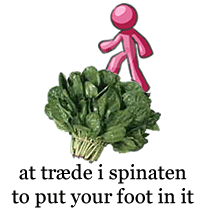
Today I learnt the Danish equivalenttræde i spinaten (“to tread in the spinach”). For example, jeg har virkelig trådt i spinaten (“I have really trod in the spinach”) = I really put my foot in it.

Accoriding to Den Danske Ordbog, træde i spinaten means “utilsigtet sige eller gøre noget dumt” (to accidentally say or do something stupid).

Another version is træde/trampe i spinatbedet (“tread/tramp in the spinach bed”) [source].

Then there’s the spinatfugl or “spinach bird”, which is apparently a person who writes reviews or other cultural material in a newspaper without a journalistic background [source].

Does anybody know why such a person is known as a spinach bird?

The word spinach comes from the Middle English spinach, from Anglo-Norman spinache, from the Old French espinoche, from the Old Occitan espinarc, from the Arabic إِسْفَانَاخ‎ (ʾisfānāḵ), from the Persian اسپناخ‎ (ispanâx).

Apparently spinach cinema refers to “Movies that are not very exciting or interesting, but that one feels one must see because they are educational or otherwise uplifting.” [source]

Are there any interesting spinach or other vegetable-related idioms in other languages?

Gender Matters

In languages with grammatical gender, such as Spanish and Swedish, gender matters and can sometimes lead to misundertandings if you get it wrong.

Some words may sound the same, but have different genders and different meanings. For example, in Swedish a team is ett lag (neuter) and a law is en lag (common gender).

I haven’t come across any other homographs like this in Swedish, but there probably are others. Do you known any more in Swedish or other languages?

I found some in Spanish, including:

  • el coma = coma; la coma = comma
  • el mañana = future; la mañana = morning
  • el moral = blackberry bush; la moral = morale, morality
  • el papa = pope; la papa = potato
  • el pez = fish; la pez = tar, pitch
  • el tema = subject; la tema = obsession

Other Swedish words I sometimes get muddled include: väg (path, road) and vägg (wall), and svart (black, dark) and svårt (hard).

So it’s not just gender that matters – accents and spelling are also important.

How do you learn the genders of nouns in languages with grammatical gender?

Shipping

Sailing ship

Recently I’ve noticed the word ship being used quite a lot in the comments on some videos on YouTube.

Here are some examples (from the comments on the video below):

  • “why do people have to ship every single person who collabs with another even when they’re in a relationship”
  • “is it okay to ship them or”
  • “I Dont Care. I Ship It.”

From the context I guessed that it means that the commenter thinks the people in the video are in a relationship, or could be, or would like them to be, and that ship is an abbreviation of relationship.

There are a variety of definitions of ship and to ship in the Urban Dictionary, including:

  • Ship, N. Short for romantic relationship, popularized in fanfiction circles.
  • A ship is when you put 2 people’s names together and want them to be in a relationship. Most commonly used among fandoms.
  • Ship – A couple. Two people one thinks should date, or likes that they do/did. Usually combines the two names to make a ship name, i.e.:John+Karen=Jaren.
  • ship (v.) to support or endorse a romantic paring that is not canon in the work(s) in which they appear. The shipping of couples is often the purpose of many fanfiction stories. Used for characters in anime, manga, video games, tv shows, etc.

A related words include: shippable – when someone can be shipped with many people. Shipping – the phenomenon of using these terms. Shipper – someone involved in shipping. Shipping war – when two ships contradict each other [source].

According to Dictionary.com, (to) ship can mean:

  • Ship = “a romantic relationship between fictional characters, especially one that people discuss, write about, or take an interest in, whether or not the romance actually exists in the original book, show, etc.”
  • To ship =”to discuss, write about, or take an interest in a romantic relationship between (fictional characters): I’m shipping for those guys—they would make a great couple!”

Apparently it was first noticed in 1995.

According to Wikipedia:

  • “Shipping, initially derived from the word relationship, is the desire by fans for two or more people, either real-life people or fictional characters (in film, literature, television etc.) to be in a romantic relationship. It is considered a general term for fans’ emotional involvement with the ongoing development of a relationship in a work of fiction. Shipping often takes the form of creative works, including fanfiction and fan art, most often published on the internet. However, shipping can involve virtually any kind of relationship- from the well-known and established, through the ambiguous or those undergoing development, and even all the way to the highly improbable and the blatantly impossible. It can be used as a friendship term.”

Do you use ship the ways described above at all?

Have you noticed others using it?

Are there equivalent words in other languages?