Are the words ford, fjord and port related? Let’s find out.
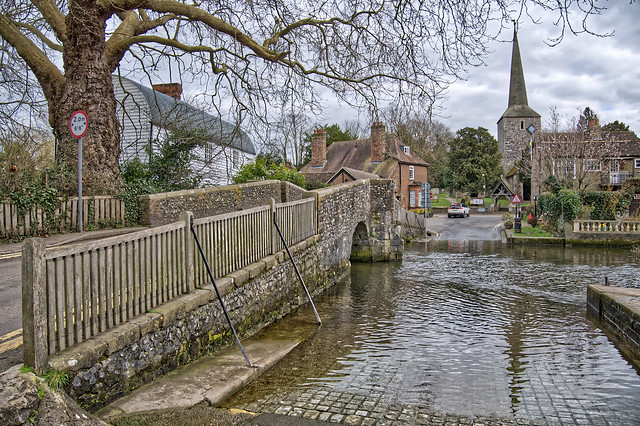
A ford [fɔːd / fɔɹd] is a location where a stream is shallow and the bottom has good footing, making it possible to cross from one side to the other with no bridge, by walking, riding, or driving through the water.
It comes from Middle English fōrd (ford, watering place, a spring, passage, path), from Old English ford (ford), from Proto-West Germanic *furdu (ford), from Proto-Germanic *furduz (ford), from Proto-Indo-European *pértus (crossing) [source].
Words from the same Proto-Germanic root include Förde (firth, fjord) and Furt (ford) in German, voorde (ford) in Dutch, ffordd (road, distance, way) in Welsh, and fordh (road, way, manner) in Cornish [source].

A fjord [ˈfiːɔːd / fiˈɔɹd] is a long, narrow, deep inlet between cliffs, and was borrowed from Norwegian.
The Norwegian word fjord [fjuːr] comes from Old Norse fjǫrðr (firth, fjord), from Proto-Germanic *ferþu(z) (inlet, fjord), from Proto-Indo-European *pértus (crossing) – so the same PIE root as ford, but a different Proto-Germanic root [source].
Words from the same Proto-Germanic root include fjörður (fjord) in Icelandic, fjørður (fjord, firth) in Faroese, fjord (firth, fjord, inlet) in Danish, and firth (an arm or inlet of the sea; a river estuary) in English [source].

Meanings of port [pɔːt / poɹt] include: a place on the coast at which ships can shelter, or dock to load and unload cargo or passengers; a town or city containing such a place, and the left-hand side of a vessel, including aircraft, when one is facing the front.
It comes from Middle English port (harbour, haven), from Old English port (port, harbour, haven, town, harbour town), from Latin portus (harbour, port, haven, refuge, warehouse), from Proto-Italic *portus (harbour), from Proto-Indo-European *pértus (crossing) – so the same PIE root as ford and fjord [source].
Words from the same PIE root include porto (port, harbour) in Italian, puerto (port, harbour) in Spanish, port (port) in French, and port (harbour, port, river bank, mound, refuge, haven) in Irish, porth (port, harbour, haven, estuary, landing-place) in Welsh and پل (pul – bridge, sound post) in Persian [source].