Mandarin or Putonghua?

Today I received an email in which the writer tells me that Chinese should be called Putonghua and not Mandarin. Apparently, “People don’t know, and school teachers don’t care! obviously; leaving me to inform: The name ‘Mandarin’ has been obsolete 105 years now.” The name Mandarin was used for a ‘Manchurian high official’ who spoke 官話 (official speech). However since the fall of the Manchurian Qing monarchy in 1911, “Mandarins dead as dodos” and to use the name Mandarin is “an affront to the republican nation”.

This language in fact has a number of different names in different countries and regions:

– 普通话 [普通話] (pǔtōnghuà) – “common speech” – in China
– 國語 (guóyǔ) – “national language” – in Taiwan
– 华语 [華語] (huáyǔ) – “Chinese language” – in the Philippines, Singapore, Malaysia, and the other parts of Southeast Asia.
– 汉语 [漢語] (hànyǔ) – “Han language” – in the USA and among the Chinese diaspora
– 中文 (zhōngwén) – “Chinese language” – in Taiwan, mainly
– Chinese, Mandarin, Mandarin Chinese, Putonghua, etc. in English-speaking countries
– Other names in other countries and languages

During the Ming (1368–1644) and Qing (1644–1912) dynasties, the language used by court officials became known as 官话 [官話] (guānhuà) – “official speech”. The word Mandarin comes from the the Sanskrit मन्त्रिन् (mantrin = counselor, minister) via the Portuguese mandarim. It was first used to refer to Chinese bureaucrats, and later it was used to refer to the language those officials spoke, which was used as a lingua franca of China from the 14th century.

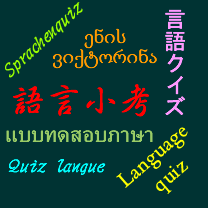
What is Mandarin / Putonghua / Chinese known as in other languages?
Source https://en.wikipedia.org/wiki/Standard_Chinese

Multilingual musicians

A Sardinian friend of mine, Elena Piras, knows six languages (Sardinian, Italian, English, Scottish Gaelic, French and Spanish) and sings in most of them, plus a few others, including Scots, Bulgarian and Georgian.

Here’s a recording of a performance from earlier this year in which she sings in Sardinian, Scots, English, Scottish Gaelic and Bulgarian.

Elena aims to sing each language in as close to a native accent as possible, and I think she does this very well.

Another multilingual singer is Jean-Marc Leclercq or JoMo, who holds the world record for singing in the most languages in one performance: 22. I heard him doing this at the Polyglot Gathering in Berlin in May this year. His pronunciation in the languages I know didn’t sound entirely native-like, and it sounded like he had a strong French accent in the other languages.

Do you know other singers who sing in multiple languages?

How well do they pronounce them?

I myself sing in various languages, and try to pronounce as well as I can, but know I could do better.

Here’s a recording of a song I wrote earlier this year in the five languages I know best (English, French, Welsh, Mandarin and Irish):

[soundcloud url=”https://api.soundcloud.com/tracks/204200300″ params=”auto_play=false&hide_related=false&show_comments=true&show_user=true&show_reposts=false&visual=true” width=”100%” height=”300″ iframe=”true” /]

Squibs and squabs

When an event is not very successful, you could say that it went off like a damp squib, or even a damp squid, as a friend mistakenly said last night.

A squib is obviously something that does not work properly when it’s wet, and I had an idea that it was some kind of explosive.

According to Reverso, a squib is:

1. a firework
2. a firework that does not explode because of a fault; dud
3. a short witty attack; lampoon
4. an electric device for firing a rocket engine
5. an insignificant person (obsolete)
6. a coward (Aus/NZ slang)

And a damp squib is “something intended but failing to impress”.

Etymology: probably imitative of a quick light explosion.

An unrelated, but similar-sounding word is squab, which is:

1. a young unfledged bird, esp. a pigeon
2. a short fat person
3. a well-stuffed bolster or cushion; a sofa
4. (of birds) recently hatched and still unfledged
5. short and fat

Etymology: probably of Germanic origin; compare Swedish dialect sqvabb (flabby skin), sqvabba (fat woman), German Quabbe (soft mass), Norwegian kvabb (mud)

Source: http://dictionary.reverso.net/english-definition/squab

Squib, squab and squid are all good words for Scrabble.

Are there equivalents of damp squibs in other languages?

Les mots de la semaine

français English Cymraeg
la fiche flash card cerdyn fflach
le dispositif d’écoute; le micro caché bug (listening device)
le bogue bug (computer) nam; diffyg
le virus; le microbe bug (germ) byg; clust
l’insecte (m); la bestiole bug (insect) pryf
mangeable edible (palatable) bwytadwy
comestible edible (safe to eat) da i’w fwyta
tremper to dunk gwlychu; trochi
trempé soaked gwlyb
trempé jusqu’aux os soaked to the skin gwlyb diferol; gwlyb diferol; gwlyb at y croen
un pétard mouillé damp squib matsien wleb
le pigeonneau squab (baby pigeon) cyw colomen
le fruit de l’imagination figment of the imagination dychmygu pethau; ffrwyth eich dychymyg

eesti keel

Last night I had an interesting chat with an Estonian student who is studying in Bangor about Estonia and the Estonian language. I knew a little about the language already, but realised that I didn’t know any words or phrases in Estonian, apart from its native name – eesti keel – and I wasn’t even sure how to pronounce that: [eːsti.keːl].

When I meet someone who speaks a language I haven’t studied, yet, quite often I know at least how to say hello or other phrases in their language, which usually impresses them, but I haven’t met any Estonians before, as far as I remember, and on this occasion I couldn’t think of a single word. I had an idea that hello was something like terve, but wasn’t sure – this is actually hello in Finnish. In Estonian it’s tere. So now I do know a few words in Estonian.

One thing we talked about was the number of Russian speakers in Estonia – they make up about 20% of the population – and the fact that Estonia is quite a good place to learn Russian. I have considered this, and if I were to do a Russian language course there, I would try to learn some Estonian as well.

Do you try to use whatever you know of a language when you meet someone who speaks it, even if you only know a word or two?

Wysinnwyg

The other day I listened to a programme on BBC Radio 4 with an unusual title – Wysinnwyg. When I first saw the title of immediately thought it was a Welsh word, although not one I’d come across before, and I tried to work out what it might mean. I couldn’t find it in any Welsh dictionary, so assumed it was a made-up word. After listening to the programme I realised it was a variation on wysiwyg (what you see is what you get), which also looks Welsh, and means “what you see is not necessarily what you get”.

There aren’t very many Welsh words that start with w, in fact, and many of them are loanwords from English. Here are some examples:

– waldio [ˈʊaldɪɔ] = to beat, to thrash
– wb [ʊb] / wbwb [ˈʊbʊb] = wi! oh! alas!
– wedi[ˈʊɛdɪ] = after
– wedyn [ˈʊɛdɨn] = afterwards
– weithiau [ˈʊɛɪθɪaɨ] = sometimes
– wele [ˈʊɛlɛ] = behold!
– wfft [ʊft] = fie! for shame!
– wfftian [ˈʊftɪan] = to flout
– wit-wat [ˈʊɪtʊat] = fickle
– wtio [ˈʊtɪɔ] = to boo
– wrth [ʊrθ] = by, with, to, compared with, because
– wy [ʊɨ] = egg
– wyneb [ˈʊɨnɛb] = face, surface
– wyth [ʊɨθ] = eight
– wythnos [ˈʊɨθnɔs] = week (eight-night)

Do you ever see acronyms or made-up words and think they are from a particular language? Or see words in one language and think they’re really from another language?

Whenever I see words with w’s and y’s and double l’s I think of Welsh. So Amarillo looks like a Welsh place name to me.

Les mots de la semaine

français English Cymraeg
la charnière; le gond hinge colyn; colfach; crogfach
le pot-de-vin bribe llwgrwobrwy; llwgrwobr; cil-dwrn
acheter; soudoyer; offirir des pots-de-vin to bribe llygru; prynu; llwgrwobrwyo; rhoi cil-dwrn
la corruption; la subornation bribery llwgrwobrwyaeth; llwgrwobrwyad
la corruption corruption llygredd; llygredigaeth
corrompu(e) corrupt (person) llygredig; llwgr
corrompre to corrupt llygru; difetha
le robinet à flotteur ball-cock tap pelen
l’accent (m) emphasis (vocal stress) pwyslais; pwys
le mot composé compound word gair cyfansawdd; cyfansoddair
le mot-valise portmanteau word cyfansoddair cywasgedig

New languages to learn?

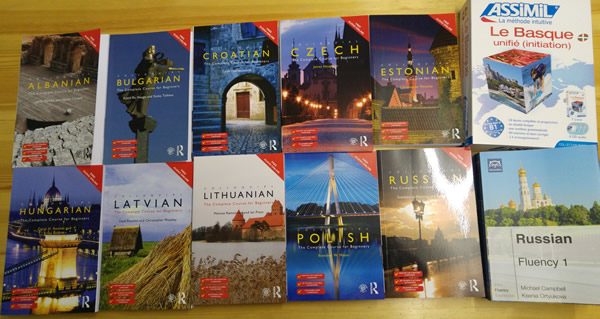
Recently I have acquired quite a few new language courses: as a sponsor of the Polyglot Conference in New York I received 10 new Colloquial language courses in Albanian, Bulgarian, Croatian, Czech, Estonian, Hungarian, Latvian, Lithuanian, Polish and Russian. I also bought a Glossika Russian course with the special offer given to conference participants, and bought a Basque course from Assimil with affiliate commission from Amazon France.

My new language courses

I learnt a little Hungarian many years ago, and am currently working on Czech and Russian, but haven’t studied any of the other languages before. I’d love to know at least the basics of all of them, though have no particular need or desire to learn them at the moment. Also, I already have courses in a number of languages that I have only glanced at so far – Arabic, Norwegian, Swedish, Scots and Cornish.

Do you sometimes get carried away with acquiring language courses and other materials?

Do you think you will get round to learn all those languages one day?