Gàidhlig

This month I am focusing mainly on improving my Scottish Gaelic (Gàidhlig). I’ve been listening to Gaelic radio, reading various things in Gaelic, writing and recording things every day in Gaelic on my other blog, and speaking and singing to myself in the language. I plan to make another animation in Gaelic sometime this month (you can see the first one I made on YouTube), and will make one in Irish soon as well. I might even try to write a song in Gaelic. I have yet to meet with any other Gaelic speakers or learners round here, but hope to find some who are willing to chat with me.

I’m really enjoying it and I think that Gaelic is one of my favourite languages at the moment – I particularly like the sounds of the language, and the more I learn it, the more I like it. I have no practical reasons for learning it, and this doesn’t bother me in the slightest. I would like to become as fluent in Scottish Gaelic as I am with Irish and Welsh, and if this takes longer than a month, I will continue with it and not switch my focus to another language at the end of this month.

Are you learning, or have you learned, any languages just because you like the sound of them, or because you find them interesting?

Mouth to mouth with the night

I discovered an interesting idiom in Scottish Gaelic today: beul ri beul na h-oidhche, which means near nightfall, or literally “mouth to mouth with the night”. Are there interesting expressions in other languages for different times of the day?

The word beul /bial̪ˠ/ means mouth; beginning; opening; edge; gunwale, and in found in such expressions as:

  • beul an latha = daybreak
  • beul na h-oidhche = nightfall, dusk
  • eadar beul-oidhche is beul-latha = from dusk till dawn
  • beul-aithris = folklore, oral tradition
  • am beul a’ bhaile = on everyone’s lips (“in the mouth of the town”)
  • beul air gualainn = blabbermouth, without reticence, not to hold back (“mouth on shoulder”)
  • beul fo bhonn = upside down (“mouth under sole”)
  • beul gun phutan = chatterbox, blabbermouth, unable to keep a secret (“a mouth without a button”)
  • port á beul = lilting, mouth music

Source: Am Faclair Beag

Gleann Cholm Cille

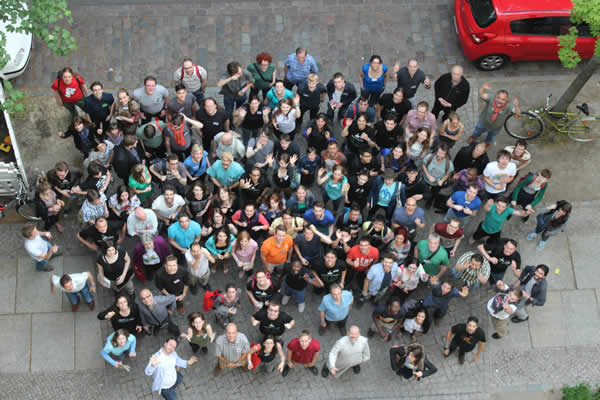
This week I’m in Gleann Cholm Cille in Donegal in the north west of Ireland taking part in the summer school in Irish language and culture at Oideas Gael. There are about 100 people here for the summer school and we have Irish language classes in the mornings and can choose from a variety of activities in the afternoons including singing, dancing, hill walking, drama and cooking. I’m doing the sean-nós singing in the afternoons and am really enjoying it.

In the evenings there are concerts, talks and other events. Last night, for example, there was a concert featuring songs and stories in Irish, hip hop in English (with a strong Dublin accent), and songs in Choctaw, as well as sean-nós dancing. It was a very unusual combination, but worked very well.

My Irish has definitely improved since I was here last year. My focus on Irish this month has helped a lot – I’m still writing something every day on my other Multilingual Musings blog while I’m here.

As well as hearing and speaking a lot of Irish, I’ve also had opportunities to speak German, French, Scottish Gaelic, Czech and Portuguese. People come here from all over the world and speak, and have studied / are studying, a variety of languages, so it’s a kind of paradise for polyglots.

Archerien

An interesting word that came up in my Breton lesson today is archerien, which means police. It caught my attention because it has no obvious connection to the word police, and because it is completely different to the equivalent words in other Celtic languages:

– Welsh: heddlu (“peace force”)
– Cornish: kreslu (“peace host”)
– Irish: gardaí (síochána) (“guards of peace”); póilíní
– Manx: meoiryn shee (“peace keepers/stewards”); poleenyn
– Scottish Gaelic: poileas

The English word police comes from the French police (public order, administration, government), from the Latin polītīa (state, government), from the Greek πολιτεία (politeia – citizenship, government, administration, constitution). It is shares the same root as policy, politics, politician and various other words [source].

Many languages use variants on the word police, e.g. Politsei (Estonian), პოლიცია (polits’ia – Georgian), Polizei (German), पुलिस (pulis – Hindi), پلیس (pulis – Persian), Booliis (Somalia), Policía (Spanish), Pulis (Tagalog), but some do their own thing:

– Bavarian: Kibara
– Chinese: 警察 (jǐngchá); 公安 (gōng’ān)
– Faroese: Løgregla
– Greek: Αστυνομία (Astynomía)
– Hungarian: Rendőrség
– Icelandic: Lögregla
– Japanese: 警察 (keisatsu)
– Korean: 警察 (gyeongchal)
– Thai: ตำรวจ (tảrwc)

Are there other examples of languages with a word unrelated to police for police?

Tag questions, innit!

Tag questions or question tags are interrogative fragments (tags) added to statements making them into sort of questions. They tend to be used more in colloquial speech and informal writing than in formal writing, and can indicate politeness, emphasis, irony, confidence or lack of it, and uncertainty. Some are rhetorical and an answer is not expected, others invite a response.

In English they come in various forms, for example:

– I like coconut, don’t I?
– You’re tall, aren’t you?
– He’s handsome, isn’t he?
– She said she’d be here, didn’t she?
– It’ll rain tomorrow, won’t it?
– We were away, weren’t we?
– You’d gone, hadn’t you?
– They’ll be there, won’t they?

A simpler tag question used is some varieties of English in innit, a contraction of isn’t it, which could be used for all the examples above. Other English tags include right? and eh? – do you use any others?

Tag questions in Celtic languages can also have quite complex forms which depend on the verb and the subject in the main clause, particularly in Welsh.

Manx
T’eh braew jiu, nagh vel? (It’s fine today, isn’t it?)
Hie ad dys y thie oast riyr, nagh jagh? (They went to the pub last night, didn’t they?)
Bee oo goll magh mairagh, nagh bee? (You’ll go out tomorrow, won’t you?)

Irish
Tá sé go breá inniu, nach bhfuil? (It’s fine today, isn’t it?)
Chuaigh siad go dtí an teach tábhairne aréir, nagh ndeachaigh? (They went to the pub last night, didn’t they?)
Beidh tú ag dul amach amárach, nach bheidh? (You’ll go out tomorrow, won’t you?)

Scottish Gaelic
Tha i brèagha an diugh, nach eil? (It’s fine today, isn’t it?)
Chaidh iad dhan taigh-òsta an-raoir, nagh deach? (They went to the pub last night, didn’t they?)
Bidh thu a’ dol a-mach a-màireach, nach bi? (You’ll go out tomorrow, won’t you?)

Welsh
Mae’n braf heddiw, on’d ydy? (It’s fine today, isn’t it?)
Mi aethon nhw nhw’n mynd i’r dafarn neithiwr, on’d wnaethon? (They went to the pub last night, didn’t they?)
Fyddet ti’n mynd allan yfory, on’ fyddet? (You’ll go out tomorrow, won’t you?)

I’m not sure about how tag questions work in Breton and Cornish.

In other languages things can be simpler:

– Czech: že?
– French: n’est-ce pas? non?
– German: nicht wahr? nicht? oder?
– Italian: no? vero? (positive), non è vero? (negative)
– Polish: prawda? (positive), nieprawdaż? (negative)
– Russian: да? (da?)
– Spanish: ¿no? ¿verdad?

Can you provide other examples?

Gaelic

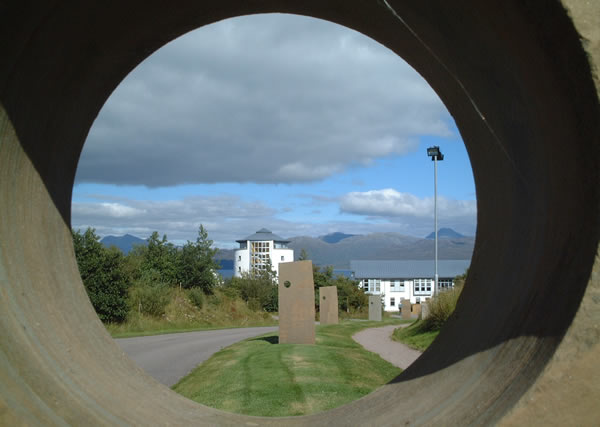
Sabhal Mòr Ostaig, the Gaelic college on the Isle of Skye

While I was in Scotland last week I took part in conversation circles in the evenings after class. Among those attending there were some whose Scottish Gaelic was very fluent, others who struggled to put sentences together, and people like me who are somewhere in between. I could understand almost everything people said and could contribute to the conversation, though tended to make mistakes and mix in bits of Irish when I didn’t know the Scottish Gaelic equivalents. Fortunately this wasn’t a problem as some people there spoke Irish and provided corrections where nessecary.

I’ve never done classes in Scottish Gaelic, but have been learning bits and pieces for many years, and listening to Gaelic radio programmes regularly. I rarely have opportunities to speak the language, so it was very helpful to take part in the conversation circles, and especially to listen to the fluent speakers. When I had conversations with less fluent speakers they were fairly short and simple, and they tended to switch to English after a while. With fluent speakers conversations tended to be much longer and more complex, and they stuck to Gaelic almost all the time, which really encouraged me to do the same.

While my Scottish Gaelic still needs quite a bit of work, I feel a lot more confident about speaking it now and will see about arranging Gaelic conversations on Skype, and to writing more stuff in Gaelic on my other blog.

One thing I still find difficult is understanding the words of songs. If I really concentrate I can understand some of the words, but I have to hear a song many times in order to understand more. It also helps to see the written lyrics. It’s simliar for songs in other languages, especially if the singers slur the words together.

Can you understand songs in languages you’re learning? Do you understand them the first time you hear them, or do you need to hear them many times.

Cuddies

An interesting Scots word I came across this week was cuddy which means coalfish or donkey and featured in the English translation of a Gaelic song. From the context I knew it was some kind of creature, but which one I wasn’t sure.

According to the Scots Language Centre website cuddy is a Scots word meaning donkey, a foolish person, a saw horse or a vaulting horse. A Scotch cuddy is a pedlar.

Another word that came up that was new to me was gaberlunzie /ɡæbərˈlʌnji/, an old Scots word for a licensed beggar who would seek fees to pray for the souls of other people [source].

Have you come across these words before?

Scottish adventures

I’ve been in Scotland since last Saturday, mainly at Sabhal Mòr Ostaig, the Gaelic college on the Isle of Skye. I’m doing a course in Gaelic mouth music (puirt à beul) and waulking songs (òrain luaidh) with Christine Primrose, and am having a wonderful time.

There are eight of us in the singing class – some from Scotland, some from England, one from Japan and one from Sardinia. The ones from Japan and Sardinia are both professional singers, and earlier today we were treated to some lovely songs from Okinawa, which sound quite similar to Irish traditional songs.

I’ve been speaking quite a bit of Scottish Gaelic, and find that I can now understand most of what I hear in Gaelic and have relatively complex conversations – so my Gaelic has improved a lot since I was last here four years ago. When I don’t know how to say something in Scottish Gaelic I try saying it in Irish and it’s usually understood, though not always.

I’ve also spoken some French, German, Czech and Welsh here, and quite a bit of Japanese. My Japanese is very rusty, but it’s starting to come back. It’s great to have opportunities to speak so many languages 🙂

Spòg

I came across the Scottish Gaelic word spòg (foot) in a song I learnt today and it caught my attention because I heard it a couple of weeks ago when I was in Ireland being used to mean foot in English. I thought it might be a Irish word, but didn’t get round to checking.

In Scottish Gaelic spòg /sbɔːg/ means claw, talon, hand, radius, spoke, paw or leg. It is also used for the hands of a clock: spòg an uaireadair.

I can’t find spog in any of the Irish dictionaries I’ve checked, so maybe it’s a word used in Hiberno-English, but which is no longer used in Irish. The usual word for foot in Irish is cos, which also means leg.

Have any of you come across the word spog before?

Gleann Cholm Cille

I returned to Bangor from the Isle of Man yesterday after a very enjoyable week at Yn Chruinnaght. I spoke and sang lots of Manx, and heard all the other Celtic languages, except Breton, being spoken and/or sung. I also spoke a bit of French and German, and even some English.

I was even inspired to write a new song while I was there, which is even sillier than my previous efforts.

Today I arrived in Gleann Cholm Cille for the Summer School in Irish language and Culture at Oideas Gael, so am now switching to Irish mode. During the week I’m here blog posts, up-dates on Omniglot and replies to emails might become somewhat sporadic.