
Filipino is the national language of the Philippines, the main lingua franca, and the official langauge, along with English. It is defined by the Commission on the Filipino Language (Komisyon sa Wikang Filipino in Filipino / KWF) as "the native language, spoken and written, in Metro Manila, the National Capital Region, and in other urban centers of the archipelago." [source].
is generally used as an alternative name for Tagalog, or specifically for the Metro Manila dialect of Tagalog.
Tagalog was chosen as the basis for the national language (Wikang Pambansâ) as it is the most widely spoken and undertood language in the Philippines, it has a rich and extensive literature, and it is the language of Manilia, which has a long history as the political and economic centre of the Philippines.
The Institute of National Language proposed Tagalog as the basis of the national language of the Philippines in 1937. It was officially declared an official language by the Philippine National Assembly in 1940, with the intention of adopting it as such in 1946.
Since 1978, Filipino has been used as the language of instruction in schools and universities throughout the Philippines, though English is widely used as well.
The Filipino alphabet has undergone a number of changes over the years. The last major one was in 1987, when the digraphs ch, ll and rr were removed from the alphabet. The alphabet was last revised in 1987.
The Abakada alphabet for Filipino was adopted in 1939 by the then Institute of National Language (Surian ng Wikang Pambansa) and the National Commission on Culture and the Arts (Pambasang Komission Para sa Kultura at mga Pambasa). Since then it has been revised a number of times and renamed the Filipino alphabet (alpabetong Filipino).
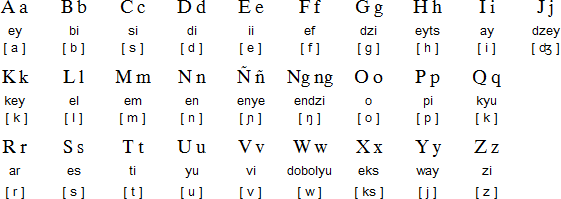
Download an alphabet chart for Filipino (Excel)
Ang lahat ng tao'y isinilang na malaya at pantay-pantay sa karangalan at mga karapatan. Sila'y pinagkalooban ng katwiran at budhi at dapat magpalagayan ang isa't isa sa diwa ng pagkakapatiran.
Ang lahat ng tao ay ipinanganak na malaya at parepareho sa dignidad at mga karapatan. Sila ay binigyan ng katwiran at konsensiya at dapat makitungo sa isa't isa sa espiritu ng pagkakapatiran.
Translated by Eugene Carmelo C. Pedro
All human beings are born free and equal in dignity and rights. They are endowed with reason and conscience and should act towards one another in a spirit of brotherhood.
(Article 1 of the Universal Declaration of Human Rights)
Information about Filipino | Tower of Babel
Information about the Filipino language
http://en.wikipedia.org/wiki/Filipino_language
https://en.wikipedia.org/wiki/Filipino_alphabet
https://en.wikipedia.org/wiki/Abakada_alphabet
https://en.wikipedia.org/wiki/Filipino_orthography
https://tl.wikipedia.org/wiki/Wikang_Filipino
https://tl.wikipedia.org/wiki/Palabaybayan_ng_Filipino
Komisyon sa Wikang Filipino (Commission on the Filipino language)
http://www.kwf.gov.ph
Aborlan Tagbanwa, Agutaynen, Bantik, Bikol, Blaan, Buhid, Bukid, Buol, Calmian Tagbanwa, Casiguran Dumagat Agta, Central Tagbanwa, Gorontalo, Hanuno'o, Iranun, Iraya, Isinai, Isnag, Kagayanen, Kalanguya, Kapampangan, Klata, Maguindanao, Mamanwa, Manide, Maranao, Matigsalug, Molbog, Mongondow, Obo, Palawano, Ponosakan, Ratahan, Rinconada Bikol, Sangirese, Sarangani, Suwawa, Tagalog, Tagabawà, Talaud, Tawbuid, Tboli, Tiruray, Tombulu, Tondano, Tonsawang, Tontemboan, Umiray Dumaget, Western Bukidnon Manobo, Western Subanon
Languages written with the Latin alphabet
Page last modified: 01.10.25
[top]

Note: all links on this site to Amazon.com


You can support this site by Buying Me A Coffee, via PayPal or Patreon, or by contributing in other ways.
If you find all the adverts annoying, there is now an Ad-free version of Omniglot which you can access for a small monthly or annual donation.

This website and its content is copyright of Simon Ager - © Simon Ager 1998-2026. All rights reserved. All images were created by me, unless otherwise indicated. More details

[top]


