| français | English | Cymraeg |
|---|---|---|
| la plance à laver | washboard | (y)styllen olchi; bwrdd sgwrio; golchwr |
| la caisse à thé | tea chest | cist de |
| le trouble des apprentissage | learning difficulties | anawsterau dysgu |
| la baleine | whale | morfil |
| la nageoire | fin | asgell |
| l’aurore boréale | aurora borealis | gwawl y Gogledd; goleuni’r Gogledd |
| le bougeoir; le chandelier | candlestick | canhwyllbren |
Cigire or Cigydd? Cross-language confusion
Last week in Ireland on the last night of the course each class played some tunes, did a sketch, sang songs, and/or did some other party piece. One of the Irish language classes did a sketch about a bunch of unruly school kids whose class was being visited by an inspector, played by Paul Kavanagh, Irish Ambassador to China. When the inspector turned up and he introduced himself as a “cigire scoile” (school inspector), and I processed the word cig in cigire as the Welsh word for meat. So at first I thought he was the school butcher, which would be cigydd ysgol in Welsh, though that made no sense in the context. I soon realised that he was an inspector, but it took a while for my mind to accept that word cigire had nothing to do with meat.
Incidentally, the Irish word for butcher is búistéir or feolaire, and feoil is meat.
Do you ever suffer from cross-language confusion?
Cruite, cláirseacha a chrythau
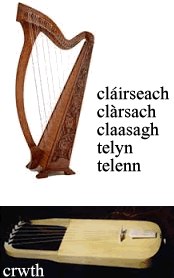
I discovered last week in Ireland that one word for the harp in Irish is cruit [krutʲ], which sounds similar to the Welsh word crwth [kruːθ], a type of bowed lyre that was once popular in Wales and in other parts of Europe, but which was largely displayed by the fiddle during the 18th century.
The word crwth from a Proto-Celtic word *krotto- (round object) and refers to a swelling or bulging out, of pregnant appearance, or a protuberance. The Irish word cruit comes from the same root and refers to small harps or lyres. The equivalent English word, which was borrowed from Welsh is crowd, which is also written crwd, crout or crouth, and in Medieval Latin such an instrument was called a chorus or crotta. The English surnames Crowder and Crowther, which mean a crowd player, and the Scottish names MacWhirter and MacWhorter also come from the same root [source].
The more common word for harp in Irish is cláirseach. In Scottish Gaelic the words cruit and clàrsach are used, with the latter being the most common, and in Manx we have claasagh and cruitçh. The Welsh word for harp is telyn, which has an equivalent in Manx – tellyn (Welsh harp). The Cornish word for harp is the same as the Welsh, and the Breton word is telenn.
Language quiz
Here’s a recording in a mystery language.
Can you identify the language, and do you know where it’s spoken?
Oideas Gael
I’m having a wonderful time in Gleann Cholm Cille learning to play the harp and speaking plenty of Irish. The course is going really well – we started with basic techniques, and have learnt a number of tunes, including some from the Bóroimhe / Brian Boru suite by Michael Rooney.
I’ve videoed our teacher, Oisín Morrison, playing all the pieces we’ve learnt so far, and he’s going to give us some more pieces to learn at home.
People come here from all over the world on holiday and to do courses at Oideas Gael – this week you can do Irish language classes, harp playing, or hill walking – so there are opportunities to speak quite a few languages, including French, German, Swedish, Mandarin, Dutch and Scottish Gaelic. I’ve even learnt a bit of Serbian from a Bosnian woman who is studying Irish here.
Language quiz
Here’s a recording in a mystery language.
Can you identify the language, and do you know where it’s spoken?
Les mots de la semaine
| français | English | Cymraeg |
|---|---|---|
| l’onde / le vague de chaleur | heatwave | ton wres; poethdon |
| le marché | bargin (deal) | bargen |
| faire un marché | to make a bargain | taro bargen; dod i delerau |
| faire le (la) difficile | to drive a hard bargain | bargeinio’n galed; taro bargen galed |
| l’affaire (f) | bargain (good buy) | bargen |
| C’était une (bonne) affaire | it was / they were a (good) bargain | roedd yn fargen dda |
| marchander | to bargain (haggle) | bargeinio |
| négocier; traiter | to bargain (negotiate) | bargeinio |
| la rampe | handrail (on stairs) | canllaw |
| la balustrade | rail (on bridge or balcony) | canllaw |
| la tringle | (curtain) rail | ffon llen; ffon cyrten |
| l’armoire (f) | wardrobe (cupboard) | wardrob; cwpwrdd dillad; dilladfa |
| la garde-robe | wardrobe (clothes) | dilladau; gwisgoedd |
| l’assiette (f) anglaise | cold meat/cuts | cig mân |
| la gencive | gum (part of mouth) | deintgig |
| le bilan de santé | (medical) check-up | archwiliad (meddygol) |
| l’arête (f) | ridge (of mountain; roof) | trum; crib; cefn |
| le diplômé (d’université) | (university) graduate | gŵr gradd; merch radd; graddedig |
| le chouchas | jackdaw | jac-do; jac-y-do; cogfran |
| la cacahuète | peanut | pysgneuenl; cneuen ddaear/fwnci |
| le frein à main | hand-brake | brêc llaw |
| le roulement de tambour | drum roll | sŵn drwm; dadwrdd drwm; tabyrddiad |
Gleann Cholm Cille
Tomorrow I’m off to Oideas Gael in Gleann Cholm Cille in Donegal in the north west of Ireland to do a course in harp playing. This will be the tenth time I’ve been there, though the first time I’ve done the harp course. Normally I go for a summer school in Irish language and culture where I do Irish language classes in the mornings and sean-nós singing in the afternoons.
The Irish language classes, at least the advanced level ones I do, tend to focus on using Irish to learn about and discuss things such as culture, politics, religion, and so on, which is interesting, though as my main interest is Irish music and songs, I’d prefer to concentrate on the singing, or singing and making music. Unfortunately they don’t offer sean-nós courses on their own, so I thought I’d do the harp course this year.
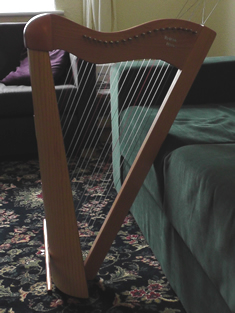
At the summer school last year a number of people mentioned the harp course and said how good it was, or that they were planning to take it, and this got me thinking about trying it myself. I’ve wanted to learn the harp for a long time, and earlier this year I bought myself a small harp from Pedran Harps (pictured top right), which I really enjoy playing.
Each time I go to Ireland my Irish (Gaelic) gets a bit better. I rarely get to speak it at other times, but keep it ticking over by listening to Irish language radio and reading Irish books and other material. I think the harp course will be taught in English, unless all the participants speak Irish, so I won’t use much Irish in class. Outside class I’ll speak Irish as much as possible. I’ll probably get to speak a few other languages as people from all over the world do the courses in Gleann Cholm Cille.
International Conference ICT for Language Learning
Here is a conference that might be of interest to you: International Conference ICT for Language Learning.
It takes place in Florence in Italy from 13-14 November 2014, and will bring together teachers, researchers, practitioners and project managers from all over the world to share findings, expertise and experience about integrating innovative technologies and solutions into language teaching and learning.
The conference will also be an opportunity for sharing results achieved in language learning projects funded by the European Commission and by other sources.
Topic areas are intentionally broad to encourage a wide range of backgrounds, ideas, and discussions.
They are currently calling for papers, and the deadline for submission is the 4th August.
Ultracrepidarianism
Are you an ultracrepidiarianist? Or maybe that should be ultracrepidiarian. Many of us are. An ultracrepidarianism is someone who makes a habit of giving opinions and advice on matters outside their knowledge or competence. It’s a word I came across in Think Like a Freak, and interesting book by Steven D. Levitt and Stephen J. Dubner.
According to Wikipedia, ultracrepidarianism first appeared in a letter by William Hazlitt in 1819. It comes from a comment by an ancient Greek artist, Apelles, made to a cobbler who criticised one of his paintings. First the cobbler criticised one of the sandals in painting, then other parts of the painting. According to Pliny, Apelles said to the cobbler “Sutor, ne ultra crepidam” (‘Cobbler, not beyond the sandals’). Related sayings are found in English: “A cobbler should stick to his last*”; Dutch: “Schoenmaker, blijf bij je leest”; and German: “Schuster, bleib bei deinem/deinen Leisten”.
According to World Wide Words, crepidam derives from Greek krepis (shoe), and crepidarian is a very rare adjective meaning “pertaining to a shoemaker”.
* A last is “A shoemaker’s model for shaping or repairing a shoe or boot.” [source].