
Here’s a recording in a mystery language.
Can you identify the language, and do you know where it’s spoken?
Here’s a recording in a mystery language.
Can you identify the language, and do you know where it’s spoken?
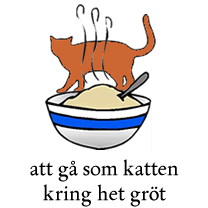
What connection is there between cats and porridge?
Well in Swedish, att gå som katten kring het gröt (“to walk like the cat around hot porridge”) means that you are not getting to the point, beating around the bush, stalling, avoiding talking directly about something sensitive or unpleasant, approaching something indirectly and cautiously, walking on egg shells, pussyfooting around, or wasting time.
Some examples of how this phrase is used:
Source: bab.la
Similar idioms involving cats and porridge are found in a number of other languages:
These are all equivalents of to beat around the bush.
The English idiom to beat around the bush was first used in writing in 1572, and referred to the practise of beating bushes in order to flush out game animals [source].
Sources: Idioms of the world, Reverso
Do you know other cat- or porridge-related idioms?

This week I finally completed the Spanish course on Duolingo. I’ve been using it to improve and refresh my Spanish, as I have studied the language with various courses before. I can now understand, read, write and speak a lot more Spanish than before, though need to practise speaking and writing it more.
I first took a placement test on Duolingo to see how much Spanish I already knew, and didn’t start from the beginning. Then I skipped through each level using the tests, rather than working through each lesson individually. Had I done that, it would take a lot longer. For now, I’m not studying Spanish actively anymore, but will use it whenever I get the chance.
Over the past two and a half years or so, I’ve studied languages every day with Duolingo (current streak = 767 days). I’ve completed courses in Spanish, Russian, Swedish, Danish and Esperanto. I also completed the Romanian course, then they added lots of extra levels, and I haven’t gone back to work on those. At the moment I’m focussing on Czech, and will continue to do so, working through every lesson, so it’s going to take quite a while. I don’t plan to start any other languages until I’ve finished the Czech course.
In the meantime, I’ve also been studying Czech, and Russian, on Mondly – Czech for 226 days and Russian for 153 days. I really like their courses and am learning a lot from them.
On Memrise I’m studying Russian, Danish and Swedish. When I started using Memrise nearly two years ago, I already knew some Russian and Swedish. and started Swedish from level 2. I started Danish last year from scratch, although my knowledge of Swedish, and German and English, certainly helps. I’m currently doing level 6 courses in Swedish and Danish, and level 5 in Russian.
By the way, if you sign up to Memrise by 16th September, you will get a 50% discount, and I’ll get a small commission.
I find these apps with the streak counters really encourage me to study every day. It has become a habit to do so, and one I plan to continue for as long as possible.
Apart from these studies, I keep my French and Welsh ticking over by speaking them regularly, and other languages by using them occasionally.
How are your language studies going?
Do you prefer to focus on one language at a time, or to learn two or more simultaneously?
What courses, apps and other resources do you use?
Here’s a recording in a mystery language.
Can you identify the language, and do you know where it’s spoken?
Another dog-related idiom that came up this week was dog-eared which is often used to refer to books with pages that are bent, somewhat ragged and or with the corners turned down.
The equivalent in French is écorné which means dented, dog-eared, tatty or thumbed. It comes from the verb écorner, which means to remove the horns of; dehorn, to chip or dent, to dog-ear, or to turn down the corner of [source].
As a bibliophile it pains me to see un livre écorné (a dog-eared book), and I never turn down the corners of pages, or write notes in the margins, crack the spines, or overwise harm books. It just feels wrong. Some of my books have become a bit dog-eared, however, due to being read many times.
When I was trying to think of a way to describe a particularly dog-eared French dictionary, the first phrase that came to mind was that it was a bit badgered. I thought I’d read about things being badgered in this way somewhere, possibly in one of Terry Pratchett’s books*, but the person I was talking to had never heard it.
Then I came up with foxed, which means “of paper, having yellowish-brown stains”, according to Wiktionary. This wasn’t quite the expression I was looking for either. Then we settled on dog-eared.
The verb to badger, meaning to annoy persistently or persuade through constant efforts, does exist [source], so people might be badgered, but does anybody use badgered to describe a book or something else that looks like it’s been attacked by badgers?

*The book is Guards! Guards! and the quote is “The Summoning of Dragons. Single copy, first edition, slightly foxed and extremely dragoned.” – so not badgered after all.
When it’s raining heavily and the weather is particularly unpleasant, it is known as hondenweer [ˈɦɔn.də(n)ˌʋeːr] (“dog weather”) in Dutch, as you would only go out in it if you had to walk your dog.

This is a phrase I learnt last week from a Dutch friend. According to Wiktionary it means “particularly bad or rough weather, the kind of weather when it is raining cats and dogs”.
The equivalent in French is temps de chien [tɑ̃ də ʃjɛ̃] (“dog weather”), which refers to filthy, dreadful or awful weather [source].
If the weather is even worse, you might say that it’s weer om geen hond door te sturen (“weather through which not to send any dog”) [source]. There is an equivalent in English: I wouldn’t send a dog out in this.
Are there any interesting dog-related expressions in other languages?
Here’s a recording in a mystery language.
Can you identify the language, and do you know where it’s spoken?
My course at Sabhal Mòr Ostaig finished today, and I’ll be leaving tomorrow. I’ll stay at my Mum’s for a few days on the way home, and should be back in Bangor next Monday.
The course has been a lot of fun, and Joy Dunlop is a really good teacher. She’s strict about getting the pronunciation right, which is important, and uses interesting ways to describe the particular sounds of Scottish Gaelic. If we all knew phonetics and the IPA, it would be much easier.
We learnt 16 songs altogether in 5 days, which is plenty – in previous years here we’ve learnt over 30 songs in a week, which was maybe slightly too many. I like all the songs we did this time, and plan to continue singing at least some of them.
There were 16 of us in the class, although not everyone was there every day. I already knew some of the people from other courses I’ve done here, and it was nice to see them again, and to meet new people. Most were from Scotland, and other parts of the UK, plus two from Ireland, one from France and one from the Netherlands. We got on well together, and I think singing together is a great way to bond.
The class was taught mainly in English, with some bits of Scottish Gaelic now and then, and only a few of us speak much Gaelic. Outside the class I got to speak quite a bit of Gaelic with people who were studying and working here. I also spoke some French, Irish and Dutch.
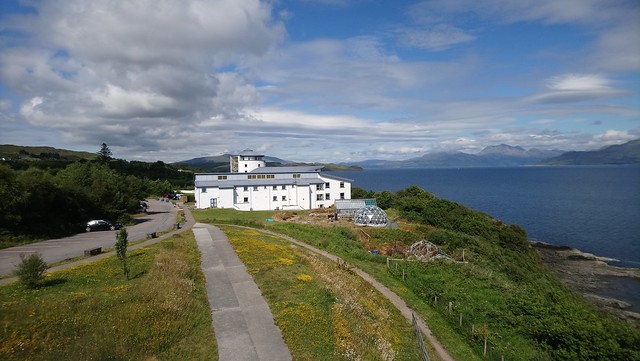
Here are a few photos and videos from this year and previous years at Sabhal Mòr Ostaig:
Here’s a recording in a mystery language.
Can you identify the language, and do you know where it’s spoken?
This coming week I will be at Sabhal Mòr Ostaig, the Gaelic college on the Isle of Skye, doing a course in Argyll Gaelic Song / Òrain Earra-Ghàidheal with Joy Dunlop. I think this is the eighth time I’ve been to the college, and I’m looking forward to it very much.
Tonight I’m staying in Glasgow, and tomorrow I’ll get the train along the West Highland Line to Mallaig, a very scenic journey, the ferry to Armadale, and then hopefully there’ll be a bus to the college.

On the train from Glasgow to Crookston, the suburb of Glasgow where I’m staying, I heard some Italian tourists talking to the guard. They didn’t seem to speak much English, and they had the wrong tickets, or they’d got on the wrong train. They asked the guard in Italian if he spoke Italian, and fortunately for them he did. It sounded to me like his Italian was very fluent, and everything was quickly sorted out. You never know when language skills might come in handy.
I haven’t heard any Scottish Gaelic yet, though I have seen it on some signs.