Frowning nosey nostrils!

Frowny face

What is the connection between frown, nose and nostrils?

The English word frown comes from the Middle English frounen (to frown as an expression of disapproval, displeasure, shame, fear, or jealousy), from the Old French frognier (to frown or scowl), from Gaulish *frognā (nostril), from the Proto-Celtic *srognā, from the Proto-Indo-European *sregʰ- (snore) [source].

The Proto-Celtic word *srognā is the root of the following words in the modern Celtic languages:

  • Irish (Gaeilge): srón [sˠɾˠoːnˠ] = nose; sense of smell; prow, projection
  • Scottish Gaelic (Gàidhlig): sròn [sdrɔːn] = nose, snout, trunk; promontory; snout (of a glacier); toe (of a shoe)
  • Manx (Gaelg): stroin [strɛin] = nose, promontory, headland, ness, naze, nose-piece
  • Welsh (Cymraeg): ffroen = nostril; muzzle of a gun, mouth of a cannon, nozzle of a pair of bellows; hole, entrance, opening (of a pipe), spout
  • Cornish (Kernewek): frig [fri:g] = nostril
  • Breton (Brezhoneg): froen = nostril, fri = nose

I’m not sure if the Cornish word frig comes from the same root, but it seems likely.

The French word renfrogner (to scowl), the Galician word enfurruñar (to frown, to get angry), the Spanish word enfurruñarse (to get angry, get cross, to sulk, to cloud over) also come from the same root.

Sources: Wiktionary, Am Faclair Beag, Online Manx Dictionary, Teanglann.ie, Geiriadur Prifysgol Cymru, Gerlyver Kernewek, Dictionnaire Favereau, Reverso

This is one of the connections I found recently while working on the Celtiadur, my collection of Celtic cognates.
Counting seconds

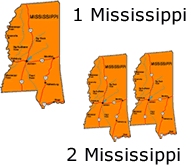
1 Mississippi 2 Mississippi

If you need or want to count in seconds, do you put a words between the numbers? For example 1 [word], 2 [word], 3 [word] etc.

I usually use Mississippi as the in-between word, but have tried others, such as elephant and hippopotamus. Elephant doesn’t really work as it doesn’t have enough syllables, but hippopotamus works well.

I remember seeing television programmes involving parachuting in which people count 1 thousand, 2 thousand, and so on before opening their parachute.

Another alternative is Piccadilly, according to this video:

There are various places named Piccadilly in England, including a street in central London, an area of Manchester, and a hamlet in Warwickshire, and also places in Australia and Canada.

What in-between word do you use (if any) in English or other languages?

Root bags

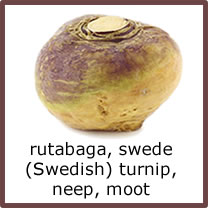
rutabaga, swede, (Swedish) turnip, neep, moot

One of the words that came up in the French conversation group last night was rutabaga [ʁy.ta.ba.ɡa], a root vegetable that originated as a cross between the cabbage and the turnip, and that was possibly introduced from Sweden.

The word rutabaga was borrowed in 1799 from the Swedish word rotabagge, a dialect word from Västergötland in southern Sweden, from rot (root) and‎ bagge (bag, short, stumpy object) [source].

This vegetable has a variety of names in different places:

  • In botanical Latin it is brassica napobrassica
  • In North America it is rutabaga, which is also used in French and Portuguese
  • In the England, Australia, New Zealand it is swede (from “Swedish turnip”).
  • In parts of northern England and the midlands, and in parts of Canada, it is a turnip.
  • In north east England swedes are known colloquially as snadgers, snaggers or narkiesno
  • In Wales it is swede or turnip in English, and as maip (Swedaidd), rwden, erfin, swedsen or swejen in Welsh.
  • In Cornwall it is turnip in English, and routabaga in Cornish.
  • In Scotland it is turnip in English, tumshie or neep in Scots, and snèap-Shuaineach (Swedish turnip / neep) in Scottish Gaelic. In parts of Scotland, particularly in the south east, it is baigie
  • In the Isle of Man it is turnip or moot in English, and as napin Soolynagh (Swedish turnip) in Manx.
  • In Ireland it is turnip in English and svaeid in Irish.
  • In Swedish it is kålrot (“cabbage/kale root”)

What other names does this vegetable have?

Sources: Wikipedia, Am Faclair Beag, Gerlyver Kernewek, foclóir.ie, Online Manx Dictionary

Glass eyes

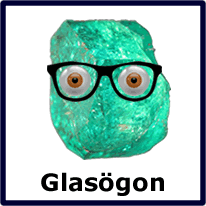
Glasögon

Recently I learnt an interesting word in Swedish – glasögon, which means glasses or spectacles, and literally means “glass eyes”.

Glas means glass, and comes from the Proto-Germanic *glasą (glass), from the Proto-Indo-European *ǵʰel- (to shine, shimmer, glow) [source].

Ögon is the plural of öga (eye), and comes from the Old Swedish ø̄gha (eye), from Old Norse auga (eye), from Proto-Germanic *augô (eye), from Proto-Indo-European *h₃ekʷ- (eye; to see) [source].

The Swedish word glas reminds me of the Russian word for eye, глаз (glaz), which I remember by thinking of a glass eye. Глаз comes from the Old East Slavic глазъ (glazŭ – ball, eye), from the Proto-Slavic *glazъ (ball), from Proto-Indo-European *g(ʰ)el- (round, spherical, stone) [source].

The Russian word for glasses is очки (ochki), which comes from очи (ochi), the plural of око (oko), the old Russian word for eye, which comes from the same Proto-Indo-European root as öga and eye [source].

In Danish and Norwegian, the word for glasses is briller, which means ‘a person wearing glasses’ in Dutch, and to shine or sparkle in French [source]. The German word for glasses is simliar – Brille, and the Dutch is bril [source].

Briller, Brille and bril come from the Middle High German berillus (beryl), from the Latin beryllus (beryl), probably from the Ancient Greek βήρυλλος (bḗrullos – beryl), from Sanskrit वैडूर्य (vaidurya – a cat’s eye gem; a jewel), from Dravidian. Probably named after the city Velur (modern day Belur / ಬೇಲೂರು) in Karnataka in southern India. The first glasses, made in about 1300 in Italy, were made from beryl [source].

Beryl is a mineral which comes from three forms: morganite (orange), aquamarine (blue-green – pictured top right) and heliodor (green-yellow).

The French word for glass, lunettes, means “little moons” [source].

Are there interesting words for glasses, spectacles, specs, or eyes in other languages?

Bulging Budgets!

What do the words bulge, budge and budget have in common?

The answer is, they all come from the same root.

Bulge comes from the Old Northern French boulge (leather bag), from the Late Latin bulga (leather sack), from the Gaulish *bulga / *bulgos, from the Proto-Celtic *bolgos (sack, bag, stomach) [source], from the Proto-Indo-European *bʰelǵʰ- (to swell) [source].

Budge, in the sense of “a kind of fur prepared from lambskin dressed with the wool on, formerly used as an edging and ornament, especially on scholastic habits”, comes from the Middle English bouge (to swell out, to bilge) from the Late Latin bulga (leather sack) [source].

Budget comes from the Middle English bogett / bouget / bowgette (leather pouch), from the Old French bougette (purse for carrying coins), the diminutive of bouge (leather bag, wallet), from the Late Latin bulga (leather sack) [source].

The Proto-Celtic word *bolgos is also the root of bolg, which means belly, stomach, abdomen, buldge or hold in Irish; belly, stomach, abdomen, corporation, bilge or bowl in Manx; and blister, bilge, bulb or womb in Scottish Gaelic [source].

In the Brythonic languages *bolgos became bol (belly, paunch, abdomen, stomach, bowels; tripe; appetite, desire, gluttony, liking) in Welsh [source], bolgh (breach, gap, opening) in Cornish [source], and bolc’h in Breton [source].

Budge, in the sense of to move, comes from a different root: from the Middle French bougier, from Old French bougier, from the Vulgar Latin *bullicāre (to bubble; seethe; move; stir), from the Latin bullīre (to boil; seethe; roil) [source].

Kabei

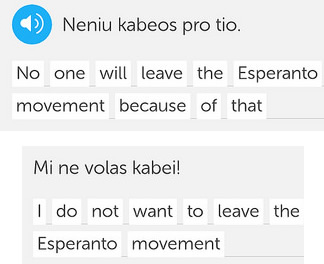
Examples of the Esperanto word kabei

The word kabei [ka.ˈbe.i] appears in one of the Duolingo Esperanto lessons I did today in the sentences, “Mi ne volas kabei” and “Neniu kabeos pro tio”.

From the words available for the translation, I worked out what it meant, but it’s not obvious. In order to understand this word, you have to know something about the history of Esperanto.

Kabei means “to leave the Esperanto movement”, so the first example means “I don’t want to leave the Esperanto movement”, and the second means “Nobody will leave the Esperanto movement because of that”.

This word is based on the pseudonym, Kabe, which was used by Kazimierz Bein (1872-1959), a Polish ophthalmologist and prominent member of the Esperanto movement. He wrote prose in Esperanto, translated novels into the language, and produced one of the first Esperanto dictionaries. At least until 1911, when he left the movement, without saying why. In 1931 Bein said that he didn’t think Esperanto was a viable solution for an international language.

Not long after he left the Esperanto movement his pseudonym became a Esperanto word meaning “to fervently and successfully participate in Esperanto, then suddenly and silently drop out”.

Another word that’s very specific to Esperanto that came up in today’s lessons is krokodili (lit. “to crocodile”), which means “to speak among Esperantists in a language besides Esperanto, especially one’s native language or a language not spoken by everyone present” [source], for example “Ne krokodilu!” (Do not speak your native language when Esperanto is more appropriate!).

The origins of this word are uncertain. It may be related to crocodile having large jaws, and to the action of flapping one’s jaws carelessly. Maybe is was used to refer to noisy non-Esperantists who disturbed an Esperanto group in Paris in the 1930s. Or it may come from Andreo Cseh, an Esperanto teacher who’s students had to speak Esperanto when holding a wooden crocodile he always had with him [source].

The antonym of krokodili is malkrokodili, which means “to speak Esperanto among non-Esperanto speakers”.

You could use both words together perhaps: “Li ĉiam krokodilis, kaj pro tio li devis kabei.” (He always spoke his native language instead of Esperanto, and therefore he had to leave the Esperanto movement).

When is the sky not the sky?

Useful phrase in Danish

In Danish, Norwegian and Swedish the word sky means cloud, as does ský in Icelandic. The word for sky in these languages is himmel (himinn in Icelandic), and in Swedish sky also means sky or gravy.

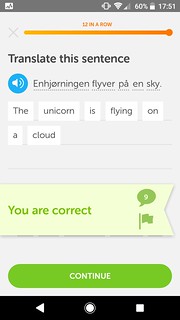
I learnt the Danish word sky the other day from the sentence: Enhjørningen flyver på en sky (The unicorn is flying on a cloud) – are very useful thing to be able to say.

Sky comes from the Old Norse ský (cloud), from Proto-Germanic *skiwją (cloud, cloud cover), from Proto-Indo-European *(s)kew- (to cover, conceal), which is also the root of the English word sky [source].

The English word cloud comes from the Old English clūd (mass of stone, rock, boulder, hill), from Proto-Germanic *klūtaz / *klutaz (lump, mass, conglomeration), from Proto-Indo-European *gel- (to ball up, clench), which is also the root of the English words chill, cold, congeal, cool, gel, gelatin and jelly [source].

In Old English there were different words for sky and cloud:

  • heofon was the sky or heaven [source], which survives in such modern English expressions as ‘the heavens opened’ (it started to rain heavily).
  • wolcen was cloud, and the plural, wolcnu was the sky or the heavens [source]. This became welkin in modern English, an archaic and poetic word for the sky, the upper air; aether; the heavens.

A sunny day in Bangor / Dydd heulog ym Mangor

Shlyap on a shapka

шапка, шляпа, шляпка

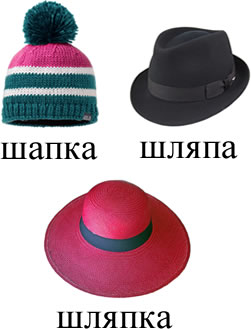
A Memrise Russian lesson I’ve been working on this week includes two different words for hat: шапка (shapka), which is translated as ‘hat (to keep you warm)’ and шляпа (shlyapa), which is defined as ‘a hat (for style)’.

Шапка comes ultimately from the Old French chape (cape) [source].

Шляпа comes from the Old East Slavic шляпа (šljapa – hat, milksop, difficult situation), from Bavarian German Schlappe (defeat, flop, slap) [source].

When you search for шапка in Google Images, you mainly get pictures of knitted woollen hats, like the bobble hat in the image, plus a few fur hats.

When you do the same for шляпа you get mainly men’s hats, like the fedora in the image.

Another word for hat in Russian is шляпка (shlyapka), which seems to refer to a variety of quite elaborate women’s hats, like in the image. It is a diminutive of шляпа.

I like these words because they’re fun to say.

Are there other words for hat in Russian?

Here here!

Here here!

There seem to be different ways to say here in Russian. In some contexts you use тут (tut), and in others здесь (zdyes’), or another word. I’m not sure when to use each one, so I thought I’d investigate.

Тут means here, then, at this point, and other things in some phrases [source]. For example:

  • У нас тут задержан подходящий подозреваемый
    = Look, we’ve got a pretty good suspect in holding here
  • Кстати, я работаю тут консультантом
    = Erm, I’m a consultant here, by the way
  • Поищу каких-нибудь заработков тут и там
    = I’ll try to pick up some odd jobs here and there

Тут comes from Old East Slavic тутъ (tutŭ – here; thereto; herewith), from ту (tu – there; thereto; then; here, herewith), from Proto-Slavic *tuto/*tu (there, here) [source].


Здесь means here or therein [source]. For example:

  • Мы можем провести больше времени здесь = I don’t know, we could spend more time here.
  • Так, подпишите здесь = Okay, sign here
  • Нам нужно зайти здесь = We need to go in here

Здесь comes from the Proto-Slavic *sьde (here, in this place) [source].


Сюда means here or therein [source]. For example:

  • (и) туда и сюда = both here and there
  • то туда, то сюда = sometimes here, sometimes there
  • ни туда ни сюда neither here nor there
  • туда-сюда = backwards and forwards, everywhere, all over the place
  • иди сюда! = come here!

Сюда comes from the Proto-Slavic *sǫda [source].


Отсюда means from here, hence [source]. For example:

  • После приёма я увезу тебя отсюда
    = After the party, I will get you out of here
  • Я выследил логово русских недалеко отсюда
    = I tracked the Russians to a warehouse not far from here
  • Я потерял их запах недалеко отсюда
    = Now, I lost their scent not too far from here.

Вот means here (is) [source]. For example:

  • вот моя мама = here is my mother
  • вот мои дети = here are my children
  • вот он идёт = here he comes

According to Reverso, здесь refers to location, сюда refers to destination, отсюда refers to departure point (from here), and тут means at this point or in the past.


Do other languages have several ways to express the idea of here?

Now now!

Now Now!

I’ve noticed that there are several ways to say now in Russian. In some contexts you use сейчас (sejchas), and in others теперь (teper’), but I haven’t worked out when to use each one yet. So I thought I’d investigate.

Сейчас means now, just now or (only) just [source]. For example:

  • Он сейчас работает = He’s working just now
  • Сейчас приду = I’m just on my way
  • Сейчас же! = Right now!
  • прямо сейчас = right now
  • Я действительно хочу заняться чаем сейчас = I’d really like to get some of that tea now

Сейчас comes from сей (this) & час (hour, o’clock, time, time of day) [source].

Сей also appears in сегодня (sevódnja — today).

Часы (chasy) = watch or clock.


Теперь means now or nowadays [source]. For example:

  • Теперь обсудим следущий вопрос = Let us now move on to the next question
  • А теперь мне пора представить вам участников = And now it’s time for me to introduce to you our contestants
  • И теперь начнем нашу совместную жизнь = So, now we’re going to start a life together

From these examples, I’m guessing that сейчас is more immediate than теперь. Is that right?

There are other ways to say now in Russian it seems:

  • в настоящее время = now, currently, at present
  • к настоящему времени = by now
  • время от времени = now and then or again
  • впредь = from now on
  • до сих пор = until now
  • пока всё = that’s all for now

Теперь comes from the Old East Slavic топере (topere), and is apparently used in contrast with the past [source].


Welsh also has several words for now [source]:

  • nawr = now; shortly, presently (South Wales)
  • rŵan = now; shortly, presently (North Wales)
  • bellach = any more, henceforth, from now on, again; now, by this time, in the end; moreover
  • ar hyn o bryd = now, at this (point in) time, at the present moment, at this juncture
  • erbyn hyn = by this time, by now
  • yn awr = now, forthwith
  • awron = now, at present, at the present time, nowadays, by this time

Do other languages have several ways to express the idea of now?

Так, пока всё, пока пока (So that’s all for now, bye bye)