Metagrobolised, gruntulous noses

Yesterday I learnt the wonderful word metagrobolised on a radio show about words and language called A Way with Words, in which they discuss and answer listeners’ questions about words, idioms and language. It’s broadcast of public radio in the USA and podcasts of the show are available online. I was aware of the show before, but only got round to listening to it yesterday, mainly because they mention Omniglot on the latest one.

metagrobolised means “totally perplexed and mixed up” or “full of difficulty or confusion or bewilderment” [source]. It is also spelt metagrabolised, metagrabolized or metagrobolised. This word appears as matagrabaliser in Sir Thomas Urquhart’s translation of The Works of Rabelais, and was “a word forged at pleasure, which signifies the studying and writing of vain things.” Apparently the word matagraboliser first appears in Rabelais’ story Gargantua and Pantagruel and combines the Greek words μάταιος (mataios – useless), γράφω (grapho – write),
and βάλλω (ballo – to throw away), making ματαιογράφοβαλίζειν, which became matagrabaliser in French. [source].

In François Lacombe’s Dictionnaire du vieux langage françois, matagroboliser is defined as “prendre beaucoup de peine pour ne rien fair qui vaille” (to take great pains to do nothing of worth).

Other interesting words they discuss include gruntulous – to speak in a grunting fashion, and spox [spoʊks], a journalistic abbreviation of spokesperson. They also ponder why curiosity is associated with the nose – if you’re interested in other people and what they’re doing, you might be called nosy, or you are said to have a big nose, or to be sticking your nose/beak into things.

According the the Online Etymology Dictionary, nosy meant “having a prominent nose” in the 17th century, and came to mean “inquisitive by the late 19th century. The name “Nosey Parker” for an inquisitive person dates from 1907.

The word nose comes from the Old English nosu, from the Proto-Germanic *nusus, from Proto-Indo-European *nas-. From the late 16th century nose was used to mean “something obvious”, and the sense of “to pry or search” was first recorded in the 1640s, while the expression “pay through the nose” appeared in the 1670s [source].

Is the nose associated with inquisitiveness and prying into other people’s business in other languages?

Mice, muscles and mussels

Larry, the official mouser at 10 Downing Street

Today I came across the German word Mäusefänger (mouse catcher) in an article, sent to me by a friend, about the cat that recently took up the position of chief mouse catcher at 10 Downing Street, the official residence of British Prime Minister David Cameron. Number 10 apparently has a bit of a problem with mice, and there’s a long tradition of keeping cats at the prime minister’s residence and the treasury.

Mäusefänger is made up of two words: mäuse, the plural of maus (mouse), and fänger (catcher, fielder, interceptor, trap). Maus, which is of course related to the English word mouse, comes from the Proto-Germanic. *mus (a small rodent), from PIE *muHs- (mouse) [source]. The word muscle comes from the same root, via the Latin musculus (muscle, lit. “little mouse”), as does mussel, via the Old English muscle/musscel, and the Late Latin muscula [source].

While looking up some of the words in the article, I came across a useful German dictionary, canoonet, which not only gives information about German words (in German), and links to dictionaries for other languages, but also has grammatical information, such as noun and verb conjugations. There is also a Morphologie-Browser, which shows the words derived from a particular word – here’s an example with the word sehen (to see).

Cave canem!

Carea Castellano

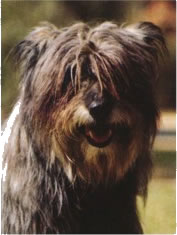
I received a email today asking when the Spanish word perro (dog) replaced can, a word for dog derived from the Latin canis, which appears in the name Canary Islands, (Islas Canarias in Spanish).

The Spanish word perro first appeared in the Diccionario de la Real Academia Española in 1737 [source]; was originally pejorative [source] and is possibly of onomatopoeic origin from the growling sounds made by dogs, perr perr (sounds more like a cat’s purr to me). Shepherds also used that sound to call their dogs. Another possibility is that perro comes from a pre-Roman language [source].

In Spanish the word can was used for dog until about the 14th century, after which it was gradually replaced by perro. The words for dog in most other Romance languages come from the Latin word canis: cane (Italian), chien (French), câine (Romanian), cão (Portuguese), can (Galician). One exception is Catalan, in which the word for dog is gos. [source].

The root of the Latin word canis, which appears in biological name for the subspecies of dogs: canis lupus familiaris, comes from the Proto-Indo-European base *kwon- (dog). This is also the root of the English hound (via the Proto-Germanic *khundas and the Old English hund), the English canine, the Greek κυων (kuōn), the German hund, the Irish cu and the Welsh ci [source].

The English word dog comes from the Old English docga, a word of unknown origin which was probably the name of a particular breed of dog, and had largely replaced the word hound as the general term for dog by the 16th century [source]. Hound started to be used to mean “a dog used for hunting” from the 12th century [source].

The name Islas Canarias probably comes from the Latin Insula Canaria (Island of the Dogs), which was originally just the name of Gran Canaria. It is possible that the dogs referred to were seals [source].

Peeling the library

Today’s word, library, comes from the Old French librairie, a ‘collection of books’, which is a nominal use of adjective librarius, ‘concerning books’, from Latin librarium, ‘chest for books’, from liber (genetive of libri), ‘book, paper, parchment’, originally the ‘inner bark of trees’, probably a derivative of Proto-Indo-European (PIE) base *leub(h) – ‘to strip, to peel’.

In French the word librarie means bookshop. A French library is a bibliothèque, which comes via the Latin bibliothēca, from the Greek βιβλιοθήκη (bibliothêkê), ‘a place to store books’, which breaks down into βίβλος (biblos), ‘book’, and θήκη (thêkê), ‘chest’.

Variations on the theme of bibliothèque are used in a number of other languages, including:

Dutch – bibliotheek
German – Bibliothek
Greek βιβλιοθήκη (bibliothiki)
Italian/Portuguese/Spanish – biblioteca
Russian – библиотека (biblioteka)

In Welsh, a library is a llyfrgell, from llyfr, ‘book’ and cell, ‘cell’, while in Irish it’s leabharlann, from leabhar, ‘book’ and lann (not sure of it’s meaning*). In Chinese, a library is 圖書館 [图书馆] (túshūguăn) = ‘map book house’.

It seems that the word library, or something like it, is not used in it’s English senses in many languages. The only ones I can find are Sesotho and Tswana (laeborari), Tsonga (layiburari) and Venda (laiburari), which appear to be loanwords from English. The Basque word for library, liburutegia, might possibly have Latin or Greek roots.

[Addendum] *lann in Irish is an archaic/obsolete word that means floor, enclosure or church. It comes from the Old Irish lann (building, house, land, plot, plate), from the Proto-Celtic *landā ((open) space, land), from the Proto-Indo-European *lendʰ- (land, heath). It is cognate with the Welsh word llan (church, parish, monastery, yard, enclosure, village), the Spanish landa (plain), and the English words land and lawn [source].

Sources: Online Etymology Dictionary, Wiktionnaire, Yawiktionary