Crusts, hogwash and turnspits

On the BBC Four programme If Walls Could Talk: The History of the Home, that I watched last night, they discussed the possible origins of a number of expressions, including by hook and by crook, upper crust, hog wash, turnspit and so on.

By hook and by crook – by whatever means necessary.
In medieval times peasants were only allowed to take wood from the trees – any wood on the ground belonged to the lord of the manor – and they gathered the wood with reapers’ billhooks or shepherds’ crooks. According to The Phrase Finder, this is the most likely origin of this phrase, though there are other suggestions: that it comes from Hook Head and Crooke, villages on opposite sides of the Waterford channel in Ireland, and Cromwell apparently said that Waterford would fall ‘by Hook or by Crooke’, i.e. by a landing of his army at one of those two places. Another possibility is that the phrase comes from two judges from the early 17th century, called Hooke and Crooke, who were called on to solve difficult legal cases.

Upper crust – the aristocracy.
The folk etymology of this phrase is that only the nobility were given the upper, unburnt part of the bread, while the peasants got the bottoms of the loaves that had sat on the oven floor and got burnt. According to The Phrase Finder though, there is no evidence for this explanation. They cite one reference from The boke of nurture, folowyng Englondis gise by John Russell (circa 146): “Kutt ye vpper crust for youre souerayne.” (iCut the upper crust [of the loaf] for your sovereign). The term upper crust wasn’t used to refer to the aristocracy, at least in writing, until the early 19th century and previously referred to the outer crust of the Earth’s surface and, more frequently, a person’s head or hat.

Hogwash – nonsene.
In Victorian times, and probably before, any food waste that couldn’t be made into soup or otherwise reused was called ‘wash’ and was sold to farmers to feed their pigs or hogs, hence ‘hogwash’, which is also known as pigswill. By the later 19th century and mainly in the USA hogwash came to mean nonsense, especially ridiculous, worthless or nonsensical ideas.

Turnspit – a person whose job it was to keep a roasting-spit turning, or a dog that kept the spit turning by running in a wooden tread-wheel to which it was attached. Such dogs were also known as turnspit dogs or turn curs and a breed (now extinct) was developed specifically for such work. Such a dog first appears in writing in Of English Dogs in 1576 with the name Turnespete. Other names for them include the Kitchen Dog, the Cooking Dog, the Underdog and the Vernepator.
Peu profond

Last night I discovered that there doesn’t appear to be a separate French word for shallow, at least when you’re talking about shallow water, dishes or graves – the term peu profond (‘not very deep’) is used in these cases. If you’re talking about a shallow person, mind, writing, novel, film or conversation though, the word to use is superficiel(le), or you can say that they manque de profondeur (lack depth).

This got me wondering whether there is a Latin word for shallow, when referring to water, etc, which didn’t end up in French. According to my Latin dictionary, shallow is brevis, vadōsus or levis. Another Latin dictionary I checked defines brevis as short, vadōsus as “full of shallows, shallow, shoal” and levis as “light, not heavy” or “smooth, not rough”.

The English word shallow first appeared in writing in the early 15th century schalowe, and is possibly related to schald (Old English sceald) – shoal.

Ingrown languages

In an interesting book I read recently, What Language Is by John McWhorter, the author discusses why some languages appear a lot more complicated or ‘ingrown’ than others. He gives the example of Persian and Pashto, two Iranian languages spoken in a number of countries in western and central Asia. Whereas Persian has more or less regular and simple verb conjugations, in Pashto the verb endings and other aspects of the language are much less regular. This is because Persian was the language of a large empire in which many people learned Persian as adults, and few did so perfectly, so many of the irregularities and other complex aspects of Old Persian were regularised and simplified. This process didn’t happen with Pashto, so the language is still ingrown.

Other languages that are or have been used as colonial languages or lingua francas with many adults learning them imperfectly have undergone a similar process of simplification. These include English, Mandarin Chinese, colloquial spoken varieties of Arabic, Indonesian and Swahili. According to McWhorter, these languages could be considered abnormal as many of their irregularities and eccentricities have been levelled out. As a result they are relatively easy to learn, or at least somewhat less difficult than more ingrown languages.

One example a particularly ingrown language is Navajo, which even linguists find superlatively forbidding. Some even claim that it’s not possible to learn it after childhood. Apparently none of the Navajo verbs follow a regular pattern, and regularity is notably absent in other parts of the language.

So if you’re struggling to get to grips with Spanish or Mandarin, it might be of comfort to you to remember that you’re not learning Navajo or a similarly ingrown language.

Oideas Gael

I’ve been having a wonderful time this week at Oideas Gael in Gleann Cholm Cille in Donegal in the north west of Ireland. I can understand most of the Irish I hear here, and my own spoken Irish is definitely improving, as is my ability to sing in Irish (I’ve been doing the sean-nóis class in the afternoons).

As well as hearing and speaking a lot of Irish, I’ve also had opportunities to speak French, German, Czech and Japanese this week with other people on the course – wonderful 🙂

I’ll be heading back to Bangor tomorrow and more regular blog posts will start to appear here again after I get home.

Panceltic concert

Last night I went to a great concert in St John’s (Balley Keeill Eoin) at which all the modern Celtic languages were sung and/or spoken, as well as English and French. It was wonderful to hear them all, and I even understood odd bits of the Cornish and Breton, the only Celtic languages I haven’t got round to studying yet.

I think it was the first time I’ve heard Breton spoken and sung live – I have heard recordings before though. I thought that it sounds kind of similar to French, but when you listen closely you realise that it isn’t French at all.

I spoke to various people in Manx, English, Welsh, French and a bit of Irish, and joined in with songs in Manx and Scottish Gaelic at the session in Peel (Purt ny hInshey) after the concert.

An Irish group called Guidewires will be playing in Peel tonight, supported by a Manx group called Scammylt, and before that there’s a talk on Welsh poetry by Mererid Hopwood.

Tomorrow I’m off to Gleann Cholm Cille in Donegal for a week of Irish language and music at Oideas Gael’s Irish Language and Culture Summer School.

Come-all-ye

Last night I went to a fascinating talk by Cass Meurig about the history of the crwth (a type of medieval bowed lyre) and its place in Welsh music and tradition, which included songs in Welsh.

After the talk there was a very enjoyable ‘Come-all-ye’ singing session lead by Clare Kilgallon and members of Cliogaree Twoaie (‘Northern Croakers’), a Ramsey-based choir who sing in Manx and English. There were songs in Manx, English, Welsh and Cornish, and I did a Scots lullaby (Hush, Hush, Time to be sleeping).

I think the phrase ‘come-all-ye’ refers to the type of songs known as “Come all ye’s”, which tend to begin with “Come all ye (sons of liberty/ good people/ tramps and hawkers etc) and listen to my song”. That’s according to Dick Gougan anyway. We didn’t actually sing any such songs last night though.

Llygad yr haul

I heard the Welsh phrase llygad yr haul (eye of the sun) on the weather forecast on Radio Cymru this morning and thought it was a poetic way of describing sunny weather. I think it appears in a sentence something like Bydd sawl mannau dan llygad yr haul yfory (“Many places will be under the sun’s eye tomorrow”).

In English you might talk about the eye of a storm, but I haven’t heard the expression the eye of the sun or the sun’s eye used in relation to the weather. Are there similar expressions in other languages?

Multilingual poetry

On Sunday I attended an evening of multilingual poetry in Bangor that feature poets from Wales and India who read poems in Welsh, English, Bengali, Malayalam and Manipuri. It was part of a project to build links between Wales and India which involved the Welsh poets translating poems by the Indian poets into Welsh, and vice versa. They also translated their poems into English. A similar event will be taking place in Ultracomida in Aberystwyth tomorrow.

I could understand the poems in Welsh quite well, and while I didn’t understand any of the poems in the languages of India, it was fascinating just to hear these three very different languages, each of which belongs to a different language family – Bengali is Indo-Aryan, Malayalam is Dravidian and Manipuri is Tibeto-Burman. Unfortunately I didn’t get any recordings of them so I can’t share them with you.

Understanding poetry in foreign languages can be quite challenging, even if you speak them well. Poetic language can differ from every day language in various ways, but I find it worth the effort to try to read and appreciate poems in their original languages rather than just relying on translations.

Epizeuxis

I came across the word epizeuxis recently (in One of Our Thursdays is Missing, by Jasper Fforde) and wasn’t sure what it meant or even how to pronounce it, so I decided to find out.

According to the OED, epizeuxis (/ɛpɪˈzjuːksɪs/) is “a figure by which a word is repeated with vehemence or emphasis.” It comes via Latin from the Greek ἐπίζευξις (epizeuxis – a fastening upon), from ἐπί (epi – upon) and ζευγνύναι (zeugnunai – to yoke).

Wikipedia says that, “In rhetoric, an epizeuxis is the repetition of words in immediate succession, for vehemence or emphasis” and gives examples such as “O horror, horror, horror.” from Macbeth, and “Education, education, education.” by Tony Blair.

Information about this and other terms used in rhetoric from abating* to zeugma** can be found in the Silva Rhetoricae: The Forest of Rhetoric.

* abating in an English version of anesis (/ˈænɪsɪs/), from the Greek ἄνεσις (anesis – a loosening, relaxing, abating) = “adding a concluding sentence that diminishes the effect of what has been said previously. The opposite of epitasis.”

** zeugma (/ˈzjuːgmə/), from the Greek ζεῦγμα (zeûgma – yoke) = “A general term describing when one part of speech (most often the main verb, but sometimes a noun) governs two or more other parts of a sentence (often in a series).”

Canapés, sofas and curtains

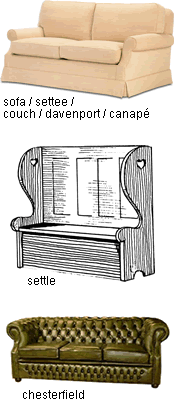
Sofa / couch / settee / davenport / settle / chesterfield

The other day I discovered that one French word for sofa is canapé (/kanape/), and that canapé-lit or canapé transformable/convertible is a sofa bed. The word sofa is also used in French, and canapé can also mean an open sandwich.

According to the OED, in English canapé (/ˈkænəpɪ/) can mean both “A piece of bread or toast, etc., on which small savouries are served.” and “A sofa”. I’ve never come across it used to mean sofa in English, and had always assumed that canapés were small items of food similar to tapas. I think such things are also known as appetisers or hors d’oeuvres.

Canapé comes from the Medieval Latin canāpēum, from canōpēum (mosquito curtains; pavilion, tent, bed), from the Latin cōnōpēum (seat with a baldaquin*), from the Ancient Greek κωνωπεῖον (kōnōpeion – an Egyptian bed or couch with mosquito curtains), from κάνωψ (kánōs – gnat, mosquito). In English the word came to mean mainly curtain or canopy, which comes from the same root, while in French and other Romance languages its primary meaning became sofa or couch.

Sofa /ˈsəʊfə/ probably arrived via the Turkish sofa from the Arabic صفة (súffa – a long seat made of stone or brick).

Settee /sɛˈtiː/ is probably a variant of settle /ˈsɛt(ə)l/, “a long bench, often with a high back and arms, with storage space underneath for linen.” [source]. Settle comes from the Old English setl, from the Germanic *setlo-, from the pre-Germanic *sedlo-, from the Proto-Indo-European *sed-lo-, from *sed- (to sit).

Couch /kaʊtʃ/ comes from the French couche, from the Old French culche, which is cognate with coucher (to sleep), which comes from the Latin collocāre (to lay in its place, lay aright, lodge) from com- (together) and locāre (to place).

*Baldaquin /ˈbældəkɪn/ = “A structure in the form of a canopy, either supported on columns, suspended from the roof, or projecting from the wall, placed above an altar, throne, or door-way”.

What do you call your a long padded seat designed for two or more people? If it can be converted into a bed, what do you call it?

For my parents such a piece of furniture is a settee, and I used to use this name as well. Now I usually call it a sofa. We also have a piece of furniture that came from my grandparents and that we call a settle – a long wooden seat with a high, straight wooden back, wooden arms and a narrow seat with a cushion on top. The seat also lifts up and we store board games inside.