Here’s a recording in a mystery language.
Can you identify the language, and do you know where it’s spoken?
Here’s a recording in a mystery language.
Can you identify the language, and do you know where it’s spoken?
I’ve noticed that there are several ways to say now in Russian. In some contexts you use сейчас (sejchas), and in others теперь (teper’), but I haven’t worked out when to use each one yet. So I thought I’d investigate.
Сейчас means now, just now or (only) just [source]. For example:
Сейчас comes from сей (this) & час (hour, o’clock, time, time of day) [source].
Сей also appears in сегодня (sevódnja — today).
Часы (chasy) = watch or clock.
Теперь means now or nowadays [source]. For example:
From these examples, I’m guessing that сейчас is more immediate than теперь. Is that right?
There are other ways to say now in Russian it seems:
Теперь comes from the Old East Slavic топере (topere), and is apparently used in contrast with the past [source].
Welsh also has several words for now [source]:
Do other languages have several ways to express the idea of now?
Так, пока всё, пока пока (So that’s all for now, bye bye)
A useful phrase that came up in my Swedish lessons on Memrise this week is Jag är lite förvirrad, which means “I’m a little confused”. This is quite a useful phase when you’re learning a new language, or trying to make sense of a new place, country or custom.
Another phrase that came up is Vi har gått vilse, which means “We’re lost” or literally “We have gone/walked astray”.
Förvirrad means confused, perplexed, addled, addlepated, bewildered, bumbling, chaotic, crazed, discombobulated, distracted, disturbed, dizzy, flighty, muddled, befuddled, diffuse, according to bab.la.
Here are a few examples of how it’s used:
Related words include:
förvirra comes from the Middle Low German vorwerren [source], which is also the root of verwirren (to confuse) in German and verwarren (to tangle, confuse, confound, befuddle) in Dutch.
The ver- and -en are affixes. The warr/wirr/werr part comes from Middle Dutch werre/warre (confusion, disarray, conflict), from Old Dutch *werra, from Proto-Germanic *werrō (confusion, disarray, conflict, strife), from the Proto-Indo-European *wers- (to grind, sand, sharpen, hone). The English war comes from the same root [source].
Vilse means lost, astray, wrong, according to bab.la.
Related words include:
Vilse comes from vill (lost), from Old Norse villr (wild), from Proto-Germanic *wilþijaz (wild), from Proto-Indo-European *wel-/*welw- (hair, wool, grass, ear (of corn), forest), which is also the root of the English word wild [source].
Here’s a recording in a mystery language.
Can you identify the language, and do you know where it’s spoken?

In the Duolingo Danish lessons I’ve been doing recently a number of words have popped with which are not really translated. One I noticed today is æbleskiver [ɛːbləˌsɡiːwɐ], which is simply translated as appleskives. That doesn’t really help as I don’t know what appleskives are.
Here’s an example sentence: Koen spiser mandens æbleskiver mens han kigger væk (The cow eats the man’s appleskives while he looks away).
From the context I guessed appleskives are something you eat and involve apples – æble = apple, but what?
The bab.la dictionary translates æbleskive as ‘pancake puff’, which doesn’t really help either.
According to Wikipedia, æbleskiver are ‘Pancake Puffs’ that are:
“spherical in shape. The name literally means apple slices in Danish, although apples are not usually an ingredient in present-day versions. Somewhat similar in texture to European pancakes crossed with a popover or Yorkshire pudding, æbleskiver are solid like a pancake but light and fluffy like a popover.”
Apparently they are traditionally eaten at Christmas, and are often served with gløgg (mulled wine). They are also served at children’s birthday parties.
This is more helpful, but what is a popover?
A popover is “a light, hollow roll made from an egg batter similar to that of Yorkshire pudding, typically baked in muffin tins or dedicated popover pans, which have straight-walled sides rather than angled.” [source].
So now we know.
Next time I go to Denmark, I will look out for æbleskiver, and try some. They sound quite tasty. I’ll have to make sure that no cows take them while I’m not looking though.
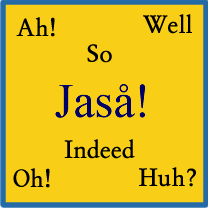
An interesting Swedish word I learned recently is jaså [ˈjasɔ]. It is described by Wiktionary as an ‘expression of mild surprise’, and can be translated as ‘indeed, so, well then, oh, well, ah, huh’. So it’s quite a useful little word.
Here are some examples of how it’s used (from bab.la):
Equivalents in Danish appear to be åh, nå, nåh and tja.
What equivalent words are there in other languages?
Here’s a recording in a mystery language.
Can you identify the language, and do you know where it’s spoken?
Last week I learnt that a butterfly in Cornish is a tykki Duw [tɪkˑi’dyˑʊ / tɪkˑi’diˑʊ], or literally “God’s pretty thing”. A moth is a tykki Duw nos or “God’s pretty thing of the night”).
The word tykki comes from teg (pretty, attractive), and Duw comes from the Proto-Celtic *dēwos (god), from the Proto-Indo-European *deywós (god), from *dyew- (sky, heaven).

Names for butterflies are interesting in other languages as well:
What about in other languages?
Sources: Gerlyver Kernewek, Wiktionary, Geiriadur Prifysgol Cymru, Geiriadur yr Academi, Am Faclair Beag On-line Manx Dictionary, Dictionnaire Favereau, bab.la
As you may or may not be aware, I have another blog called Multilingual Musings, which was where I practised using languages I’m learning, and posted interesting words that come up in the French conversation group I go to.
Recently I transfered all the content from there to this blog, and renamed that blog Celtiadur. I am now building an etymological dictionary of Celtic languages there.
It will contain information about the six modern Celtic languages: Irish, Scottish Gaelic, Manx, Welsh, Cornish and Breton, as well as their historical versions and ancestors.
The name Celtiadur is one I coined which combines the word celt and the Welsh suffix -adur, which appears in such words as geiriadur (dictionary), dyddiadur (diary), gwyddoniadur (encyclopedia) and ieithiadur (grammar, dictionary, vocabulary). It is also used in Breton.
There isn’t much there yet, but I will be transferring all the words in my Celtic Cognates section, and adding many more.
Here’s a recording in a mystery language.
Can you identify the language, and do you know where it’s spoken?