
Here’s a recording in a mystery language.
Can you identify the language, and do you know where it’s spoken?
Here’s a recording in a mystery language.
Can you identify the language, and do you know where it’s spoken?

Recently I learnt that there are two different words for room in Danish: rum [ʁɔmˀ], which is a general room, and værelse [ˈʋæʁɑlsə], which is a room for spending time in, at least according to Memrise. Is this correct?
Værelse comes from være (to be) and -else (a suffix that turns verbs into nouns) [source].
Subspecies of værelse include:
[source]
A related word is tilværelse (life, existence).
Rum means room, comparment or space, and comes from the Old Norse rúmr, from the Proto-Germanic *rūmaz (roomy, spacious, open), the same root as the English word room [source].
Subspecies of rum include:
[source].
Other Danish words for rooms include lokale (room), stue (living room), sal (hall) and køkken (kitchen).

If someone called you a knuff, would you see it as a compliment or an insult?
Knuff is an obsolete English word that means a lout or clown, so it would be an insult. It comes from the Old English cnof (a churl). The k is silent, but I think in Old English the c was pronounced [source].
Possibly related Swedish words include knuff (nudge, push, boost, dig, shove) [source] and knuffa (to push, nudge, shove) [source].
Possibly related German words include knuffen (to nudge; to jab; to pinch (usually playfully or even tenderly)) [source] and knuffig (cuddly) [source]
Possibly related Dutch words include knuffelen (to cuddle, hug), from the Low German knuffen (to poke; bump; nudge) [source], knuffig (cuddly) [source], knuffel (hug, cuddle, stuffed toy) [source] and knuffelbeest (stuffed toy) [source].
The word knuff came up in one of my Swedish lessons this week, and as I like the sound of it, I thought I’d write about it. There’s something about that combination of k and n and the beginning of a word that makes it sound cute and cuddly to me.
Which sounds and combinations of sounds (in any language) most appeal to you?
Here’s a recording in a mystery language.
Can you identify the language, and do you know where it’s spoken?
This week I learnt a couple of interesting French words – embabouiner [ɑ̃.ba.bwi.ne] (to flatter, butter up) and embobiner [ɑ̃.bɔ.bi.ne] (to bamboozle).
Embabouiner combines the prefix em- and suffix -er with babouin (baboon), so you are making a baboon of someone when you flatter them [source].
Babouin comes from the Middle French babouyne, baboin, from Old French babouin, from baboue (grimace, muzzle), which is related to German dialectal word Bäppe (lips, muzzle) [source].
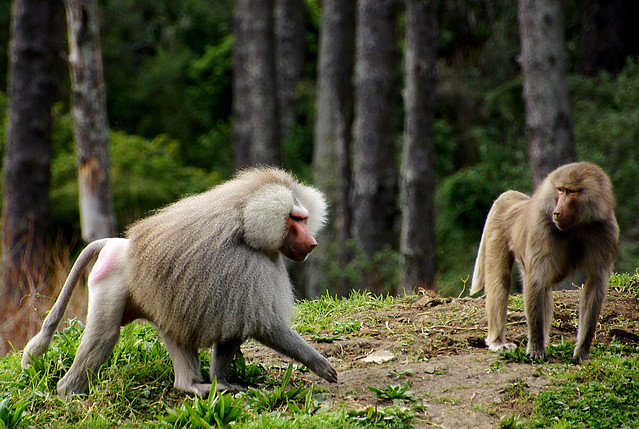
Embobiner means to get round (someone), to pull to wool over someone’s eyes, to bamboozle or to outfox. It can also mean to wind up, reel up/in or wrap up. It combines the same prefix and suffix as embabouiner with bobine (bobbin, reel, spool, drum), so you are winding someone on a bobbin when you bamboozle them [source].
Bobine probably comes from the Latin word balbus, (stammering, stuttering, lisping, fumbling) and is immitative of the noise of a bobbin [source].
The English word bamboozle comes from the 17th century slang word bam (to trick, to con), from the noun bam (fraudster, cheat), possibly from the French embobiner [source].
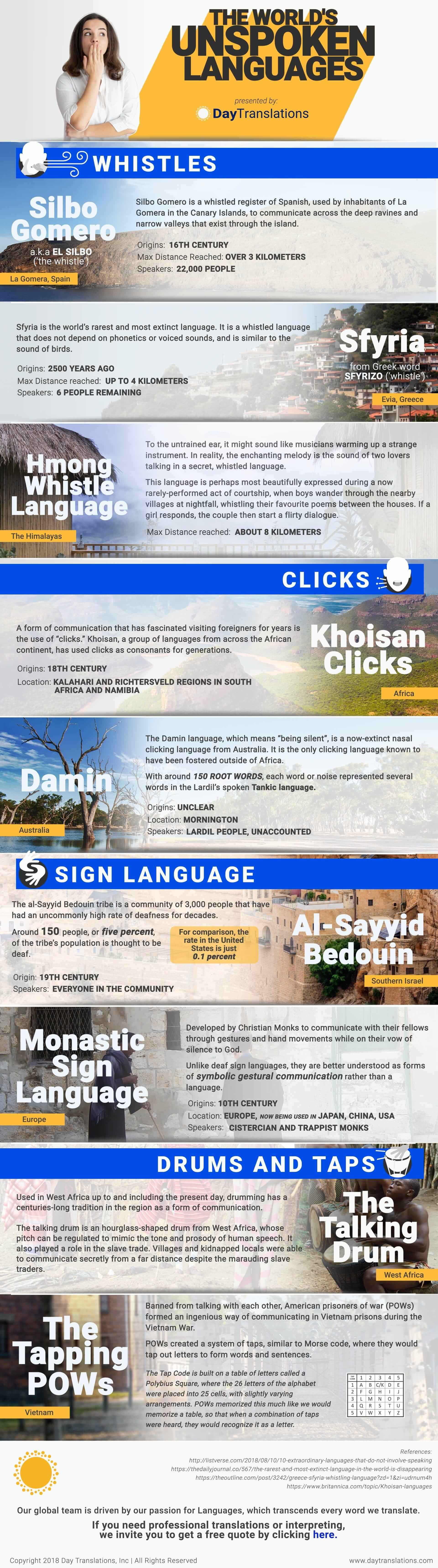
While most languages are spoken, there are other ways to communicate, including sign languages, whistled and hummed languages, and ways to communicate via drums and sounds. This infographic gives details of some of these.

If someone said to you, “A’m gey wabbit, an a’v a sair thrapple comin on”, would you have any idea what they were talking about?
This is an example of Scots from L Colin Wilson’s Luath Scots Language Learner. It means, “I’m very tired, and I’ve a sore throat coming on”.
Wabbit, is a childish pronunciation of rabbit in English, and means exhausted, tired out, played out, feeble or without energy in Scots. It is also written wubbit, wibbit or wappit [source]., and it’s not certain where it comes from [source].
Here are some examples of how it’s used:
Thrapple [ˈθrɑpəl], means the windpipe, gullet or throat; to grip by the throat, throttle, strangle; to suppress (laughter) in the throat; to entangle with cords; to gobble up, to devour. It is also written thropple or throapple [source].
It is not certain where it comes from, but may be realted to the English dialect word thropple (larynx, windpipe), which comes from the Old English þrotbolla (windpipe) [source].
Here are some examples of how it’s used:
Thrapple & Wabbit would be a good name for a firm of solicitors / lawyers perhaps, or a comedy double act.
Here’s a recording in a mystery language.
Can you identify the language, and do you know where it’s spoken?
One of the things that came up at the French Conversation Group last night was the difference between buffalo and bison, and the words for them in French.
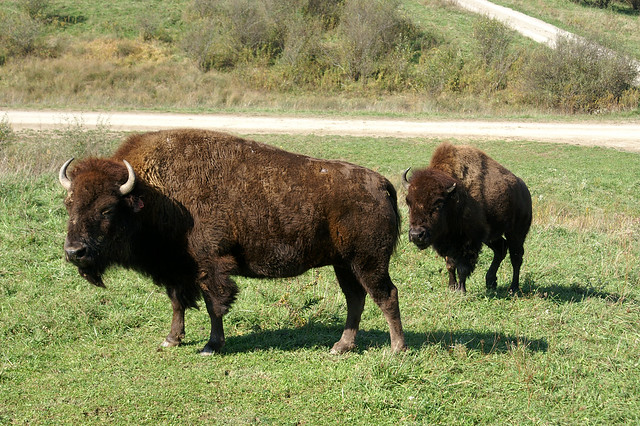
The creature found North America commonly known as a buffalo is actually a bison or American bison, and the its scientific name is Bison bison. There are two subspieces: the plains bison (Bison bison bison) – so good they named it thrice – and the wood bison (Bison bison athabascae).
In French it’s known as le bison or le bison d’Amérique du Nord. The plains bison is known as le bison des plaines, and the wood bison as le bison des bois [source].

There is also a European bison (Buson bonasus), which was hunted to extinction by the early 20th century, but was kept alive in captivity, and has since been reintroduced into the wild [source].
In French it is known as le bison d’Europe [source].

There are several species of buffalo in African, including the African buffalo or Cape buffalo (Syncerus caffer) in southern and eastern Africa, the African forest buffalo (Syncerus caffer nanus) in central and west Africa, the Sudanese buffalo (Syncerus caffer brachyceros) in west Africa, and the Nile buffalo (Syncerus caffer aequinoctialis) in east Africa [source].
In French the African/Cape buffalo is known as le buffle d’afrique, le buffle noir des savanes or le grand buffle noir des savanes [source].
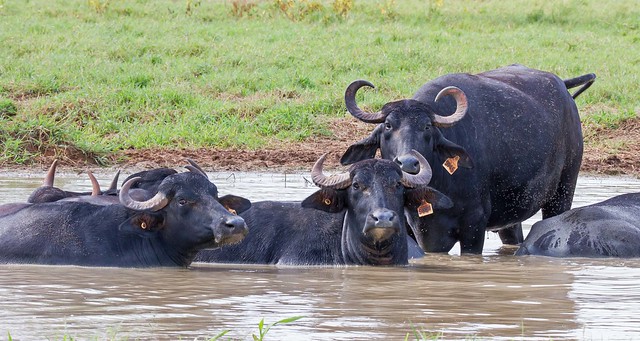
The water buffalo (Bubalus bubalis) originating in South Asia, Southeast Asia and China, and is now found in other places [source].
In French it’s known as le buffle domestique or le buffle d’Asie [source].
According to many reports, a language becomes extinct every two weeks, on average, and over the next century, up to 90% of the world’s languages will cease to be spoken.
This is an oft-repeated story, but is it true?
According to Mike Campbell of Glossika, the actual data on language death tells a different story. He wrote a blog post about this, and made a video:
If a language dies every two weeks, you would expect an average of 26 to die each year, and 260 each decade. This is not what is happening at the moment, and new languages are even being discovered. Or at least forms of speech that were formerly classified as dialects are being reclassified as separate languages.
These the languages that have become extinct since 2008. The dates given are for when the last known native speakers of these languages died.
That’s a total of 18, plus a couple of dialects I haven’t listed, over the past decade – slightly less than the predicted 260. Moreover, while there are no native speakers of these languages, efforts are being made to revive some of them.
More information about recently extinct languages, language death and language revitalization:
https://en.wikipedia.org/wiki/Extinct_language
https://en.wikipedia.org/wiki/Language_death
http://rosettaproject.org/blog/02013/mar/28/new-estimates-on-rate-of-language-loss/
https://en.wikipedia.org/wiki/Language_revitalization