Budge up!

Notice in local café in Bangor

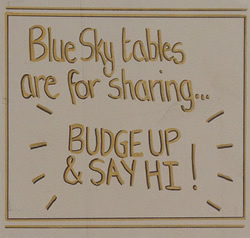
In the café where I had lunch today I saw a sign saying “Blue Sky tables are for sharing. Budge up and say Hi!” (see photo).

I thought budge up sounding like a very British kind of thing to say. Is it used in other English-speaking countries? If not, how would you ask someone to move up?

Budge comes from the French bouger (to move), from the Vulgar Latin *bullicāre, frequentative of Latin bullīre (to bubble, boil), from bulla (bubble; bubble-shaped object), from Gaulish, from Proto-Indo-European *beu ‎(swelling) [source].

It’s a gas!

In Hiberno-English people might describe something fun and enjoyable as a gas. For example, “That’s gas”, “A gas laugh”, “Come on, it’ll be gas”, “He’s a gas character”, “Your man is gas” [source].

Last week an Irish friend told me that this expression comes from laughing gas (nitrous oxide), which was used at parties to induce hilarity and euphoria in the guests.

According to The Grammarphobia Blog, the earliest citation in the OED for gas meaning fun was in James Joyce’s 1914 collection of stories, Dubliners, in which one character says he’s brought along a slingshot “to have some gas with the birds.”

According to Historically Speaking, Humphrey Davy noticed that nitrous oxide produced a state of induced euphoria which led to laughter followed by a state of stupor and, finally, a dreamy and sedated state. He introduced it to the British upper class in 1799 and it became used as a recreational drug at “laughing parties”. The term “it’s a gas” soon came to refer to what happened at such parties.

The Right To Read, The Right To Write

Today we have a guest post by Tim Brookes of the Endangered Alphabets Project

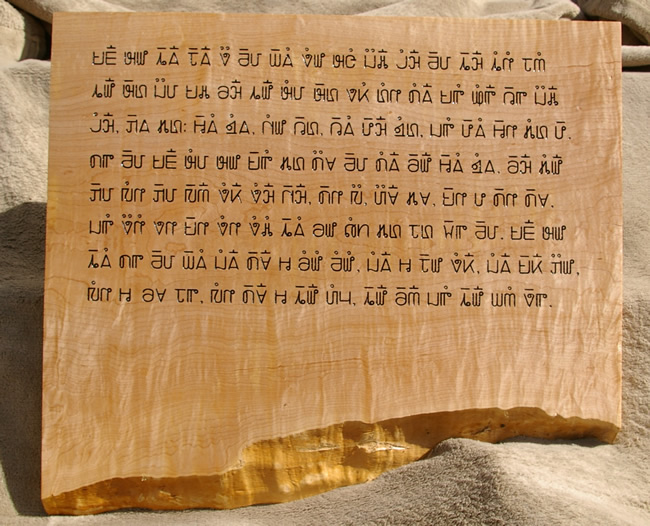
An text in Hmong in the Pahawh Hmong script carved into a wooden block

As those of us in the United States head into the long weekend that celebrates the country’s independence from colonial authority (yes, as a Brit I have to accept my birth country’s history!), the Endangered Alphabets’ Mother Tongue initiative is especially significant.

Take a look at the photo, for example. The Hmong were, and to some extent still are, a disadvantaged minority in many of the countries of their native southeast Asia. The fact that they did not have their own written language was seen as a sign of how uncivilized they were. When Shong Lue Yang, an unlettered farmer, created this script for his people it gave them such a strong sense of identity that the majority cultures of the region were disturbed – so much so that soldiers were sent to assassinate him.

I’d like to suggest we think of Independence Day not just in terms of nations but in terms of people and cultures, and the right of all peoples to their own culture, history, identity and language. That’s what our Mother Tongue exhibition will be all about.

Please take a moment to back our Kickstarter this weekend.

And then go back to celebrating independence!

Thanks.

Tim Brookes

PS I learned about most of this on Omniglot, of course!

Say Something in Manx

There’s a new course on the SaySomethingin website: Manx (Gaelic). There are currently 10 free lessons in this introductory course, which follow the same format as the other languages on the site, as far as I can see, and 8 more lessons will be available soon.

I heard about this course at the Polyglot Gathering in Berlin in May from Ivan Baines, who was testing it at the time. It has now been launched.

I’m still working on SaySomethingin Cornish. So far I’ve got to lesson 5 and feel like I’ve learnt quite a lot and can say a variety of things.

The vocabulary for each lesson is now available on the lesson pages – previously it was only available on the forum. The design of the site has also improved, and it works well on smaller screens.

Les mots de la semaine

français English Cymraeg
la vapeur steam ager
la locomotive à vapeur steam engine peiriant ager, ager-beiriant
le presbytère vicarage ficerdy, persondy
le pasteur, le curé vicar ficer, ficar, person
moudre to mill malu
le jardin ouvrier allotment cyfran
animé lively bywiog
démolir to demolish (building) dinistrio; distrywio
interdire to ban gwahardd
lancer to launch lansio; gwthio
le taux de participation turnout cynulliad
le bureau de vote polling station gorsaf bleidleisio
la crue soudaine; la crue subite flash flood gorlifo yn sydyn; fflachlifo
la maison individuelle detached house tŷ ar wahân; tŷ sengl
la maison jumelée semi-detached house tŷ pâr
la maison en bande;
la maison mitoyennef
terraced house tŷ teras; tŷ rhes
le financement funding nawdd; noddiant

Magrangs

Does anyone know if there is a word for words that have the same length and constituent letters, but are not anagrams, such as bee and ebb, and aloof and offal.

I received an email from Peter Hewkin today who suggests the word magrang (a magrang of anagram) for such words.

Do you have other suggestions?

Can you think of other examples?

Savouring sapient and savvy saphiophiles

An interesting new word I came across recently is sapiophile [seɪpɪofaɪl/sapiofaɪl]. When I first saw it I wasn’t sure what it meant, but as soon as I looked it up it made sense. It means “someone who is (sexually) attracted to intelligence / intelligent people” [source]. It comes from the Latin sapiō and the Ancient Greek φιλέω (phileō – I love) [source].

Sapiō is a form of sapiēns, as in homo sapiens, which means wise, discreet; wise man, philosopher, man of taste. Related words include sapienter (wisely, sensibly), and sapientia (wisdom, discernment; philosophy; knowledge).

The English word sapient (wise), comes from the Old French sapient, from the Latin sapientem (nominative sapiēns), the present participle of sapere (to taste, have taste, be wise), from the Proto-Indo-European root *sep- (to taste, perceive) [source]. Alternatively it comes from the Proto-Indo-European *sh₁p-i- ‎(to notice), from the Proto-Indo-European *seh₁p- ‎(to try, to research). This is also the root of words meaning to know in quite a few languages, including: savoir (French), sapere (Italian, Sardinian), saber (Portuguese, Spanish, Galician, Catalan, Asturian, Occitan), and of the English words to savour and savvy (shrewd, well-informed and perceptive) [source].

A number of women on dating sites say they are a saphiophile – that’s where I stumbled on the word. A lot of women on such sites are looking for someone who is genuine, which can mean various things, including “belonging to, or proceeding from the original stock; native; hence, not counterfeit, spurious, false, or adulterated; authentic; real; natural; true; pure” [source]. Which of these meanings is meant I’m not sure.

Genuine comes from the Latin genuinus ‎(innate, native, natural), from gignere, from the Old Latin genere ‎(to beget, produce), from the Proto-Indo-European *ǵénh₁os ‎(race), from *ǵenh₁- ‎(to produce, beget) [source].

So maybe I should mention on Match and POF that I’m seeking a savvy, single, multilingual saphiophile – try saying that a few times quickly, it’s a bit of a tongue twister.

On Match you can search for people by the language(s) they speak. So, for example, you could search for someone who speaks French, Welsh, Kazakh, Swahili, Nepalese, Chinese, Taiwanese, Esperanto, or quite a few other languages. The list of languages is a bit random and looks like users were able to enter languages at some stage, so it includes Bable (Asturian), Euskera (Basque), Chinese, Chinese Traditional, Gallero (?), Indian (?), Iranian (?), Mallorquin, Valenciano and Visayan (Cebuano).

There are currently 651 Welsh-speaking women on Match, for example, 65 Esperanto speakers, and 42 Taiwanese speakers. However, in your profile you can only choose three languages – on Plenty of Fish (POF) you can only choose one second language, and you can only search one language at a time. These sites are obviously not set up with polyglots in mind.