Churches and Cells

Today I discovered that the Welsh word llan (church, parish), which is used mainly in place names, such as Llanfairpwllgwyngyll, has cognates in the other Celtic languages: lann in Irish, Scottish Gaelic, Cornish and Manx, and lan in Breton. These words all come from the Proto-Indo-European root *lendʰ- (land, heath) [source].

Another word church-related word that is used mainly in Irish and Scottish place names is kil(l), as in Kildare (Cill Dara), Kilkenny (Cill Chainnigh) and Kilmarnock (Cill Mheàrnaig). It means church or graveyard and comes from the Irish cill (cell (of a hermit), church, burial place), from the Old Irish cell (church), from the Latin cella [source] (a small room, a hut, barn, granary; altar, sanctuary, shrine, pantry), which comes from the Proto-Indo-European *ḱelnā, which is made up of *ḱel- (to cover) and a suffix -nā.

The Welsh word cell (cell); the Scottish Gaelic cill (chapel, church yard, hermit’s cell); the Manx keeill (church, cell); and the Breton kell (cell) all come from the same root.

The more commonly-used words for church in the Celtic languages are: eglwys (Welsh), eaglais (Irish and Scottish Gaelic), eglos (Cornish), iliz (Breton) and agglish (Manx). These all come from the Latin ecclēsia (church), from the Ancient Greek ἐκκλησία (ekklēsía – church).
High Stones

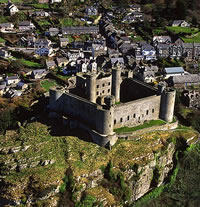
A photo of Harlech castle and town

I spent yesterday in Harlech [ˈharlɛx] with a friend looking round the castle, exploring the village and wandering along the beach. We wondered where the name Harlech comes from, so I thought I’d find out. According to Wikipedia, there are two possible sources: from the Welsh ardd (high; hill) llech (stone) or from hardd (beautiful) llech (stone). Apparently it was referred to as ‘Harddlech’ up until the 19th century in some texts, so the second derivation might be more likely.

The word ardd is not used in modern Welsh – high is usually uchel and hill is bryn. There are cognates in the other Celtic languages: arth (hill) in Cornish; arz (high) in Breton; ard (head; ascent; incline; high; height; senior; advanced) in Irish; àrd (high, lofty, tall; great; loud; chief, eminent, superior, supreme) in Scottish Gaelic; and ard (high, towering, tall, big, loud, height, high place, fell, incline) in Manx.

These all come from from the Proto-Celtic *ardwos (high), from the Proto-Indo-European *h₁rh₃dh-wo- (high, steep), which is also the root of the Latin words arduus (lofty, high, steep, tall, elevated) and arbor (tree, mast, javelin), the Ancient Greek word ὀρθός (orthós – straight), the English word arduous, [source].

Cruite, cláirseacha a chrythau

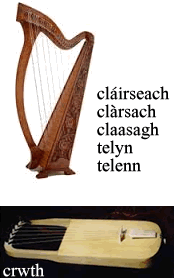
Cláirseach / Clàrsach / Claasagh / Telyn / Telenn, & Crwth

I discovered last week in Ireland that one word for the harp in Irish is cruit [krutʲ], which sounds similar to the Welsh word crwth [kruːθ], a type of bowed lyre that was once popular in Wales and in other parts of Europe, but which was largely displayed by the fiddle during the 18th century.

The word crwth from a Proto-Celtic word *krotto- (round object) and refers to a swelling or bulging out, of pregnant appearance, or a protuberance. The Irish word cruit comes from the same root and refers to small harps or lyres. The equivalent English word, which was borrowed from Welsh is crowd, which is also written crwd, crout or crouth, and in Medieval Latin such an instrument was called a chorus or crotta. The English surnames Crowder and Crowther, which mean a crowd player, and the Scottish names MacWhirter and MacWhorter also come from the same root [source].

The more common word for harp in Irish is cláirseach. In Scottish Gaelic the words cruit and clàrsach are used, with the latter being the most common, and in Manx we have claasagh and cruitçh. The Welsh word for harp is telyn, which has an equivalent in Manx – tellyn (Welsh harp). The Cornish word for harp is the same as the Welsh, and the Breton word is telenn.

Berlin

I’m having a wonderful time at the Polyglot Gathering. My luggage arrived, finally, and I’ve been speaking even more languages, including Cantonese, Taiwanese, Irish, Japanese, Czech, Russian and Turkish (a few words only). I haven’t found any speakers of Breton, Manx or Scottish Gaelic yet though.

I have been to some very interesting lectures and discussion about subjects like synesthesia, Scots, Indonesian, raising multilingual children, maintaining multiple languages, and the neuroscience of polyglot brains.

This morning I gave a talk about language death and revival, focusing particularly on the Celtic languages. When I saw that I’d been given an hour in the programme I thought I wouldn’t have enough material to fill it, but I could have easily talked for twice as long. Instead I talked for about 45 minutes then opened it up for questions. My talk was semi-structured and semi-stream of conciousness, but it seemed to go down well, and people found it interesting.

Tonight there’s another polyglot games evening, similar to the one we had last night. Tomorrow night I’ll be singing a few songs in the international culture evening. I will probably do a Welsh one and maybe an Irish one, but haven’t decided which ones yet.

Cuckoo bells

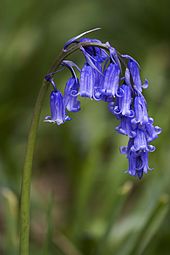
Bluebells (Hyacinthoides non-scripta)

I discovered this week that in Welsh bluebells (Hyacinthoides non-scripta) are known as Clychau’r Gog (“cuckoo bells”), which I really like the sound of. They are also known as Bwtias y Gog (“cuckoo’s boots”), Croeso Haf (“welcome summer”), Cennin y Brain (“crows’ leeks”), Clychau’r Eos (“nightingale’s bells”), Glas y Llwyn (“blue of the grove”), hosanau’r Gwcw (“cuckoo’s socks”).

In Breton bluebells are known as bokidi-koukou (“cuckoo flowers”) or pour-bran (“crows’ flowers/pears”).

In French they are known as jacinthe des bois (“wood hyacinths”) or jacinthe sauvage (“wild hyacinths”).

Other names for them in English include common bluebell, English bluebell, British bluebell, wild hyacinth, wood bell, fairy flower and bell bottle.

Do they have interesting names in other languages?

Les mots de la semaine

français English Cymraeg Brezhoneg
l’avant-dernier the last but one yr olaf/diwethaf ond un
la tuile (roof) tile teilsen; teilen; priddlech teol
le carreau (wall/floor) tile teilsen (lorio/wal) karrezenn
carreler to tile (a floor) llorio â theils; teilsio
la dalle de moquette carpet tile teilsen garped
faire la fête/la java to have a night on the tiles cael noson ar y criws / ar y sbri ober bos/fest
l’âne (m); le cancre; l’imbécile; un(e) nullard(e) dunce dỳns; twpsyn; penbwl azen; penn-karn; yann ar yod; paotr ar yod; loull
le bonnet d’âne dunce’s cap cap twpsyn/dỳns/papur; capan penbwl
la loupe (grossissante) magnifying glass chwyddwydr loupenn
à la loupe in minute detail mewn manylion lleiaf
sous la loupe under the microscope dan y microsgop

Les mots de la semaine

français English Cymraeg Brezhoneg
vaciller; danser to flicker (light) fflachio; neidio trabellat; horellat
le vacillement flicker (flames) naid; dychlamiad horelladenn
la lueur flicker (light) llygedyn skleur
la coupure de courant power cut toriad trydan troc’h tredan
le véhicule haut high-sided vehicle cerbyd ochrau uchel karbed uhel (?)
se retourner to overturn troi drosodd treiñ
marécageux marshy corslyd, corsiog, siglennog geunieg; gwazheg
le marais; le marécage marsh cors gwern; gwazh
le marais salant; le salin salt marsh morfa heli palud-holen; holenek

Les mots de la semaine

français English Cymraeg Brezhoneg
se multiplier comme des lapins to breed like rabbits magu fel cwningod
un raccourci; un moyen rapide short cut llwybr llygad/tarw berradenn
prendre un raccourci to take a short cut mynd y ffordd gyntaf;
dilyn llwybr llygad/tarw
hent miliner
une borne bollard postyn; clymbost matezh
faire la une;
faire la première page
to be front-page news bod yn brif newyddion;
bod ar y dudalen flaen
bezañ a bajenn gentañ (?)
un demi-tour (lit);
un revirement,
une volte-face (fig)
U-turn tro pedol hanterdro; distroenn;
faire volte-face to do a U-turn (fig) gwneud tro pedol ober hanterdro (?)

Les mots de la semaine

français English Cymraeg Brezhoneg
le gel; la gelée frost rhew; llwydrew; barrug rev
le givre hoarfrost barrug; glasrew; llwydrew kler
faire tourner to spin troi; troelli reiñ tro
jouer à pile ou face to spin a coin taflu ceiniog
inspecteur de police principal chief inspector Prif Arolygydd (yr Heddlu) pennenseller polis
le tollé outcry protest; banllefo brotest; gwrthgri hulch’o
un tollé général a public outcry protest cyhoeddus
la benne skip sgip benn
mécanique clockwork perfedd; clocwaith; peirianwaith mekanek
marcher comme sur des roulettes to go like clockwork mynd fel cloc; troi fel deiol
thé (de cinq heures);
thé de l’après-midi
afternoon tea te prynhawn/pnawn; prynhawnbryd te goude kreistez (?)

Les mots de la semaine

français English Cymraeg Brezhoneg
recommandé; prudent; conseillé advisable doeth; call; buddiol erbedet; avizet
récurrent;
périodique (math)
recurring dibaid; cylchol oc’h addonet; mareadeg
soins intensifs intensive care gofal arbenning;
gofal dwys
prederioù askoridik
cours intensif intensive course cwrs carlam staj d’an daoulamm
la paquet bundle (clothing) sypyn; swp; bwndel pakad
la liasse bundle (banknotes; newspapers sypyn; swp; bwndel strobad
un vrai boute-en-train a bundle of fun hwyl anfarwol ur kaser ar cholor
ce n’était pas une partie de plaisir it wasn’t a bundle of laughs doedd hi ddim yn hwyl anfarwol
coûter bonbon;
coûter une fortune
to cost a bundle/packet costio yn ddrud;
costio ffortiwn
bezañ un dirañson
la brique brick bricsen; priddfaen brik