Dilemmas and Trilemmas

A dilemma is “a situation necessitating a choice between two equal, esp. equally undesirable, alternatives”, or “a problem that seems incapable of a solution” [source].

It comes, via Late Latin, from the Ancient Greek δίλημμα (dílēmma, – ambiguous proposition), from δι- (di-, having two of) and λῆμμα (lêmma, – premise, proposition) [source].

Today I spotted the word trilemma in an article in The Spectator. I hadn’t seen it before, but from the context it appears to be a variant of dilemma involving three choices.

According to Wiktionary, a trilemma is “A circumstance in which a choice must be made between three options that seem equally undesirable” or “put another way, in which a choice must be made among three desirable options, only two of which are possible at the same time.”

I thought trilemma was a recently-coined word, but according to Wikpedia, it was first used in writing back in 1672.

Soft mitigation

The Russian word милый means dear, sweet (having a pleasing disposition); beloved, dear or darling. I learnt this while putting together a page of terms of endearment in Russian today.

It comes from the Proto-Slavic word *milъ (sweet, dear), from the Proto-Indo-European word *meh₁y- (mild, soft).

The Czech word milý (nice, kind, good, dear, pleasant, sweet; boyfriend) comes from the same root, as do similar words in other Slavic languages, such as the Belarusian мілы (sweet, nice), the Bulgarian мил (dear), and the Polish miły (nice, pleasant).

The Latin mītis (gentle, mild, ripe) comes from the same Proto-Indo-European root, as does the Italian word mite (mild, moderate, balmy), the Portuguese word mitigar (to mitigate), the Spanish word mitigar (to mitigate, alleviate, allay, assuage, quench, soothe), and the English word mitigate.

I’m would like to put together pages of terms of endearment / affection in other languages. Can you help with this?

Dog-eared and Badgered

Another dog-related idiom that came up this week was dog-eared which is often used to refer to books with pages that are bent, somewhat ragged and or with the corners turned down.

The equivalent in French is écorné which means dented, dog-eared, tatty or thumbed. It comes from the verb écorner, which means to remove the horns of; dehorn, to chip or dent, to dog-ear, or to turn down the corner of [source].

As a bibliophile it pains me to see un livre écorné (a dog-eared book), and I never turn down the corners of pages, or write notes in the margins, crack the spines, or overwise harm books. It just feels wrong. Some of my books have become a bit dog-eared, however, due to being read many times.

When I was trying to think of a way to describe a particularly dog-eared French dictionary, the first phrase that came to mind was that it was a bit badgered. I thought I’d read about things being badgered in this way somewhere, possibly in one of Terry Pratchett’s books*, but the person I was talking to had never heard it.

Then I came up with foxed, which means “of paper, having yellowish-brown stains”, according to Wiktionary. This wasn’t quite the expression I was looking for either. Then we settled on dog-eared.

The verb to badger, meaning to annoy persistently or persuade through constant efforts, does exist [source], so people might be badgered, but does anybody use badgered to describe a book or something else that looks like it’s been attacked by badgers?

Badgers

*The book is Guards! Guards! and the quote is “The Summoning of Dragons. Single copy, first edition, slightly foxed and extremely dragoned.” – so not badgered after all.

Dog Weather

When it’s raining heavily and the weather is particularly unpleasant, it is known as hondenweer [ˈɦɔn.də(n)ˌʋeːr] (“dog weather”) in Dutch, as you would only go out in it if you had to walk your dog.

Walking in the Rain

This is a phrase I learnt last week from a Dutch friend. According to Wiktionary it means “particularly bad or rough weather, the kind of weather when it is raining cats and dogs”.

The equivalent in French is temps de chien [tɑ̃ də ʃjɛ̃] (“dog weather”), which refers to filthy, dreadful or awful weather [source].

If the weather is even worse, you might say that it’s weer om geen hond door te sturen (“weather through which not to send any dog”) [source]. There is an equivalent in English: I wouldn’t send a dog out in this.

Are there any interesting dog-related expressions in other languages?

Sticky Cat-fish

Sticky catfish

Today I received a email from an advertising agency who are keen to put some ads on Omniglot. The jargon used in such emails is sometimes difficult to decipher. Some examples include:

“All companies are white”
– Presumably this means that the don’t engage in any dodgy or shady practices. I’ve heard of white hat and black hat hackers, and white and black magic, but not of companies being white.

“We can buy your unsold inventory”
– Not sure what this means. I think that inventory is any places on my site where you could place an ad, and unsold inventory is probably places that don’t already contain ads.

“We encourage you to place our banners, sticky cat-fish and pre-rolls.”
– I know what banners are, but sticky cat-fish and pre-rolls??

A catfish ad “appears (slides in or fades in) as a horizontal area at the bottom of a page. The term likely comes from the image of a catfish coming up to the water surface for air.” [source].

I suppose a sticky catfish ad is one that sticks around and can’t be minimised or dismissed. If you’re viewing this site on a phone or other small-screened device, you might spot some catfish, which are not sticky, as far as I know.

A pre-roll ad “is a video advertisement that automatically plays directly before a featured video.” [source].

Is there similar advertising jargon in other languages?

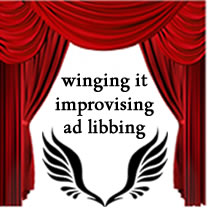
Winging It

Winging it, improvising, ad libbing

When actors have to take on a role in the theatre at the last minute, and try to learn their lines while waiting in the wings, or at the side of the stage, they are said to be ‘winging it‘.

At least that is thought to be the origin of this phrase, according to The Phrase Finder.

Apparently it was first used in writing in 1885 in the Stage magazine in the form of the verb ‘to wing’:

“‘To wing’… indicates the capacity to play a rôle without knowing the text, and the word itself came into use from the fact that the artiste frequently received the assistance of a special prompter, who… stood… screened by a piece of the scenery or a wing.

Winging it came to mean to do make things up as you go along, or to improvise with little preparation.

This is how I tend to make my podcasts and give presentations – I know more or less what I’m going to talk about, I make some notes, and I might rehearse it in my head a few times. Then I just wing it.

When speaking in foreign, I also wing it some of the time, paraphrasing when I don’t know particular words, and guess the grammar when I’m not sure of it. This is a very useful skill to develop.

Related expressions include to do something off the top of your head, to do something on the fly, to ad lib, and to make it up as you go along.

Are there similar phrases in other languages?

Between Four Eyes

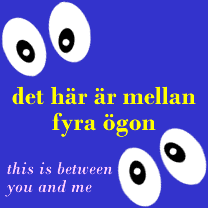
Illustration of the Swedish phrases mellan fyra ögon (between four eyes)

I learnt this week that in Swedish if you say that something is “between four eyes” – mellan fyra ögon – it means that it is known just to you and the person you’re speaking to, and should be kept secret.

Equivalent expressions in English include:

  • This is (just) between you and me/I
  • Keep it under your hat
  • This is between you, me and the post / gatepost / fencepost / bed-post / lampost / wall
  • Mum’s the word

The phrase “keep it under your hat” with the sense of keeping something a secret apparently first appeared in writing in the early 20th century, and referred to keeping something in your head, i.e. the thing you keep under your hat [source].

The phrase “between you, me and the bed-post” possibly first appeared in writing in 1832 in Eugene Aram, a novel by Edward Bulwer-Lytton [source].

The phrase “Mum’s the word” has nothing to do with mothers or Egyptian mummies. Instead it refers to the medieval tradition of mumming, a kind of performance involving acting and dancing that was at first done in silence [source].

Do you know any other similar phrases in English or other languages?

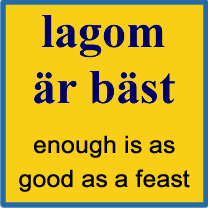
Lagom är bäst

Lagom

One of the Swedish idioms I learnt recently is lagom är bäst, which is translated as “less is more”, “enough is as good as a feast” or “there is virtue in moderation”, and literally means something like “the right amount is best”.

Lagom [lɑːɡɔm] is a word that is supposedly untranslatable. It is variously defined as meaning “in moderation, in balance, perfect-simple, suitable, enough, sufficient, adequate, just right”.

The Svesnska Akademiens Ordbok defines lagom as:

som är som sig bör (för att passa för ett visst ändamål), lämplig, passande; medelmåttig, medelstor, medelbred, medelgod osv., av normal storlek, styrka osv., normal.

which is as it should (to suit a particular purpose), appropriate, appropriate; mediocre, medium, medium-width, average good, etc., of normal size,. strength, etc., normal

Lagom is apparently the basis of the Swedish national psyche, which emphasises consensus, equality, modesty and avoidance of extremes.

According to Mattias Persson, the word lagom itself actually means “for the law”, or “within the boundaries of the law”, that is, what is normal or according to normal customs. It is a dative case (indirect object) form from lag (law).

Is less more? Are you a minimalist?

Are there words in other languages that have similar meanings to lagom?

Scrupulous Scruples

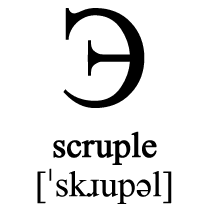
Scruple

A scruple can be a doubt, hesitation or unwillingness to do something due to uncertainity about what is right, or to show reluctance on grounds of conscience [source].

When scruple first appeared in English in the 14th century [source], it referred to a unit equal to ¹/₂₄ of an apothecaries ounce, ⅟288 of a pound, twenty grains, one third of a dram or 1.3 grams. As a liquid measure it was ¹/₂₄ of a fluid ounce, ⅓ of a fluid dram, 20 minims, ¼ of a teaspoon, or 1.23mm [source]. It could also refer to a minute part or quantity of something.

The symbol for a scruple is ℈ (see top right), which was used by alchemists and apothecaries. Related symbols include ℥ = apothecary ounce and ℨ = dram or drachm [source]. More alchemical symbols.

By the 15th century a scruple was “an ethical consideration or principle that inhibits action” or a “mental reservation” [source]

Scruple comes from the Old French scruple (scruple, compunction, qualm), from the Latin scrūpulus (a small sharp or pointed stone; ¹/₂₄ of an ounce; uneasiness of mind, anxiety, doubt, trouble; scruple), a diminutive of scrūpus (a rough or sharp stone; anxiety, uneasiness).

Winning One’s Steak

An interesting French expression I learnt last night was gagner son bifteck, which means literally “to win/earn one’s steak”, and is the equivalent of “to bring home the bacon” [source].

The French word bifteck [bif.tɛk] comes from the English beefsteak, and means steak.

Related expressions in French include:

  • gagner sa vie = to earn one’s living
  • gagner de quoi vivre = to earn one’s keep
  • gagner sa croûte = to earn one’s crust
  • gagner une misère = to earn a pittance

Similar phrases in English include:

  • to keep the wolf from the door
  • to put food on the table
  • to keep clothes on your back
  • to keep a roof over your head

Do you know any others?

In Welsh equivalent expressions include:

  • ennill eich tamaid = to earn one’s living (“to achieve/win/earn one’s bite”)
  • ennill eich bara (menyn) = to earn one’s bread (and butter)

What about in other languages?

By the way, if you’ve been unable to access this blog, or other parts of Omniglot recently, this is because of my inept attempts to make it secure with SSL, etc. Fortunately the good people at Kualo, where this site is hosted, were able to sort things out quickly, and normal service has now been resumed, hopefully.

If you’re looking for somewhere to host your website, I would definitely recommend Kualo. Their service and technical support are excellent, and their prices are reasonable. They also use renewable energy as much as possible.