Jumpers and sea pigs

Llamhidydd / Porpoise / Mereswine

Llamhidydd, (n/m) [pl. llamhidyddion] – porpoise, dancer, acrobat, jumper

Today’s word appears in a book I’m reading at the moment and is a new one to me. I’m not sure about the etymology of the hid part, but llam means jump, and the suffix -ydd indicates a person or agent.

As well as jump, llam also means fate, leap, bound, stride, step, and is found in such words as llamddelw – puppet (jump + image/idol); llamu and llamsach – to jump; llawsachus – capering, prancing, and llamwr – leaper. Llam most likely comes from the same root as the Irish léim, Scottish Gaelic leum, Manx lheim, Cornish lamma and Breton lam. More common Welsh words for jump and to jump are naid and neidio.

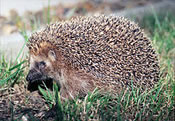
Other Welsh words for porpoise include môr-fochyn (sea pig) and morhwch (sea sow), which is also applied to dolphins. The Irish for porpose is muc mhara (sea pig).

The English word porpoise comes from the French pourpois, which is from Medieval Latin porcopiscus, which is a compound of porcus (pig) and piscus (fish).

Another English word for porpoise is apparently mereswine, the roots of which can be traced back to the Proto-Germanic *mariswīnaz (dolphin, porpoise), from *mari/*mariz (sea) and *swīnaz/*swīnan (swine, pig), via the Middle English mereswin and the Old English mereswīn.

Bœuf

One thing we were discussing last week at the French conversation group was words for animals and their meat. In French the words for meat are also used for the animals: bœuf means beef and ox, porc means pork and pig, mouton means mutton and sheep, while in English there are different words for these things.

The popular explanation for the different English words for the animals and their meat is that after the Norman invasion of Britain in 1066, the animals were reared by the English, who called them , pecges and scéapes (cows, pigs and sheep) and eaten by the Normans, who called them boef, porc and motun (beef, pork and mutton). However the distinction between the names for the meat and the animals didn’t become set until the 18th century, and mutton and beef were used to refer to sheep and cows for many centuries after the Norman Conquest.

Bœuf comes from the Latin bos (ox, cow), the reconstructed Proto-Indo-European (PIE) root of which is gwóu (cow). This is also the root of vache, the French word for cow, via the Latin vacca (cow), and of the English word cow, via the Old English (pl. ) and the reconstructed Proto-Germanic word kwom. In fact many of the words for cow, bull or cattle in Indo-European languages probably come from the PIE root gwóu. Examples include: (Irish and Scottish Gaelic), booa (Manx), buwch (Welsh), bugh (Cornish), buoc’h (Breton), govs (Latvian), կով (kov) (Armenian), گاو (gav – Persian) and Kuh (German).

As well as ox or steer and beef, bœuf also means (a) surprising; unusual; (b) stupid (in Swiss French); (c) (musical) jam session / jazz improvisation.

Idioms containing bœuf include:

  • avoir un boeuf sur la langue (to have a cow on the tongue) = to keep quiet; not give anything away
  • boeuf carottes (beef carrots) = internal affairs (Police)
  • comme un boeuf (as an ox) = very strong
  • gagner son boeuf (to earn one’s beef) = to earn a living
  • on n’est pas des boeufs (we are not cattle) = a little consideration and respect, I beg you

Meanings of mouton include: (a) sheep; (b) mutton; (c) sheep / lamb (someone easily led); (d) stool pigeon / grass; (e) moutons = white horses (on waves) / fluff / fluffy or fleecy clouds. Mutton and mouton possibly come from the Gaulish multo (ram) via the Middle Latin multonem and the Old French moton (ram, wether, sheep).

Idioms containing mouton include:

  • mouton à cinq pattes (a sheep with five feet) = white elephant rara avis / rare bird (something difficult or impossible to find)
  • revenir à ses moutons (to return to one’s sheep) = to return to the thread / subject of one’s discourse
  • suivre comme un mouton (to follow like a sheep) = to act like everyone else; gregarious

Sources
http://www.anglo-norman.net/
http://www.ceantar.org/Dicts/MB2/mb04.html
http://www.indo-european.nl/
http://www.le-dictionnaire.com/
http://www.etymonline.com/
http://indoeuro.bizland.com/project/phonetics/word28.html

Eastáit na Sí

Eastáit na Sí

An interesting Irish expression I came across recently is Eastáit na Sí (“Fairy Estates”), which are known as Ghost Estates in English. These are housing estates full of empty houses that nobody can afford thanks to the disappearance of the Celtic Tiger.

The Irish version refers to the (fairies or little people) from Irish folklore. The writer of the article suggests a solution to this problem – making the empty estates into new Gaeltachtaí [source].

The old spelling of is sídhe; in Old Irish it’s síde; in Scottish Gaelic it’s sìth, and in Manx it’s shee, and the English word banshee comes from the Irish bean sí (fairy woman).

The fairy folk are often referred to be other names and it is consider unlucky to call them fairies. Instead they might be known as wee folk, good folk, people of peace, fair folk, good neighbours or little people in English. In Welsh they’re known as the tylwyth teg (fair tribe), in Manx they’re the mooinjer veggey (little people), and in Cornwall they’re known as piskies or the pobel vean (little people).

The word fairy comes from the Late Latin fata (one of the Fates) via the Old French faerie, which means the land, realm, or characteristic activity (i.e. enchantment) of the people of folklore called faie or fee [source].

Lá Fhéile Pádraig Shona Daoibh / Happy St Patrick’s Day!

Cennin Pedr

Daffodils / Cennin Pedr / Narcissi

Yesterday was St David’s Day (Dydd Gŵyl Dewi), a day when many Welsh people wear daffodils (cennin Pedr) in honour of their patron saint. The daffodil (cenhinen Bedr) is one of the national symbols of Wales, along with the leek (cenhinen), and the Welsh name for daffodil means “Peter’s leek”. The leek has been a Welsh symbol for many centuries and features prominently in traditional Welsh dishes such as cawl cennin (leek soup). The daffodil became popular as a national symbol during the 19th century, especially among women.

The names for daffodil in Irish, Manx and Scottish Gaelic are similar: lus an chromchinn, lus ny cam-ching and lus a’ chrom-chinn, which mean “bent-headed plant”. Alternative names in Manx include lus ny n’guiy (goose plant) and lus yn arree (Spring plant).

The English word daffodil is thought to comes from the Middle English affodill (asphodel), from the Middle Lation affodillus, from the Latin asphodelus, from the Greek asphodelos, the origin of which is unknown. The initial d perhaps came from a merging of the Dutch definite article de with affodil (Source).

According to Plutarch the Latin name for daffodil, narcissus, comes from the Greek ναρκαώ [narkao] (to numb), which is also the root of narcosis, as the plant which produces numbness or palsy (Source). Although other sources claim that the narcissus was named after Νάρκισσος [Narkissos], the character in Greek myths.

The daffodil or narcissus is a symbol of vanity in the West, while in China it’s a symbol of wealth and good fortune.

Word of the day – cawl

Today’s word, cawl /kaul/, is a Welsh word meaning soup, broth, gruel or a mess.

Cawl is also a traditional Welsh stew made with meat and vegetables. It’s the kind of dish that’s made from whatever is available so the exact ingredients vary, but it often includes lamb and leeks, and is often served with bread and cheese. There a recipe for cawl and more information here.

The word cawl probably comes from the Latin caulis, which means the stalk of a plant, a cabbage stalk or a cabbage. It is related to the Irish cál, the Scottish Gaelic càl, the Cornish caul, the Breton kaol, the German Kohl, the English cole, as in coleslaw, and the Scots kail, all of which mean cabbage. The Welsh word for cabbage is completely different – bresychen.

The Proto-Indo-European root of caulis is *kaw(ǝ)l, which means tubular bone or pipe.

It’s a braw bricht moonlicht nicht

Full moon

I went for a walk with some friends last night and one of the things we were talking about was the moon, which was nearly full and very bright. One of my companions suggested that there should be an adjective similar to sunny to describe such a night. He came up with moony, and I couldn’t think of anything better – can you?

I’ve since discovered that full moons have different names in different months. A December full moon like the one tonight, for example, is known as the oak moon in the medieval English calendar, as the cold moon in the Celtic calendar, as the peach moon by the Choctaw, as the snow moon by the Cherokee, and as the bitter moon by the Chinese. More moon names.

By the way, the title of this post is the Scots for ‘It’s a beautiful moonlit night’ and comes from a song by Sir Harry Lauder called Wee Deoch an Doris, which you can hear here. Deoch an Doris comes from the Scottish Gaelic expression ‘deoch an dorais’ – lit. ‘drink of the door’, which means ‘one for the road’ or ‘the parting glass’.

Y Cooish

I’m currently in the Isle of Man for the Cooish, a festival of Manx language and traditional music from the Isle of Man, Ireland and Scotland. Last night I went to an excellent concert in Peel which included the Arrane son Mannin (Song for Man) competition, and there’s a lecture in Manx (Leaght y Ghaaue) this evening.

Yesterday I met a Manx-speaking friend on the boat coming over and we talked Manx throughout the crossing. Well actually she did most of the talking and I contributed to the conversation whenever I could. It was the longest conversation I’ve ever had in Manx and I was pleased to find that I could understand almost everything, and even got the jokes.

My Manx tends to get mixed up with Irish and Scottish Gaelic, and even Welsh sometimes, but my friend is fluent in Irish, and speaks some Scottish Gaelic and Welsh, so this didn’t matter so much. We did try to stick to Manx most of the time though.

One of the things we were discussing was false friends between the Gaelic languages. For example, daoine means people in Irish, while in Manx dooiney means men, and the word for people is sleih, mooinjer or pobble. In Scottish Gaelic people is poball or sluagh, and men is daoine.

We also tried to translate Queen’s Bohemian Rhapsody into Manx, though couldn’t remember all the words in English and weren’t sure of the Manx equivalents of some of the words we could remember.

When is a language extinct?

The recent publication of UNESCO’s Atlas of the World’s Languages in Danger has generated quite a few new stories and discussion.

The Atlas has a list of 2,500 endangered languages ranked according to five different levels: unsafe (607), definitely endangered (632), severely endangered (502), critically endangered (538) and extinct (200). Of these languages, 199 have fewer than 10 speakers, and 178 have between 10 and 50 speakers. The Atlas is apparently available online, although I can only find information about endangered languages in Africa.

Among the extinct languages it mentions Manx and Cornish, which has stirred up a lot of comment, especially among those who speak these languages and are learning them. For example, the website iomtoday.co.im tells us that the ‘Manx language is very much alive’ and there are articles on Manx and Cornish on the BBC site.

The comments on the iomtoday site are interesting and seem to agree that Manx is nobody’s first language, which I believe is true. One commenter points out that Manx is dead because “there are no longer any monoglot Manx speakers, or even speakers with Manx as a first language”. I’m not sure why it’s essential for there to be monoglot speakers of a language for it to be considered living. There are very few, if any, monoglot speakers of Welsh, Irish or Scottish Gaelic over the age of 5 or so, but there are plenty of people who speak them as their first language.

My dissertation will be a study of the revival of Manx, and this will give me a better idea of the current state of the language.

Faclair Dwelly

I heard recently that there is now an online version of Dwelly’s Gaelic Dictionary, the most comprehensive Gaelic dictionary currently available. You can search for words via Scottish Gaelic or English, a significant improvement on printed version. You can also search for whole words, parts of words, exact spellings or similar sounding words. Another advantage of the online version of the dictionary is that you can read the text clearly and change the size if necessary – in the printed version the text is quite small and not always easy to read.

Edward Dwelly (1864-1939) was an English man with no Scottish connections who became fascinated by Scotland and learned to speak Gaelic like a native, and to play the bagpipes to a virtuoso level. He was also an active member of Comunn Gàidhealach an Lunainn (the Gaelic Society of London). He started work on his Illustrated Gaelic-English Dictionary in 1891, and it was published between 1902 and 1911. He not only compiled the dictionary, but also edited, illustrated, proof-read and printed it.

While the dictionary is somewhat out of date, the guys who digitised it are planning to add new words, recordings and images to it to bring it up-to-date.