
Icelandic is a Northern Germanic language spoken by about 390,000 people mainly in Iceland (Ísland), where it is an official language. There are also speakers of Icelandic in Denmark, the USA and Canada, particularly in Manitoba in an area known as New Iceland (Nýja Ísland).
Icelandic is the closest of the Northern Germanic languages to Old Norse, and it is possible for Icelandic speakers to read the Old Norse sagas in the original without too much difficulty. It is closely related to Faroese and western dialects of Norwegian, and less closely related to Danish and Swedish. Written Icelandic and Faroese are more or less mutually intelligible, but the spoken languages are not.
The first permanent settlement in Iceland was established by Vikings from Norway and Celts from the British Isles in 870 AD. The main language of the settlers was Old Norse or the Dǫnsk tunga (Danish tongue). A number of great literary works - the sagas - were written by Icelanders during the 12th and 13th centuries. These sagas, many of which were the work of unknown authors, were written in a language very much like Old Norse. The greatest known authors from this period were Ari the Learned (1068-1148) and Snorri Sturlson (1179-1241).
From 1262 until the 15th century, Iceland was governed by Norway, then the Danes took over. During the periods of Norwegian and Danish rule, Norwegian and Danish were used in Iceland, to some extent.
In 1944 Iceland gained its independence and Icelandic was revived as an official and literary language. Today there is a flourishing publishing industry in Iceland and Icelanders are probably the keenest readers and writers in the world.
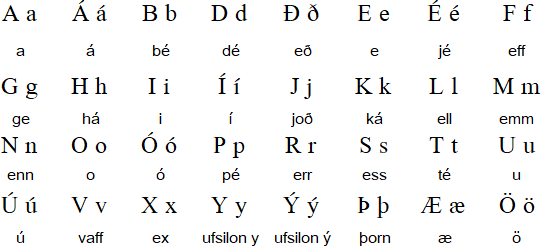
The letters C (se), Q (kú) and W (tvöfalt vaff) are also used, but only in foreign loanwords. The letter Z (seta) is only used in the newspaper Morgunblaðið and in words borrowed from other languages, such as pizza.
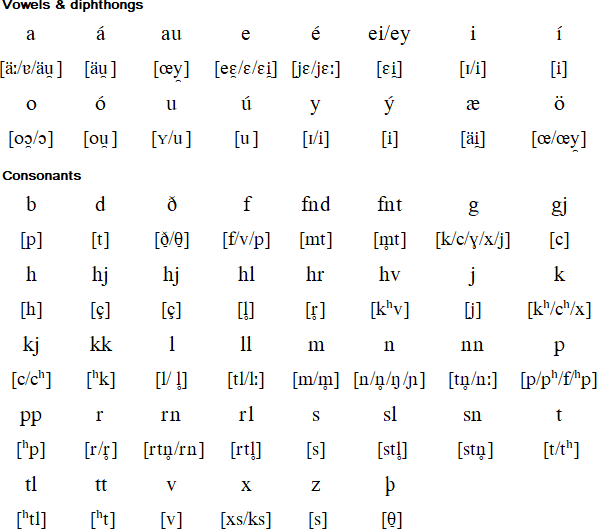
Download an alphabet chart for Icelandic (Excel)
Hear how to pronounce the Icelandic letters with example words:
Hver maður er borinn frjáls og jafn öðrum að virðingu og réttindum. Menn eru gæddir vitsmunum og samvisku, og ber þeim að breyta bróðurlega hverjum við annan.
A recording of this text by Marc Volhardt
A recording of this text by Alexander Jarl
A recording of this text by Stefan Steinsson
All human beings are born free and equal in dignity and rights. They are endowed with reason and conscience and should act towards one another in a spirit of brotherhood.
(Article 1 of the Universal Declaration of Human Rights)
Information about Icelandic | Phrases | Numbers | Colours | Family words | Time | Terms of endearment | Idioms | Tongue twisters | Tower of Babel | Learning materials
Information about Icelandic
http://en.wikipedia.org/wiki/Icelandic_language
https://is.wikipedia.org/wiki/Íslenska
https://www.britannica.com/topic/Icelandic-language
https://guidetoiceland.is/history-culture/the-difficult-icelandic-language
Online Icelandic lessons
http://www.digitaldialects.com/Icelandic.htm
http://www.101languages.net/icelandic/
http://mylanguages.org/learn_icelandic.php
http://www.ielanguages.com/icelandic.html
http://tungumalatorg.is/viltu_laera_islensku/en
Icelandic Grammar
http://www.dettifoss.org
http://www.language-learning-advisor.com/support-files/icelandicprimer.pdf
https://islenzka.is/
Icelandic phrases
http://www.bbc.co.uk/languages/other/quickfix/icelandic.shtml
http://wikitravel.org/en/Icelandic_phrasebook
http://www.linguanaut.com/english_icelandic.htm
Online Icelandic dictionaries
http://www.ordabok.is/index.asp?mal=en
http://www.hugtakasafn.utn.stjr.is
http://digicoll.library.wisc.edu/IcelOnline/
Online Icelandic radio
http://www.ruv.is
http://www.bylgjan.is
http://www.utvarpsaga.is
Online Icelandic newspapers
http://www.bb.is
http://www.visir.is
http://www.mbl.is
Afrikaans, Alsatian, Bavarian, Cimbrian, Danish, Dutch, Elfdalian, English, Faroese, Flemish, Frisian (East), Frisian (North), Frisian (Saterland), Frisian (West), German, Gothic, Gottscheerish, Gronings, Hunsrik, Icelandic, Limburgish, Low German, Luxembourgish, Mòcheno, Norn, Norwegian, Old English, Old Norse, Pennsylvania German, Ripuarian, Scots, Shetland(ic), Stellingwarfs, Swabian, Swedish, Swiss German, Transylvanian Saxon, Värmlandic, Wymysorys, Yiddish, Yola, Zeelandic
Languages written with the Latin alphabet
Page last modified: 24.07.26
[top]

Note: all links on this site to Amazon.com


You can support this site by Buying Me A Coffee, via PayPal or Patreon, or by contributing in other ways.
If you find all the adverts annoying, there is now an Ad-free version of Omniglot which you can access for a small monthly or annual donation.

This website and its content is copyright of Simon Ager - © Simon Ager 1998-2026. All rights reserved. All images were created by me, unless otherwise indicated. More details

[top]


