Multilingual Manchester

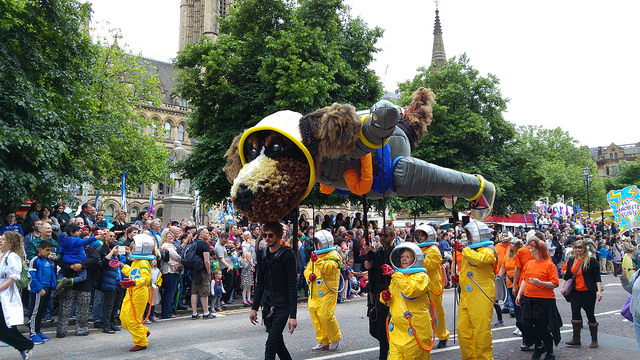
Part of the Manchester Day Parade 2016

I had a multilingual day in Manchester today – I spent part of it listening to choirs and other groups performing as part of the Manchester Day celebrations. They sang in English, Irish, Scottish Gaelic, Maori, Hebrew and Yiddish, and I also watched the Manchester Day parade.
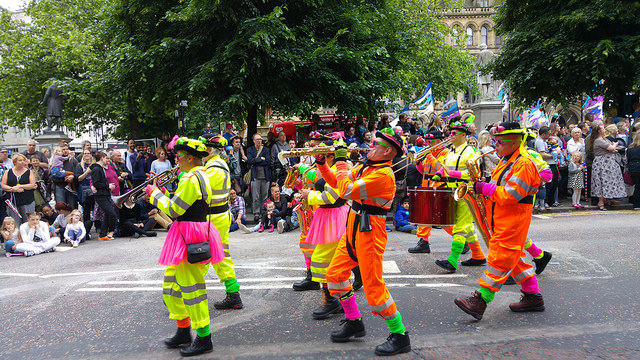
Part of the Manchester Day Parade 2016

I also went to the Polyglot Pub, a meet-up arranged by Kerstin Cable of Fluent Language. The seven of us who turned up spoke in English, French, German, Spanish, Portuguese, Italian, Russian and Swedish, plus odd bits of Welsh, Irish, Scottish Gaelic, Japanese, Finnish and Estonian. This was the first Polyglot Pub in Manchester, and hopefully won’t be the last.
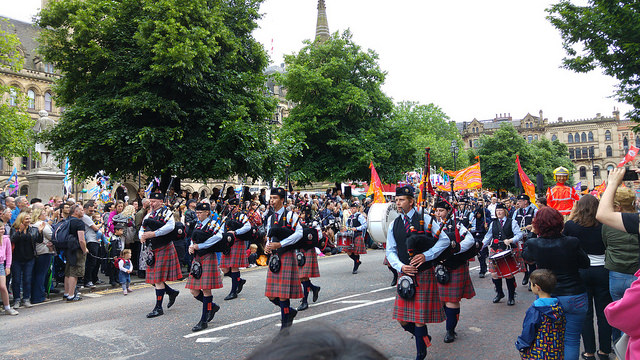
Greater Manchester Fire & Rescue Service Pipe Band

You can see more photos on Flickr

There will be a language quiz tomorrow, by the way.
Suburban bans

In French the word banlieue [bɑ̃.ljø] can refer to:

1. Circonscription territoriale qui s’étendait à une lieue hors de la ville et dans laquelle un juge pouvait exercer sa juridiction.
(Territorial division that stretched a mile out of town and in which a judge could exercise jurisdiction).

2. Territoire et ensemble des localités qui environnent une grande ville.
(Territory and all the communities that surround a large city).

This word comes from the Medieval Latin banleuca (the space within a mile of a city to which extended the ban in feudal society). The word ban in this context refers to the jurisdiction of an overlord in which he could call vassals for war. It comes from Old French, from the Frankish *ban.

Sources: le Trésor de la langue française informatisé and Wiktionnaire

The word banlieue is also used in English to refer to “The outskirts of a city, especially in France, inhabited chiefly by poor people living in tenement-style housing” [source].

The English word banns, as in banns of marriage, probably comes from the same root as the French ban, but the English word ban (to forbid, prohibit), comes from the Middle English bannen, from the Old English bannan ‎(to summon, command, proclaim, call out), from the Proto-Germanic *bannaną ‎(curse, forbid), from the Proto-Indo-European *bʰeh₂- ‎(to say) [source].

The elusive illusive

Sometimes you think you know a word, but when you check it, you discover that you’ve mixed it up with a similar-sounding word. That’s what happened to me this week with the words elusive and illusive. Without looking them up, do you know what they mean?

When you’re searching for something but have trouble finding it, that thing is elusive. According to the Collins English Dictionary, it means:

1. difficult to catch (an elusive thief)
2. preferring or living in solitude and anonymity
3. difficult to remember (an elusive thought)

So something that is elusive might difficult to find, describe, remember, or achieve.

Illusive, on the other hand, means illusory or unreal.

So something that is illusive could also be elusive.

Elusive comes from the Latin elus-, the past participle stem of eludere (to elude, frustrate) plus the -ive ending. Elude comes from ex- (out, away) and ludere (to play) [source].

Illusive comes from illusion + -ive. Illusion comes from the Old French illusion (a mocking, deceit, deception), from the Latin illusionem (a mocking, jesting, jeering; irony), from the past participle stem of illudere (mock at), from in- (at, upon) and ludere (to play) [source].

Rowing your boat

The French equivalent of to go for a row (in a boat), is faire un tour en barque or faire de la barque, and to row (a boat) is ramer, which also means to stake, although if you’re rowing as a sport then it’s faire de l’aviron.

A barque is a small boat or rowing boat, a barque de pêche is a fishing boat, a patron de barque is a skipper. Aviron is rowing or an oar, which is also main d’aviron or pagaie, and avironner means to paddle, which is also pagayer.

To ram in French is percuter, and a battering ram is a bélier, which is also a ram (male sheep).

A row (noise) in French is un vacarme, and a row (noisy argument) une dispute and to row is se disputer.

So to have a row [raʊ] while going for a row [rəʊ] would be “se disputer en faire un tour en barque”, I think.

Source: Reverso

Micro-learning

I got an email yesterday from someone who is “developing a micro-learning program dedicated to language learning”. This was the first time I’d heard the term micro-learning so I wasn’t entirely sure what it meant.

According to Wikipedia, microlearning “deals with relatively small learning units and short-term learning activities”. This sounds like the technique some people recommend of using whatever spare moments you have to learn a bit more of a language, or whatever you’re studying.

Do you engage in microlearning?

Do you find it a good way to learn?

I’ve tried this, and find it can be quite effective, but prefer to learn in a focused way with as few distractions as possible for a longer time – about 30 minutes seems work best for me.

Peripatetic false friends

The English word peripatetic means “tending to walk about; constantly travelling; itinerant; nomadic”. It is also related to Aristotle, his philosophy, and the school of thought he founded. A peripatetic teacher is one who teaches in a number of different schools, and it’s common, at least in the UK, for music teachers and sometimes language teachers, to be peripatetic.

It comes from the French péripatétique, from the Latin peripatēticus, from Ancient Greek περιπατητικός ‎(peripatētikós – given to walking around), from περιπατέω ‎(peripatéō – I walk around), from περί ‎(perí – around) and πατέω ‎(patéō – I walk). The French and Latin words mean “of or relating to Aristotle and his philosophy” [source].

The French for a peripatetic teacher is enseignant itinérant, and a travelling salesman is vendeur ambulant and a busker is musicien ambulant. The word péripatéticien(ne) does exist in French, but refers to a streetwalker / prostitute [source]. So should be handled with caution.