**************************************************************
A multlingual Merry Christmas and happy language learning in the New Year!
**************************************************************
**************************************************************
A multlingual Merry Christmas and happy language learning in the New Year!
**************************************************************
Here’s a recording in a mystery language.
Can you identify the language, and do you know where it’s spoken?
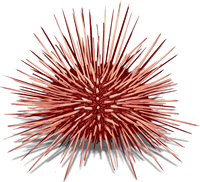
I discovered today that sea urchins (echinoidea) are known as zee-egels (sea hedgehogs) in Dutch, and that they used to be known as sea hedgehogs in English as well. They have similar names in other languages, for example, in German they are Seeigel (sea hedgehogs), in French they are oursins or hérissons de mer (sea hedgehogs) and in Spanish they are erizos de mar (sea hedgehogs).
The word urchin comes from the Middle English word yrichon (hedgehog), from the Old North French word *irechon, from the Old French herichun (hedgehog) – in Modern French hedgehog is hérisson – from the Vulgar Latin *hericionem, from the Latin ericius (hedgehog), from the Proto-Indo-European root *ghers- (to stiffen, bristle, stand out). From the same root we also get such English words as gorse, hirsute, horror and ordure.
The word urchin is apparently still used for hedgehog in some English dialects such as Cumbria, Yorkshire and Shropshire. It came to refer to people who looked or acted like hedgehogs from the early 16th century, and to poor, ragged youths from the mid 16th century, though this usage didn’t really take off until the late 18th century. Sea urchin was first used in the late 16th century.
Sources: Online Etymology Dictionary and Indo-European Lexicon
I heard about an interesting project today: 7000 Languages Project – the goal of the project is to create web- and mobile-delivered learning materials for the 7,000 languages beyond the top 100 or so that attract significant commercial support.
The 7000 Languages Project involves creating Langscape, an online portal for learning about languages worldwide, that combines an interactive language map with links to an expanding range of resources on thousands of languages. Langscape is intended to serve multiple communities, including language teachers and learners, researchers, K-12 educators, government and NGOs, and public outreach.
When I learnt a Russian word for frost – мороз (moróz) – this week I thought that the word for ice cream – мороженое (morózhenoe) – might come from the same root. According to Wikitionary they are related: мороженое comes from морозить (to freeze) from мороз, which comes from the Proto-Slavic *morzъ (frost).
Related words include:
– заморозок (zamorozok) = overnight freeze, cold snap (usually in late spring or early autumn, when days are warm)
– морозилка (morozilka) = freezer
– морозный (moroznyj) = frosty
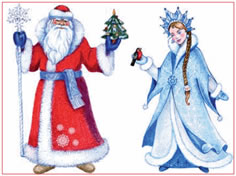
Дед Мороз (Ded Moróz) is the Slavic equivalent of Father Christmas / Santa Claus. His name means “Old Man Frost” and he traditionally delivers presents to children on New Year’s Eve (31st December), and is accompanied by Снегурочка (Snegúrochka), the Snow Maiden.
Here’s a recording in a mystery language.
Can you identify the language, and do you know where it’s spoken?
Yesterday I received an email telling me that there shouldn’t be Hebrew versions of Merry Christmas and Happy Easter among the Hebrew phrases on my site as,
“the Hebrew language is a holy language” and that “if you say Happy Easter, or Merry Christmas in Hebrew you pretty much burn to death in the spot if you’re a Jew.”.
He also states that,
“Most of the people who will be reading your Hebrew section are either Jewish and will be offended, or will think they can say those things to Jewish people, and they will offend the Jewish people they speak to.”
I’m aware that Jews do not celebrate Christmas or Easter, and that the majority of people who speak Hebrew are Jews. However I understand that there are around 350,000 Hebrew-speaking Christians in Israel [source] who probably do celebrate these festivals and use these phrases – I’ve added a note to the Hebrew phrases page along these lines. I’ve had similar comments about the Somali versions of these phrases.
Do you think that my correspondent is right about this?
A mishap is “an unlucky accident”, according to the Oxford Dictionaries, and is often accompanied by the word minor – e.g. we had a few minor mishaps in the kitchen, but at least we didn’t burn the chicken.
I happened upon the word mishap today and it got me wondering whether the word hap also exists. It does, though it rarely used these days, as far as I can tell.
Hap means:
– luck, fortune
– a chance occurrence, especially an event that is considered unlucky
– to come about by chance
– to have the fortune or luck to do something.
So it’s a contronym or auto-antonym in that it can mean good luck and the opposite, bad luck.
Here are some examples:
– If you have the good hap to come into their houses
– I entertained the Company with the many Haps and Disasters
– What can hap to him worthy to be deemed evil?
– Where’er I happ’d to roam
Source: Oxford Dictionaries
Hap, mishap, and happen and happy, all come from the Old Norse word happ (chance, good luck), from the Proto-Germanic *hap-/*hampą (convenience, happiness), from the Proto-Indo-European *kob- (to suit, fit, succeed), which is also the root of the Old Irish cob (victory) and the Russian кобь [kob’] (fate).
Source: Online Etymology Dictionary and Wiktionary
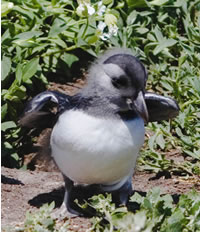
The other day I discovered that a young puffin is known as a puffling, which I really like the sound of.
There are a few other words that include the -ling suffix that are commonly used: sibling, duckling, underling, earthling, seedling, yearling (an animal that is between one and two years old) – can you think of others?
There are plenty more on Wiktionary, though few are in common use, as far as I know.
Here’s a recording in a mystery language.
Can you identify the language, and do you know where it’s spoken?