Taiwan to adopt Hanyu pinyin

According to this report, hanyu pinyin is to be officially adopted in Taiwan from the beginning of next year.

The main romanization systems currently used in Taiwan are Wades-Giles and Tongyong Pinyin. However, as they are not taught in schools, mistakes and misspelling are very common, and it’s not usual to see the romanized name of a street written in several different ways. The Wade-Giles system was devised by Thomas Francis Wade, a British ambassador to China and Chinese scholar, in the late 19th century, and refined in 1912 by Herbert Allen Giles, a British diplomat in China. The Tongyong Pinyin system was invented in Taiwan and adopted in 2000. Hanyu pinyin was developed in China in the 1950s and was adopted as the international standard for romanizing Chinese in 1979.

It hanyu pinyin is adopted for place names as well as street names, Taipei will become Taibei, Kaohsiung will change to Gaoxiong, Hsinchu will change to Xinzhu and Keelung will change to Jilong, along with many other changes.

You can find details of places names in Taiwan at:
http://pinyin.info/taiwan/place_names.html

This is a positive development, however it remains to be seen whether local governments in Taiwan will be more consistent in their use hanyu pinyin than they have been with Tongyong pinyin.
Txtng nt bd 4 U

The abbreviations and variant spellings found in text messages are not detrimental to your language, according to this article. In fact kids who send the most text messages tend to be more literate better at spelling than others.

David Crystal, an independent language consultant, author and honorary professor of linguistics at Bangor University, and has done some research into text messaging and has discovered that most of the things people believe about them are wrong. It’s not kids who send the most messages, but adults and businesses who send 80% of them. He comments that:

“If you can’t spell a word, then you don’t really know whether it’s cool to misspell it. Kids have a very precise idea of context – none of those I have spoken to would dream of using text abbreviations in their exams – they know they would be marked down for it.”

What many fear are the ways new technologies will change language. This was true for printing, which some was a devil-inspired machine that would be used to print unauthorised versions of the bible. Some believed that the telephone would lead to the breakdown of family life as people would stop speaking to one another directly, while radio and television stirred worries about brain-washing. Each generation is also concerned about the next generation taking over ‘their’ language and changing it for the worse. Such concerns are not a recent phenomenon and people have been complaining about the way the kids are ruining the language for millenia.

Word of the day – poc

In Welsh a poc (/pok/) or pocyn (/’pokɪn/), is a kiss, however this word is rarely used in everyday speech. The more common word for kiss is cusan (/’kɪsan/) or sws (/sʊs/) and ‘to kiss’ is cusanu.

When I came across the word poc while looking for something else in the dictionary, it immediately reminded me of the Irish word for kiss – póg (/po:g/) and I assumed that they came from the same root. At first I thought the root was a ancient Celtic word, but have since discovered, via MacBain’s Dictionary, that both words come from the Latin pâcem, “the kiss of peace”, a part of the Mass.

There are similar words for kiss in the other Celtic languages: pòg in Scottish Gaelic, paag in Manx and pok in Breton.

Hen gychod a Dyffryn Cegin

Hen gychod

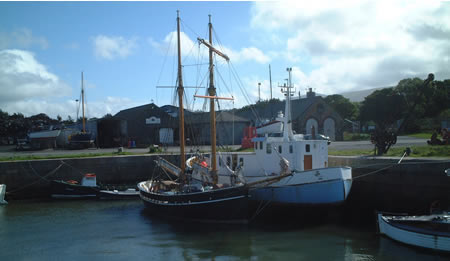
Ddoe es i am dro draw i Borth Penrhyn, lle roedd nifer o gychod diddorol fel yr hen gwch hwylio yn y ffoto uwch. Yna mi nes cerdded ar hyd Dyffryn Cegin, trwy Faesgeirchen ac dros Fynydd Bangor. Mae’r llwybr Dyffryn Cegin yn rhedeg ar hyd glan Afon Cegin, yr afon sy’n dihysbyddu ei hun ym Morth Penrhyn, ac trwy goedwig hyfryd.

Roedd hi’n braf efo dim ond cawodydd ysgafn o bryd yw gilydd – ‘na newid neis ar ôl wythnosau o dywydd diflas.

Sean bháid agus Gleann na Cistine

Inné chuaigh mé ag spaisteoireacht go Porth Penrhyn, cá raibh a lán báid suimiúla mar an sean bhád seoil ann an grianghraf thaobh thuas. Ansin shiúl mé feadh Dyffryn Cegin (Gleann na Cistine), trí Maesgeirchen (Páirc na Coirce) agus suas Mynydd Bangor (Sliabh Bangor). Tá cosán Dyffryn Cegin ag rith feadh Afon Cegin (Abhainn na Cistine), an abhainn atá ag folmhú í féin i Borth Penrhyn, agus trí coillearnach álainn.

Bhí sé go breá le níl ach tóg cith o ám go hám – sin athrú deas i ndiaidh go leor seachtain le drochaimsir.

Old boats and the Cegin Valley

Yesterday I went for a walk over to Porth Penrhyn, where there were lots of interesting boats like the old sailing boat in the photo above. Then I walked along the Cegin Valley, through Maesgeirchen and over Bangor Mountain. The path along the Cegin Valley runs along the banks of the River Cegin, which empties itself at Porth Penrhyn, and through some lovely woodland.

It was fine with only occasional showers – a nice change after weeks of pretty unpleasant weather.

The value of words

I’m currenty rereading Louis de Bernières’ series of novels set in a ficticious South American country. In the first book, The War of Don Emmanuel’s Nether Parts, the revolutionaries give people receipts whenever they take something from them, and say that they will pay everything back after the revolution. Many of the people who receive these receipts are unable to read them and don’t really understand their purpose, however they are impressed by the writing on them and start using them as an alternative currency. The value of the receipts depends on the number of words, so people ask the revolutionaries to write more on them.

I haven’t been able to discover whether receipts have been or are being used in this way in South America or elsewhere. Does anyone know?

On another matter – Radványi Balázs would like to create a font for his Harta alphabet. If you can help, please contact Balázs at guti@tvnetwork.hu. He can supply the images in vector format.

Anglesey

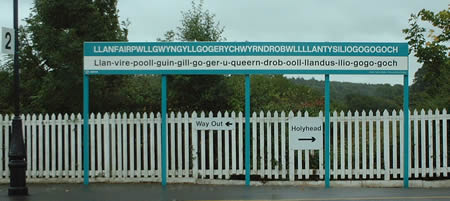
An seachtain seo caite, tháinig mo thuismitheoirí go Bangor ar feadh cúpla lá. Thaiscéal muid páirteanna Bangor agus Porth Penrhyn, an port beag in aice le Bangor, agus tiomáin muid timpeall Anglesey (Ynys Môn i mBreatnais). Chuaigh muid go dtí an stáisiún traenach leis an ainm is faide san Bhreatain mhór – Llanfairpwllgwyngyllgogerychwyrndrobwllllantysiliogogogoch (Eaglais Naomh Muire i log an choill bháin in aice leis an bpoll súraic tapaidh agus Naomh Tysilio na huaimhe deirge), nó Llanfairpwllgwyngyll. Níl a lán rudaí ann a fheiceáil san sráidbhaile beag sin ach an stáisiún traenach agus an ionad cuairteoirí mór in aice leis.

Station at Llanfairpwllgwyngyllgogerychwyrndrobwllllantysiliogogogoch

Bhreathnaigh muid thart taispeántas iontach ealaín gloine sa stáisiún, agus d’ith muid ár lón sa chaife san ionad cuairteoirí. Ansin chuaigh muid timpeall an oileán agus thug muid cuairt ar iarsmalann an shuimiúil sa Port Amlwch. Stad muid i Feaumaris, ach bhí sé ag cur fearthainn go trom, agus dá bhrí sin ní stad muid i bhfad ansin. Is amhlaidh bhí báisteach ann beagnach an t-am ar fad nuair a bhí mo thuismitheoirí anseo, agus tháinig an grian amach i ndiaidh siad a fhágadh.

Last week my parents came to Bangor for a couple of days. We explored parts of Bangor and Porth Penrhyn, the small port near Bangor, and drove round Anglesey. We went to the railway station with the longest name in Great Britain – Llanfairpwllgwyngyllgogerychwyrndrobwllllantysiliogogogoch (St Mary’s church in the hollow of the white hazel near to the rapid whirlpool and the church of St Tysilio of the red cave), or Llanfairpwllgwyngyll for short. There’s not much to see in the village about from the railway station and the huge visitors’ centre nextdoor.

We had a look round an exhibition of art made from glass in the station, ate some lunch in the visitors’ centre, then went round the island. We visited the very interesting museum in Amlwch’s port and stopped in Beaumaris, by which time it was raining very heavily and we didn’t stay long. In fact it was raining almost all the time my parents were here, and the sun came out after they left – typical!

Why can’t cats and dogs get on?

Cats and dogs do not always live in perfect harmony together, but this doesn’t have to be the case.

According to an article in Science Daily, one reason why cats and dogs often don’t get on together is because they misinterpret each other’s body language. For example, when cats are angry they usually lash their tails, but dogs growl and arch their backs. When a cat averts its head, it is a sign of aggression, but this signifies submission in dogs.

If cats and dogs are introduced to the same house when they’re young – under 6 months for cats and under a year for dogs, they can learn each another’s body language and are therefore less likely to fight and more likely to get along well together.

If you’re wondering what this has to do with language, well not much really. I am interested in body language and animal communication as well and will be writing about it here occasionally.

Bilingual Radio

Today we have a guest post from James P. in Chile:

I was listening to Catalan radio the other day (long story: short version, I’m thinking of whether to live in Spain and if I can be bothered with learning Catalan or whether it would just get mixed up in my Spanish).
They had interviews with people about the Madrid Spanair crash, and the people were talking in Spanish. No big deal really, as all Catalan speakers in Spain will know Spanish too. However , I’ve just been listening to Radio España 5, and they had clips of untranslated Italian, which assumes mutual intelligibility in all listeners. That reminded me of one time on Colombian Radio Caracol, when they had untranslated (Brazilian) Portuguese in an interview with a footballer. Again, they assumed that all listeners would be able to understand the Portuguese.

Do others have examples of bilingual radio, which assumes mutual intelligibility at a general level?

(I have strange half memories of listening to Italian radio and hearing an interview when one person spoke in French, and the other in Italian, but I may be hallucinating.)

———————–

I’ve heard people on Irish language radio (Raidió na Gaeltachta) speaking Scottish Gaelic without translation.