| français | English | Cymraeg |
|---|---|---|
| s’installer | to settle in | ymgartrefu; ymsefydlu |
| se calmer | to settle down | bod yn llonydd; bod yn dawel |
| se contenter de | to settle for | bodloni ar |
| régler | to settle up | talu’ch dyledion |
| s’établier sur | to settle (land) | sefydlu mewn; cyfandeddu |
| se déposer | to settle (dust) | dawelu; gorweddi |
| rudimentaire | rough and ready (accommodation, method) | ffwrdd-â-hi |
| le décor | (stage/TV) set | set |
| le plateau | (film) set | set |
| la pièce (de théâtre) | play | drama |
| tenace | tenacious | diollwng; anollyngol; diymollwng; cadarn |
Category: Welsh (Cymraeg)
Clymau tafod
Mi wnes i dyfeisio cwlwm tafod Cymraeg heddiw:
Llawr ar lawr y cawr enfawr mae llawer o lewod lliwiog yn llyfu llaw Gwawr nawr.
Ti’n gwybod unrhyw glymau tafod Cymraeg eraill?
This is a Welsh tongue twister I came up with today. It means “Down on the giant giant’s floor many colourful lions are licking Gwawr’s hand now.”
Do you know any other Welsh tongue twsiters?
Beds that lie
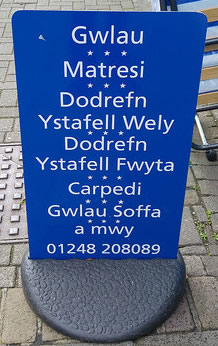
The other day I noticed the word gwlau on a sign outside a furniture shop. It’s a Welsh word I hadn’t seen or heard before, but from the context I worked out that it meant ‘beds’. The sign also included the words gwlau soffa (sofa beds). As I hadn’t come across this plural form of gwely [ˈɡwɛlɨ/ˈɡweːli] (bed) before, I wondered if it was a mistake.
According to Geiriadur yr Academi and Geiriadur Prifysgol Cymru, the plural forms of gwely are gwelyau or gwlâu, so the words on the sign weren’t wrong, but were just missing a to bach (circumflex) on the a.
Gwely comes from the Proto-Celtic *uɸo-legyom from *legh (to lie down), from the Proto-Indo-European *upo (under, below) & *legʰ- (to lie (down)), and is cognate with the Cornish guely and the Breton gwele. *legʰ- is the root of the Irish luigh, the Manx lhie, and the Scottish Gaelic laigh (to lie (down)); and also the Italian letto and French lit (bed), via the Latin lectus (bed); the English lair, the German Lager (store, camp), and the Swedish läger (camp), as well as other words [source].
Ingenious genius
The word ingenious sounds like the antonym (opposite) of genius as in- is often used as a negative suffix (invisible, indivisible, etc). However they are not.
Ingenious means:
– displaying genius or brilliance
– tending to invent
– characterized by genius
– cleverly done or contrived; witty; original; shrewd; adroit; keen; sagacious.
It comes from:
– the Middle French ingénieux (ingenious)
– from the Old French engenious (ingenious)
– from the Latin ingeniōsus (endowed with good natural capacity, gifted with genius), from ingenium (innate or natural quality, natural capacity, genius), from in (in) and gignere (to produce)
– from the Old Latin genere, from genus (birth, origin)
– from the Proto-Italic *genos (lineage, origin)
– from the Proto-Indo-European *ǵénh₁os (race), from *ǵenh₁- (to produce, beget).
Genius means:
– someone possessing extraordinary intelligence or skill; especially somebody who has demonstrated this by a creative or original work in science, music, art etc.
– extraordinary mental capacity
– inspiration, a mental leap, an extraordinary creative process
– the guardian spirit of a place or person (in Roman mythology)
– a way of thinking, optimizing one’s capacity for learning and understanding
It comes from:
– the Latin genius (the guardian spirit of a person, spirit, inclination, wit, genius, literally “inborn nature”), from gignō (to beget, produce)
– from the Old Latin genō
– from the Proto-Indo-European root *ǵenh₁- (see above)
So ingenious and genius come from the same root, as do many other words, but took different paths to arrive at their modern forms.
In Proto-Celtic the PIE root *ǵenh₁- became *gniyeti (to make, to do), which became gníid / ·gní (to do, to work) in Old Irish, which, with a suffix became dogní (to do, to make), which became déan in Modern Irish, jean in Manx and dèan in Scottish Gaelic. This is possibly also the root of the Welsh gwneud, the Cornish gul and the Breton (g)ober). All these words mean to do or to make.
Sources: Wiktionary
The Salmon’s Daughter
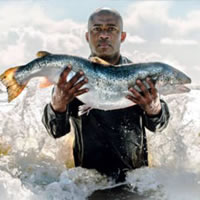
On Tuesday I saw a play in Bangor called Merch yr Eog / Merc’h an Eog (Daughter of the Salmon) in four different languages: Welsh, Breton, French and Guadeloupean Creole.
It was a co-production between Theatr Genedlaethol Cymru (Welsh National Theatre) and Teatr Piba from Brittany, and featured actors from Wales and Brittany. The lead role was played by Lleuwen Steffan, a Welsh singer-song writer who lives in Brittany and speaks Welsh, Breton, French, and English, fluently.
For me it was interesting to hear all the different languages, especially the Breton. I understood most of the Welsh and French, though I couldn’t always hear what they were saying clearly, and understood, or at least recognised, bits of the Breton.
There’s some discussion in the play about similarities between Welsh and Breton words, though I doubt very much if any of the Welsh speakers in the audience understood much of the Breton, unless they’d studied it. The languages have many similar words, but sound very different.
When one of the actors started speaking in Guadeloupean Creole I thought it was French at first with an unfamiliar accent, but when I listened more closely I thought is was probably a French-based Creole.
Translation was provided via an app called Sibrwd (Whisper) and was available in English, Welsh, French and Breton. However it was mainly a summary of what the actors were saying rather than a word-for-word translation, and wasn’t in time with the speech. Sometimes it was behind, sometimes ahead, so it was like watching a badly dubbed film, and made it tricky to follow the story.
There’s a review of the Bangor performance in the Daily Post.
Cashlines, ATMs and Holes in the Wall
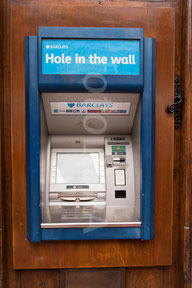
I discovered the other day that in Scotland the bank machines that dispense cash are known as cashlines. This was apparently the name used first for Royal Bank of Scotland cash machines, and came to be used as the general term for ATMs in Scotland [source].
In other parts of the UK such machines are known as cash machines, ATMs (Automated Teller Machines), holes in the wall and cashpoints.
In Welsh a cash machine is a peiriant arian parod (cash machine), twll yn y wal (hole in the wall) or peiriant tynnu arian (money withdrawing machine)
What are they known as in other countries and languages?
Les mots de la semaine
| français | English | Cymraeg |
|---|---|---|
| la pédale | pedal | pedal |
| pédaler; aller à velo | to pedal (a bicycle) | pedlo; padlo |
| le lotissement (de logements sociaux) | (council) estate | (y)stad (dai cyngor) |
| la cité | housing estate | (y)stad o dai |
| courageux; brave; vaillant | brave | dewr; gwrol; glew; eofn |
| droit | straight | syth; union |
| les groseilles noires | black currant(s) | cyransen ddu (cwrens duon) |
| la haie | hedge | gwrych; clawdd |
| le noyau | (fruit) stone | carreg; cnewyllyn; dincodyn |
| la graine | seed (of plant) | hedyn |
| le pépin | seed / pip (of fruit) | dincodyn; carreg; hedyn |
| étudiant de première année; jeune recrue | first year student; fresher; freshman | glasfyfyriwr |
A bit of a breeze
One of the words that came up at the French conversation group this week was brise (breeze), which appears in the following expressions:
– pare-brise = windscreen / windshield
– brise matinale = early breeze
– brise insulaire = island breeze
– brise de mer = sea breeze
– brise de terre = land breeze
The French word brise and the English word breeze come possibly from the Old Spanish briza (cold northeast wind), which was used from the 1560s in West Indies and the Spanish Main to mean a “northeast trade wind”, and then a “fresh wind from the sea”. Breeze came to mean a “gentle or light wind” from the 1620s, and something easy from the 1920s in the USA.
Alternatively the English word breeze might come from is from East Frisian brisen (to blow fresh and strong), or the Saterland Frisian briese (breeze) or the Dutch bries (breeze).
Apparently as well as being a light, gentle wind, a breeze can be:
– Any wind blowing across a cricket match, whatever its strength.
– Any activity that is easy, not testing or difficult.
– Ashes and residue of coal or charcoal, usually from a furnace.
– An excited or ruffled state of feeling; a flurry of excitement; a disturbance; a quarrel.
Sources: Online Etymology Dictionary, Wiktionary and Reverso
Les mots de le semaine
| français | English | Cymraeg |
|---|---|---|
| la brise | breeze | awel |
| convenable; adéquat; apte | suitable | addas |
| la poterie | pottery | crochenyddiaeth; crochenwaith |
| sculpté; gravél ciselé | carved | cerfiedig; nadd |
| tailler; sculpter; grave; ciseler | to carve | cerfio; carfio; naddu |
| plongée | diving | plymio |
| luxuriant | lush | toreithiog; iraidd; ir |
| enflé; gonflé | swollen | wedi chwyddo |
| la cheville | ankle | ffêr; migwrn |
| le bord | edge | min; ymyl |
| le pare-choc | bumper (on car) | bymper; ffender |
| le course à travers champ | cross-country (race) | ras ar draws gwlad / traws gwlad |
| seul; solitaire | lonely | unig; digwmni |
Joskins, bumpkins and yokels
Last week a friend asked me about the origins of the word joskin [ˈdʒɒskɪn], which I hadn’t come across before. According to the Urban Dictionary it is defined as follows:
North-Walian term used in both English and Welsh to describe anyone from a rural or farming background. It is used both affectionately and in a derogatory way depending on the audience.
Example: He’s a right joskin – he’s got a tractor and everything.
According to the Collins English Dictionary joskin is a slang word meaning “a country bumpkin; hick”.
Wiktionary suggests that is comes from the dialect word joss (bump) and (bump)kin. Alternatively it comes from the name Joseph + (bump)kin [source].
Bumpkin, a clumsy, unsophisticated person or a yokel, apparently comes from the Dutch boomken (shrub, little tree) [source]. Or it might come from the Dutch bommekijn (small cask), from the Middle Dutch bomme (cask) [source], and was also used as a derogatory reference to short and dumpy Dutch people [source].
Yokel possibly comes from German dialect word Jokel, a diminutive of Jakob, or an English dialect word meaning woodpecker [source].
What other words are there for joskins?