Here’s a recording in a mystery language.
Can you identify the language, and do you know where it’s spoken?
Here’s a recording in a mystery language.
Can you identify the language, and do you know where it’s spoken?
Following on from my last post, I decided to look at words for difficult, and related words, in Irish today.
There are a number of different words for difficult in Irish:
– deacair = hard, difficult; difficulty; hardship, distress; (used in Connacht)
– doiligh = hard, difficult; hard to bear, distressing; hard to deal with; difficult, intractable (used in Ulster and Munster)
– crua = hard; Firm, solid; difficult; strenuous; tight; forceful; severe; harsh, unfeeling; stingy; hardy
– dian = intense, vehement; hard, severe
– duaisiúil = laborious, difficult, troublesome, distressing
– dúshlánach = challenging
– casta = twisted, wound; complicated, intricate, involved; gnarled, bent; wizened
– ciotach = left-handed; Awkward, unhandy; difficult, troublesome; inconvenient
Here are some examples of usage:
– Is deacair ceann críonna a chur ar cholainn óg = You can’t put an old head on young shoulders
– Is deacair a bheith suas leis = He is a very tricky person to deal with
– Is doiligh ciall a bhaint as = It is hard to make sense of it
– Is doiligh corrán maith a fháil do dhrochbhuanaí = A bad workman quarrels with his tools (It is hard to get a good sickle from a bad reaper)
– Ceist chrua = A difficult question
– Fadhb chrua le réiteach = A difficult problem to solve
– Bhí saol crua aici = She had a hard life
– Tá mé ag staidéar go dian = I am studying hard
– Tá tú mós dian air, = You are a bit too hard on him
– Obair dhuaisiúil = Tedious, wearing, work
– Aistear duaisiúil = Weary/wearying journey
– Scéal casta = Complicated story
= Ceist chasta = Knotty question
In Scottish Gaelic words for difficult include:
– doirbh [dɤrʲɤv] = difficult, hard; tricky
– bruaill [bruəl̪ʲ] = difficult; intractable
– duilich [dulɪç] = sorry; difficult, hard; regrettable; sad
– doilidh [dɔlɪ] = sorry; difficult, hard; regrettable; sad
– deacrach [dʲaxgrəx] = difficult, hard; mournful, sad
– cruaidh [kruəj = hard, firm; difficult; painful, distressing; scarce
In Manx words for difficult include:
– doillee = difficult, hard, stiff, ticklish, uphill
– doccaragh = arduous, grievous, hard, inconvenient, laborious, painful, uphill
– condragh = difficult, mischievous, wicked
– creoi = adamant, difficult, distressing, hardy, heartless, obdurate, severe, stubborn
– neuaashagh = awkward, difficult; discontented, restless, uneasy
Sources: foclóir.ie, teanglann.ie, Am Faclair Beag, Fockleyreen
Quite a few people I’ve talked to here in Glencolmcille have told me that Irish is a difficult language. This got me thinking about what makes a language difficult to learn.
Here are some aspects of Irish that learners may find difficult:
Spelling and Pronunciation
Irish spelling takes quite a while to get used to. It is far more regular than English, though works in different ways, and there are many silent letters. For example, bhfaigheadh (would get) is pronounced [wiu], which you would never guess from the spelling. Some older Irish texts are written in the Gaelic Script (An Cló Gaelach), which adds a extra layer of difficulty.
Vocabulary
Irish vocabulary is quite different to English, and most other European languages, so very few words are familiar to learners, unless they know Scottish Gaelic or Manx. There are words borrowed from English, and a few from Latin, though.
Grammar
Irish grammar is similar to the other Celtic languages, but quite different to other European languages. For example, the word order is VSO (Verb, Subject, Object); verbs have positive (tá = am/is/are), negative (níl = am not/isn’t/aren’t) and question forms (an bhfuil = am/is/are?); there is no verb ‘to have’; there are no single words for yes or no, and the pronouns fuse with prepositions – le (with) and mé (I) becomes liom, do (to) tú (you, singular) becomes duit, and so on. On the other hand, there are only 11 irregular verbs, no indefinite articles, and verbs only conjugate for person and number in some tenses.
Dialects
Like many languages, Irish has dialects. The differences between then are mainly in pronunciation and vocabulary. If you learn one, you might find the others a little difficult to understand at first, but before long you’ll be able to understand most things.
These are all things that can be difficult in any language. Basically the more differences there are between your mother tongue and the language(s) you’re learning, the more challenging it will be.
Have you learnt or are you learning Irish?
Do you find it difficult?
What aspects of Irish do you find most challenging?
Here’s a recording in a mystery language.
Can you identify the language, and do you know where it’s spoken?
This week I have been speaking quite a bit of Irish. Even though I rarely speak it at home, it is usually there when I need it. When trying to understand songs or poems in Irish, I realise that there are plenty of gaps in my vocabulary, but I can at least get the gist of them.
On Monday night there was a little Russian-speaking corner in the pub made up of three Belarusians, a Bulgarian, and me. I was able to understand quite a bit of what the others were saying in Russian, and to join in occasionally.
Yesterday I learnt a bit about Finnish language and culture from the Finnish guy who is doing the harp course. He told me that Finns tend to be less talkative than people from other countries, but that there is a lot of non-verbal communication between them.
I have also had opportunities to speak a bit of German, and have learnt a bit about German musical terms. For example, in German musical notes are not A to G, but A to H – H refers to B, and B refers to B♭, which is slighly confusing to someone used to the English system.
Do musical notes have other names in your language, or in other languages you know?
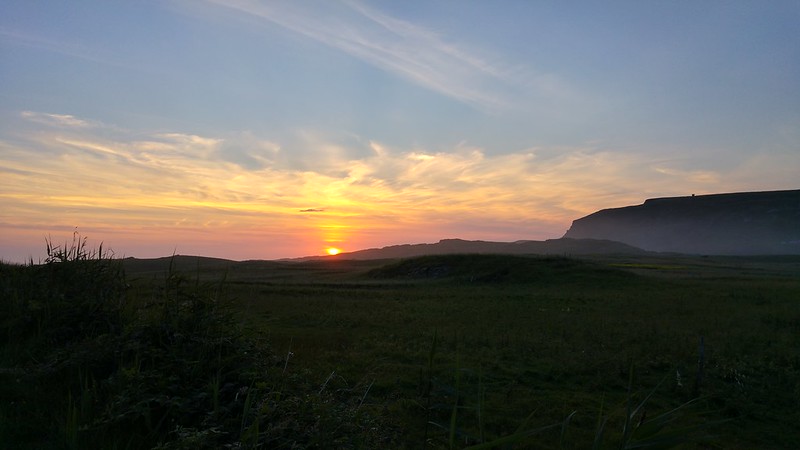
Last night I arrived safely in Glencolmcille in Donegal in the northwest of Ireland. I left Peel at 8am, went by bus to Ronaldsway airport, flew to Dublin, then took buses all the way to Glencolmcille, arriving just before 8pm, so it took nearly 12 hours.
I met people I know from previous visits to Ireland along the way – at Dublin airport, in Donegal town, and in Killybegs – so the journey didn’t seem quite so long as I had people to talk to. As they say in Irish, bíonn siúlach scéalach (travellers have tales to tell), and giorraíonn beirt bóthar (two people shorten a road).
On the road and after I arrived in Glencolmcille I had conversations in English, Irish, German, Welsh, and spoke odd bits of Russian, French, Romanian, Swedish and Manx.
Today the courses start – there are courses in Irish language, translation, flute and whistle player, and harp playing (that’s the one I’m doing), and also a group going hill walking every day.
There are people here from many countries, including Ireland, the UK, the USA, Australia, France, Belgium, Luxembourg, Finland, Germany, Switzerland, Belarus, Brazil and Slovakia. So I will have plenty of opportunities to practise my languages.

Here’s a recording in a mystery language.
Can you identify the language, and do you know where it’s spoken?
This week I’ve had quite a few conversations in Manx. I only speak it when I come to the Isle of Man, and when I meet Manx learners at polyglot events. At the beginning of the week my Manx was decidedly rusty, but it’s starting to flow now. When I don’t know a word or phrase in Manx, I switch to Irish, and often get away with it. It helps that some of the Manx speakers I know here also speak Irish.
As well as Manx, and English, I spoke some Welsh last night, and odd bits of Scottish Gaelic, Cornish and Breton.
The performers here for the festival are from the Isle of Man, Scotland and Ireland. The songs have been in English and Manx, and the evening concerts have been introduced bilingually in Manx and English. There aren’t any performers here from Wales, Cornwall or Brittany this year, but there have been in previous years.
Tomorrow I’m off to Glencolmcille (Gleann Cholm Cille) in Donegal in the northwest of Ireland. I will speak plenty of Irish there, and probably other languages, and learn more traditional Irish songs and tunes.
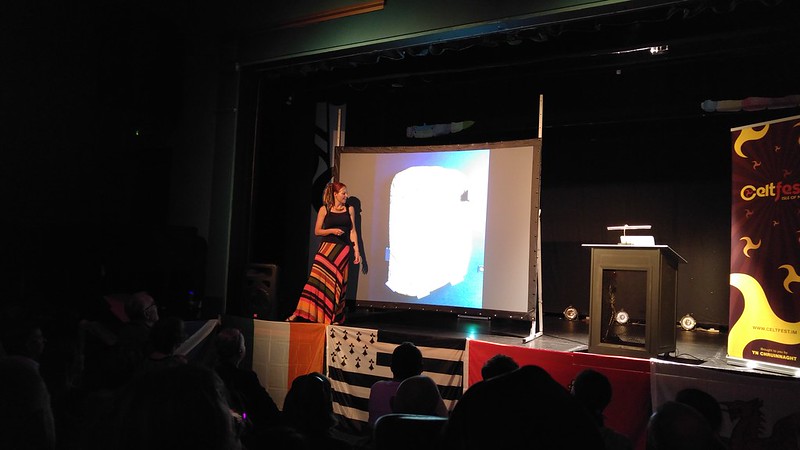
This week I am in the Isle of Man for the CeltFest, a festival of Manx and Celtic music and culture. There are lunchtime concerts every day at the Noa bakehouse in Douglas, and concerts and other events every night in Peel.
Last night I went to a fascinating talk by Alice Roberts, an anatomist, anthropologist and broadcaster, about the history of the Celtic people and languages.
One popular theory is that the Celtic people originated from the Urnfield culture of central Europe during the Late Bronze Age (about 1,200 BC) and spread to many other parts of Europe after that.
The Romans and Greek talk about Celtic people inhabiting parts of Gaul (France), Iberia (Spain and Portugal), northern Italy, Helvetica (Switzerland), Anatolia (Turkey), and parts of eastern Europe. However, no ancient writers mention Celtic people in the British Isles or Ireland. The Ancient Greek historian Herodotus, for example, tells us that “the Celts live beyond the Pillars of Heracles, being neighbors of the Cynesii, who are the westernmost of all the peoples inhabiting Europe.” [source].
The people who spoke Celtic languages in the British Isles, Ireland and Brittany didn’t refer to themselves as Celts before the 18th century. It was Edward Lhuyd (1660-1709) who first used the word Celt in print in 1707 to refer to people who spoke Celtic languages. Before then they were just Welsh, Irish, Scottish, etc [source].
Professor Roberts told us that there is no evidence for large-scale movement of people in Europe during the Iron Age, the time when the Celts were thought to have spread from central Europe. People did move around, taking goods, ideas and technology with them, but not in large enough numbers to show up in the archaeological record.
There is, however, evidence for significant movements of people associated with the Bell-Beaker culture out of the Pontic-Caspian Steppe of central Asia into Europe from about 2,900 BC.
During the Bronze Age, people migrated into Europe from central Asia, bringing their Proto-Indo-European (PIE) language and culture with them. The people already in Europe, apart from the Basques, adopted the new culture and language. Over time the Indo-European languages developed from PIE. The Celtic languages developed mainly in western Europe. They disappeared from continental Europe, apart from in Brittany, after the 6th century AD, and continue to be spoken in parts of the British Isles and Ireland. At least that is my understanding of last night’s talk.
The earliest known inscriptions in a Celtic language date from the 6th century BC and were found in southern Portugal. They are written in an alphabet known as the Southwestern Script, and the language is referred to as Tartessian or South Lusitanian. Professor Roberts suggested that this script developed from the Phoenician script, independently of alphabets elsewhere in Europe, and the Tartessians, or whatever they called themselves, came up with the idea of adding vowels.
Here’s a recording in a mystery language.
Can you identify the language, and do you know where it’s spoken?