
Yoruba is a member of the Volta-Niger branch of the Niger-Congo family of languages. It is spoken by about 43 million people, mainly in southwestern Nigeria, and also in Ghana, Benin, Togo, Côte d'Ivoire and Niger.
Yoruba is spoken by about 42 million people in Nigeria, is one of the four official languages of Nigeria, along with English, Hausa and Igbo, and the de facto provincial language in the southwestern region. It is taught in schools, and used in newspapers, TV, radio and literature.
In Benin Yoruba is spoken by about 209,000 people, especially in Porto-Novo city in the southwest. Yoruba is taught in some primary schools in Benin.
Other countries with significant numbers of Yoruba speakers include Ghana (460,000), Togo (117,000), Côte d'Ivoire (115,000) and Niger (74,800).
Yoruba is also known as Yariba, Yooba or Yorùbá. There are five groups of Yoruba dialects: Northwest, Northeast, Central, Southwest and Southeast. The Northwest dialects of Ọyọ and Ibadan are the basis for Literary Yoruba or Standard Yoruba, the formal written version of Yoruba.
Yoruba was written with a version of the Arabic alphabet (Ajami) from the 17th century. Missionaries devised ways to write Yoruba with the Latin alphabet during the 19th century. The first Yoruba publications were a number of teaching booklets produced by John Raban in 1830-2. The person who made the biggest contribution to Yoruba literacy was Bishop Ajayi (Samual) Crowther (1806-1891), who studied many of the languages of Nigeria, including Yoruba, and wrote and translated in some of them. Crowther was also the first Christian bishop of West African origin.
A standard orthography for Yoruba in Nigeria was agreed on at a conference organised by the Church Missionary Society in 1875. A revised version has been used since 1966. One of the changes was to use dots rather than lines between e, o and s (ẹ, ọ, ṣ rather than e̩, o̩, s̩)
A slightly different alphabet for Yoruba is used in Benin. It was standardized by the National Language Commission in 1975, and revised by the National Center for Applied Linguistics in 1990 and 2008.
A new way to write Yoruba, known as Odùduwà, was devised by Tolúlàṣẹ Ògúntósìn, a priest-chief from Benin, in 2011.
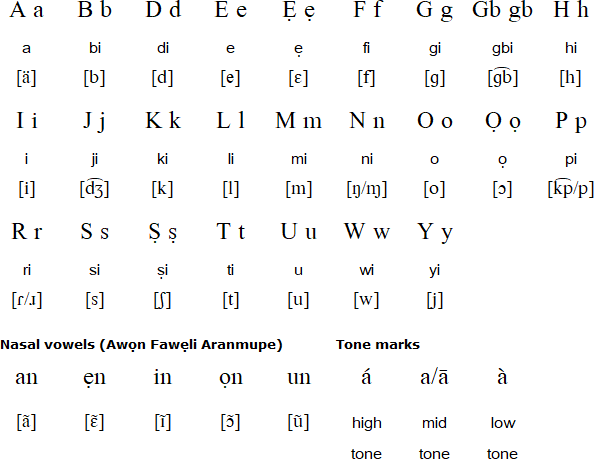
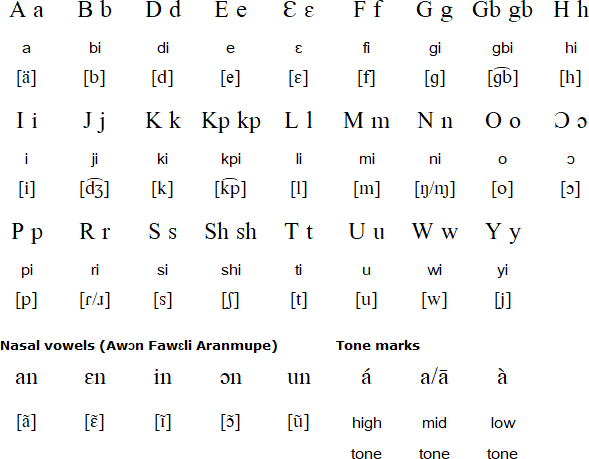
The mid tone is not usually marked.
Download an alphabet chart for Yoruba (Excel)
Hear the Yoruba alphabet:
Gbogbo ènìyàn ni a bí ní òmìnira; iyì àti ẹ̀tọ́ kọ̀ọ̀kan sì dọ́gba. Wọ́n ní ẹ̀bùn ti làákàyè àti ti ẹ̀rí-ọkàn, ó sì yẹ kí wọn ó máa hùwà sí ara wọn gẹ́gẹ́ bí ọmọ ìyá.
All human beings are born free and equal in dignity and rights. They are endowed with reason and conscience and should act towards one another in a spirit of brotherhood.
(Article 1 of the Universal Declaration of Human Rights)
Information about Yoruba | Phrases | Numbers | Time | Tower of Babel | Books about Yoruba on: Amazon.com and Amazon.co.uk [affilate links]
Information about Yoruba
http://en.wikipedia.org/wiki/Yoruba_language
Online Yoruba lessons
http://mylanguages.org/yoruba_audio.php
http://www.africa.uga.edu/Yoruba/about.html
http://www.learnyoruba.com
http://polymath.org/yoruba.php
https://www.youtube.com/c/yorubalessons/videos
Online Yoruba phrases
http://www.motherlandnigeria.com/languages.html
http://www.abeokuta.org/yoruba.htm
Online Yoruba dictionary
http://www.yorubadictionary.com
http://aroadeyorubadictionary.com
http://www.nigeriandictionary.com/language.php?lang_id=68&char=
Online Yoruba Radio
https://radiolagos.net/
Languages written with the Latin alphabet
Page last modified: 25.05.26
[top]

You can support this site by Buying Me A Coffee, and if you like what you see on this page, you can use the buttons below to share it with people you know.

If you like this site and find it useful, you can support it by making a donation via PayPal or Patreon, or by contributing in other ways. Omniglot is how I make my living.

Note: all links on this site to Amazon.com


[top]


