
Hū’in is a Romanization system for Shanghainese devised by Arthur Thompson as part of a research project while studying at University of London's School of Oriental and African Studies (SOAS). It is based on an existing Shanghainese Romanization system with a new way to indicate tone value and tone sandhi.
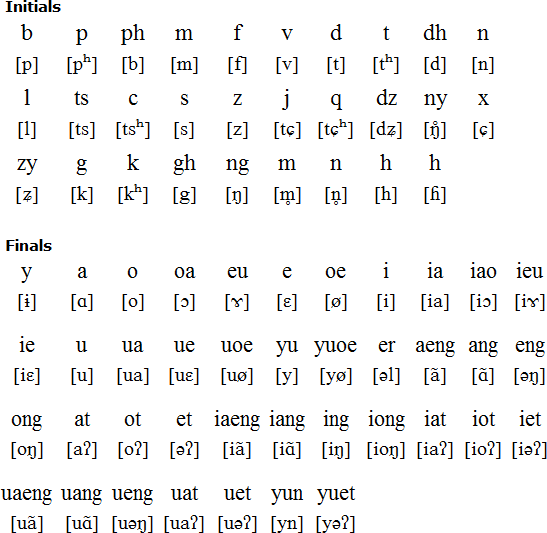
An apostrophe is used to divide syllabic vowels, e.g. Zȁng hé’e’ò [CVC.CV.V.V] and Hū’in [CV.VC]
The number 5 is the absolute highest tone, while the number 1 is the absolute lowest. Tones can only be marked by the whole numerals one through five, there are no decimals or fractions used to mark tones. Repeating a number signifies that the tone is more drawn-out than if it were marked with just a single digit, i.e. 44 is the same tone as 4 but it is “longer”. Double digits also indicate the “direction” of a tone. The first digit signifies from where the tone must begin, while the second digit dictates to what extent the tone should go, i.e. 35 is a mid-rising tone (cf. Mandarin first tone) while 53 is a mid-falling tone (cf.
Shanghainese first tone). It would be almost impossible to explain Shanghainese tone sandhi without explaining the convention of tone value.
Unlike Mandarin, Shanghainese tone sandi does not change according to a word’s combination of tone1. Rather, tone changes rely on the number of characters in the word/or phrase. Tones change according only to the tone of the first character (except for one tone change which moves from left to right, thus depending on the tone of the second character)². (Note: The maximum character per word/phrase is four). In most cases, the tone of the first character spreads across the different syllables of the word/phrase, creating a staircase like pattern of tone combinations (i.e. low to high to higher, or low to high to low to lowest).
Right to left tone sandhi of the five tones (according to number of characters per word/phrase)³
| Number of Characters: | One | Two | Three | Four |
|---|---|---|---|---|
| First tone | 53 | 5-2 | 5-3-2 | 5-3-3-2 |
| Second tone | 34 | 3-4 | 3-4-2 | 3-4-3-2 |
| Third tone | 13 | 1-4 | 1-4-2 | 1-4-3-2 |
| Fourth tone | 55 | 3-4 | 3-4-2 | 3-4-3-2 |
| Fifth tone | 12 | 1-3 | 1-1-3 | 1-2-2-24 |
Left to right tone sandhi (according to number of characters per word/phrase):
| Third tone | 13 | 1-3 | N/A | N/A |
| Fifth tone | 12 | 1-3 | N/A | N/A |
Aside from a few exceptions, the “original tone” (i.e. single character tone) of the first character is always written in a multisyllabic word/phrase. The changes in tone sandhi (usually just the dropping of the original tone’s second digit) must be memorized. There are five set ways to mark the five original tones. The five original tones are marked by a combination of (an) accent mark(s). The accent marks indicate the pitch (cf. tone value) of the tone (highest, high, mid, low, and lowest). The grave accent marks represent low tones, while the macron and acute accent marks represent the high tones. Absence of an accent mark signifies a mid-level tone.
| Tone Value (high to low): | 5 | 4 | 3 | 2 | 1 |
|---|---|---|---|---|---|
| Single Digit Tones: | ā | á | a | à | ȁ |
| Number of Characters: | One | Two | Three | Four |
|---|---|---|---|---|
| First tone (53) | āa | ā-à | ā-a-à | ā-a-a-à |
| Second tone (34) | aá | a-á | a-á-à | a-á-a-à |
| Third tone (13) | ȁa | ȁ-á | ȁ-á-à | ȁ-á-a-à |
| Fourth tone (5) | āā | a-á | a-á-à | a-á-a-à |
| Fifth tone (12) | ȁà | ȁ-a | ȁ-ȁ-a | ȁ-á-á-áà* |
*the last syllable is a low-rise which has the tone value of 24
Left to right tone sandhi (according to number of characters per word/phrase):
| Third tone: | ȁa | ȁ-a | N/A | N/A |
| Fifth tone: | ȁá | ȁ-a | N/A | N/A |
| Shanghainese Dialectical Characters | Hū’in 滬音/ 沪音 | English |
|---|---|---|
| 儂好 | Nȍng hoa | Hello |
| 再會 | Tse Úe | Goodbye, Bye |
| 儂飯吃過了𠲎? | Nȍng vè qièt gùú let vá? | Have you eaten yet? |
| 吃過了。 | Qiet gú lèt | (I) have eaten. |
| 上海閒話 | Zȁng hé e’ò | Shanghainese (dialect) |
| 上海人 | Zȁng hé nìng | Shanghainese person |
| 伊出去了。 | ȉ cét qi lè | He/She went out. |
| 啥辰光? | Sa zéng kuàng? | When? |
| 早浪頭 | Tsoa láng dhèu | Morning |
| 上半日 | Zȁng bóe nièt | Late Morning |
| 中浪頭 | Tsōng lang dhèu | Noon |
| 下半日 | Ȕo bóe nièt | Afternoon |
| 夜到頭 | Yȁ dóa dhèu Evening, | Night |
| 鞋里? | Hȁ li | Where? |
| 哪能? | Nȁ neng | How? |
| 謝謝 | Dziȁh dziah | Thanks, thank you |
Information about Shanghainese | Phrases | Numbers | Books about Shanghainese on: Amazon.com and Amazon.co.uk [affilate links]
Information about Shanghainese
http://en.wikipedia.org/wiki/Shanghainese
http://www.earnshaw.com/shanghainese/shanghainese.cfm
Online Shanghainese lessons
http://www.fyan8.com/shanghai/
https://www.memrise.com/course/256754/shanghainese-with-audio/
https://mangolanguages.com/available-languages/learn-shanghainese/
https://chinesepod.com/library/courses/shanghainese/13
Shanghainesee pronunciation
http://www.wuunion.com/home/html/wugniutzyseq1/2009/0831/7.html
http://edu.sina.com.cn/l/2001-09-10/15828.html
Shanghainese dictionary
http://wu-chinese.com/minidict/search.php
上海人 | 世界第一上海前沿文化平台 - Top Shanghai youth culture portal
http://www.shanghaining.com
Dungan, Cantonese, Fuzhounese, Gan, Hakka, Jian'ou, Mandarin, Puxian, Shanghainese, Taiwanese, Taiwanese Hakka, Teochew, Weitou, Wenzhounese, Xiang
Written Chinese: Oracle Bone Script, Simplified characters, Bopomofo, Types of characters, Structure of written Chinese, Evolution of characters, How the Chinese script works, Xiao'erjing, General Chinese
Spoken Chinese: Mandarin, Dungan, Wu, Shanghainese, Wenzhounese, Yue, Cantonese, Weitou, Min, Jian'ou, Taiwanese, Teochew, Fuzhounese, Puxian, Hakka, Xiang, Gan, How many people speak Chinese?
Other Chinese pages: Chinese numbers (數碼) | Chinese classifiers (量詞) | Electronic dictionaries | Chinese links | Books: Chinese characters and calligraphy | Cantonese | Mandarin, Shanghainese, Hokkien and Taiwanese
Akkadian Cuneiform, Ancient Egyptian (Demotic), Ancient Egyptian (Hieratic), Ancient Egyptian (Hieroglyphs), Chinese, Chữ-nôm, Cuneiform, Japanese, Jurchen, Khitan, Linear B, Luwian, Mayan, Naxi, Sawndip (Old Zhuang), Sui, Sumerian Cuneiform, Tangut (Hsihsia)
Page last modified: 15.03.23
[top]

Note: all links on this site to Amazon.com


You can support this site by Buying Me A Coffee, via PayPal or Patreon, or by contributing in other ways.
If you find all the adverts annoying, there is now an Ad-free version of Omniglot which you can access for a small monthly or annual donation.

This website and its content is copyright of Simon Ager - © Simon Ager 1998-2026. All rights reserved. All images were created by me, unless otherwise indicated. Feel free to use them for personal, educational or non-commercial purposes, and don't forget to mention where they came from. More details about copyright

[top]


