Llongrats!

In the comments on an article about Welsh literature I read today, I came across the word llongrats!, which appears to be a Welsh-English hybrid combining the Welsh word llongyfarchiadau and it’s English equivalent, congratulations.

While it’s common for bilingual people to switch languages, often in mid-sentence, this is the first example I’ve seen of a mid-word switch in Welsh/English.

Have you come across anything like this?

Actually, when I come to think about it some words in English do have bilingual roots, particularly those borrowed from Latin and Greek, such as television, from the Greek τῆλε ‎(têle – at a distance, far off/away/from) and from the Latin vīsiō ‎(vision, seeing), via Anglo-Norman and Old French.
Dardledumdue

Today I came across the wonderful word dardledumdue. It means “daydreamer” in East Anglian dialect (east of England), and its origin is uncertain. Perhaps it’s the type of nonsense words a daydreamer might sing or mumble while daydreaming [source].

It also sounds like the kinds of ‘words’ some Irish singers use when lilting – a way of singing tunes with made-up words.

Here’s an example:

Another example:

Does anything like this exist elsewhere?

Nix and Natch

The words nix and natch have come up quite a bit in things I’ve read and/or heard recently, so I thought I’d look into their meanings and origins.

Nix as a verb means “to ​stop, ​prevent, or ​refuse to ​accept something” and as a noun it means “nothing or no”. These usages are apparently mainly informal and used in the US [source].

Accroding to the Online Etymology Dictionary, nix comes from the German nix, a dialectal variant of nichts (nothing), from the Middle High German nihtes, from the genitive of niht/nit (nothing) from the Old High German niwiht, from ni/ne (no) and wiht (thing, creature).

I rarely come across this word in British English.

Natch is an abbreviation of naturally, natch – I didn’t realise this until I looked it up. I thought it was some kind of negative, but wasn’t sure what it meant.

Pinkies

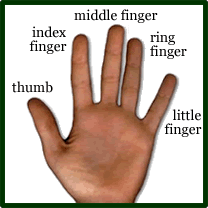
Finger names

What do you call your smallest finger?

I call it my little finger, but I hear more and more people in the UK calling it their pinkie / pinky, which I thought was exclusively used in North America. Is this name used in some dialects of English in the UK, or is this an example of American influence?

[Addendum] The word pinkie apparently comes from Dutch, via Scots. It was first recorded as meaning little finger in John Jamieson’s An Etymological Dictionary of the Scottish Language in 1808. It comes from the Old Dutch phrase pinck ooghen (pink eye = half-shut or peering eye), which is the root of the modern Dutch verb pinkogen (to half close the eyes or squint). The modern Dutch word for little finger is pink, the diminutive of which is pinkje [source]. Other etymologies are available.

Anatomical names for the fingers are:

– 1st finger (thumb)
– 2st finger, digitus secundus or digitus II
– 3rd finger, digitus tertius, digitus III, digitus medius
– 4th finger, digitus quartus, digitus IV, digitus annularis, digitus medicinalis
– 5th finger, digitus quintus, digitus V

Others names for the fingers include:

– Thumb
– Index finger, pointer finger, forefinger, trigger finger
– Middle finger, bird finger, long finger
– Ring finger
– Little finger, baby finger, pinky

Source: http://www.yourdictionary.com/finger

Do you use other names for fingers?

Anti-languages

Here’s an interesting article on the BBC website about anti-languages, such as Thieves Cant, Polari and Gobbledygook.

They have been around at least since Tudor times, and are used as secret slang by prisoners, escaped slaves, criminal gangs and gay people to keep their activities secret from the police and other authorities.

Any group of people who spend a lot of time together tend to develop their own vocabulary and references which can be mystifying to outsiders, but these anti-languages are deliberately created to prevent outsiders from understanding.

Some anti-language words become part of mainstream language. For example, from Polari, a form of gay slang, we get camp, butch, palaver and naff.

Languages in Newcastle

Last weekend I went to see a friend in Newcastle, and while we were exploring the place, I was listening out for languages other than English. The only ones I heard were Mandarin and Spanish, and my friend and I spoken mainly in English and Welsh, with a bit of Czech thrown in for variety.

While I was there we saw The Revenant, which includes dialogue in English, French and Arikara, a Caddoan language closely related to Pawnee, and spoken by a handful of people in North Dakota.

I’m sure other languages are spoken in Newcastle, as it’s a relatively large city with a number of universities and plenty of foreign students, but maybe we were in the wrong parts to hear much foreign talk.

I also heard plenty of Geordie, the local dialect, and didn’t get some of the things people said to me first time, so had to ask them to repeat themselves. It differs from standard English in various ways, and if you’re not used to it can sound almost like a different language.

Are there any regional accents / dialects in your country that you have trouble understanding?

AreSpacesBetweenWordsImportant?

Did you know that the practice of putting spaces between words was started by Irish monks writing in Latin?

This is what I discovered from an episode of the Allusionist – apparently when Christianity arrived in Ireland in the 6th century and people started writing in Latin, they put spaces between the words to make texts easier to read. Before then writing in Ireland was done in the Ogham alphabet without spaces between words. So when they started using a different alphabet, the Latin or Roman alphabet, and a language that wasn’t their native one, they weren’t so sure where words began and ended and the spaces made this clear.

Ogham continued to be used to some extent until the 9th century and was used to write Latin, however the Latin alphabet eventually replaced it.

The version of the Latin alphabet used in Ireland until the mid-20th century was the Irish Uncial alphabet or An Cló Gaelach, which is still used for decorative purposes.

The practice of putting spaces between words spread to the rest of Europe over subsequent centuries.

Some languages, like Chinese and Thai, don’t bother with spaces, which can make them tricky to read.

A not entirely uninteresting post

The title of this post is perhaps an example of litotes [laɪˈtəʊ.tiːz], a figure of speech that uses understatement, particularly double negatives, to make a positive statement [source]. Other examples include:

– I didn’t do too badly in the test
– It’s a bit chilly
– He’s not a bad guitarist

Litotes comes from the Ancient Greek λιτότης ‎(litótēs), from λιτός ‎(litós – simple) via the French litote (litotes, understatement) [source].

The antonym of litotes is hyperbole (overstatement), which comes, via Latin, from the Ancient Greek ὑπερβολή ‎(huperbolḗ – excess, exaggeration), from ὑπέρ ‎(hupér, -above) and βάλλω ‎(bállō – I throw) [source].

I make some use litotes (that’s an example), as do many British people. Is this common in other countries?

This post was inspired by an episode of The Allusionist, a podcast in which Helen Zaltzman discusses language, words and related topics.

When is an MBA a person?

An article I added to Omniglot today, The Most Valuable Languages for an MBA to Learn, uses “an MBA” to refer to a person with an MBA. I’ve also seen students referred to in a similar way: for example a student of French might be ‘a French Major’, and someone with a PhD in linguistics might be ‘a linguistics PhD’.

This usage appears to be common in American English, as far as I can tell, but sounds rather strange to my British ears.

Does this sound normal to you?

Are people with particular qualifications referred as ‘a [name of qualificaiton]’ in other languages?

The Power of Procrastination

Are you a procrastinator? Do you find yourself doing all sorts of things to avoid doing something you have to do?

For example, when you should be revising for an exam you keep finding other things to do which you convince yourself are essential and have to be done right now, such as cleaning, putting your books/CDs/DVDs into alphabetical order, researching the origins of knitting, or whatever.

I certainly do this – at times I can be a prolific procrastinator. I try to study a bit of at least one language every day, for example, but often find excuses not to, and other things to do that seem more important. The kinds of things I do instead of studying include working on Omniglot, playing music, singing, writing tunes and songs, juggling, reading, shopping, gardening, and cleaning and tidying. I do enjoy discovering and exploring languages, but sometimes find the process of studying them a bit tedious.

Maybe if I set myself another task that I don’t really want to do or find difficult, such as setting up databases, then I would end up studying languages as an alternative displacement activity. That is, I could embrace the power of procrastination.