
Ewe is a member of the Volta-Niger branch of Niger-Congo languages. It is spoken by about 5.5 million mainly Ghana, and also in Togo and Liberia. There are about 3.8 million speakers of Ewe in Ghana, in particularly in the Eastern region and the Volta region. In Togo there are about 1.7 million Ewe speakers, particularly in the Maritime and Plateaux regions. There are also about 3,560 speakers of Ewe in Liberia.
Ewe is also known as Éwé, Ebwe, Efe, Ehwe, Eibe, Eue, Eve, Gbe, Krepe, Krepi, Popo and Vhe. Dialects include Anglo, Awuna, Hudu and Kotafoa. Ewe is closely related Gbe languages, such as Fon, Gen, Phla, Phera and Aja.
The Ewe people believe that their ancestors came from Ketu, a town in Benin, and migrated to the southeast of Ghana. Some of the Ewe also settled in Togo.
Diedrich Hermann Westermann (1875-1956), a German missionary linguist, published dictionaries and grammars for Ewe and related languages. Other linguists have worked on various aspects of Ewe since then.
Ewe is an officially recognised language in Ghana, and is taught in primary and secondary schools, and used in literature and the media. It is also taught in some secondary schools in Togo. It is written with the Latin alphabet, and there have been various spelling systems since the 1850s.
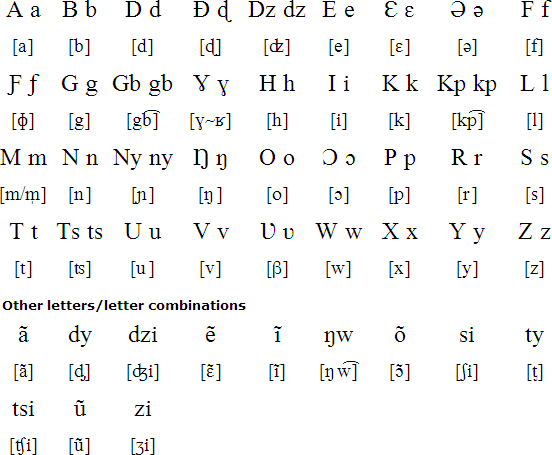
Download an alphabet chart for Ewe (Excel)
Hear how to pronounce Ewe letters:
Wodzi amegbetɔwo katã ablɔɖeviwoe eye wodzena bubu kple gomekpɔkpɔ ɔsɔe. Susu kple dzitsinya le wo dometɔ ɖesiaɖe si eyata wodze be woanɔ anyi le ɖekawɔwɔ blibo me.
All human beings are born free and equal in dignity and rights. They are endowed with reason and conscience and should act towards one another in a spirit of brotherhood.
(Article 1 of the Universal Declaration of Human Rights)
Information about Ewe | Phrases | Numbers | Tower of Babel
Information about the Ewe language
http://en.wikipedia.org/wiki/Ewe_language
https://www.ethnologue.com/language/ewe
Online Ewe courses
https://www.livelingua.com/project/peace-corps/Ewe
Ewe phrases
https://en.wikivoyage.org/wiki/Ewe_phrasebook
http://zorinco.com/djembe/ghana/lang/ewe.html
https://wikitravel.org/en/Ewe_phrasebook
Ewe dictionary
https://lughayangu.com/ewe
https://glosbe.com/ee/en
Aja, Ayizo, Ewe, Fon, Gen, Gun, Saxwe
Languages written with the Latin alphabet
Page last modified: 25.05.26
[top]

Note: all links on this site to Amazon.com


You can support this site by Buying Me A Coffee, via PayPal or Patreon, or by contributing in other ways.
If you find all the adverts annoying, there is now an Ad-free version of Omniglot which you can access for a small monthly or annual donation.

This website and its content is copyright of Simon Ager - © Simon Ager 1998-2026. All rights reserved. All images were created by me, unless otherwise indicated. More details

[top]


