
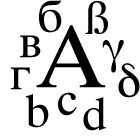
Writing is a method of representing language in visual or tactile form. Writing systems use sets of symbols to represent the sounds of speech, and may also have symbols for such things as punctuation and numerals.
Here are a number of ways to define writing systems:
a system of more or less permanent marks used to represent an utterance in such a way that it can be recovered more or less exactly without the intervention of the utterer.
From: Daniels, Peter T. & Bright, William, The world's writing systems, P.3 (Oxford, Oxford University Press, 1996)
a set of visible or tactile signs used to represent units of language in a systematic way, with the purpose of recording messages which can be retrieved by everyone who knows the language in question and the rules by virtue of which its units are encoded in the writing system.
From: Coulmas, Florian, The Blackwell Encyclopedia of Writing Systems (Oxford, Blackwell, 1999), P.560
All writing systems use visible signs with the exception of the raised notation systems used by blind and visually impaired people, such as Braille and Moon. Hence the need to include tactile signs in the above definition.
In A History of Writing, Steven Roger Fischer argues that no one definition of writing can cover all the writing systems that exist and have ever existed. Instead he states that a 'complete writing' system should fulfill all the following criteria:
From: Fischer, Steven Rodger, The History of Writing (London, Reaktion, 2001), P.12
Writing systems are both functional, providing a visual way to represent language, and also symbolic, in that they represent cultures and peoples. In The writing systems of the world, Florian Coulmas describes them as follows:
As the most visible items of a language, scripts and orthographies are 'emotionally loaded', indicating as they do group loyalties and identities. Rather than being mere instruments of a practical nature, they are symbolic systems of great social significance which may, moreover, have profound effect on the social structure of a speech community.
From: Coulmas, Florian, The Writing Systems of the World (Oxford, Blackwell, 1991)
Writing systems: Abjads | Alphabets | Abugidas | Syllabaries | Semanto-phonetic scripts | Undeciphered scripts | Alternative scripts | Constructed scripts | Fictional scripts | Magical scripts | Index (A-Z) | Index (by direction) | Index (by language) | Index (by continent) | What is writing? | Types of writing system | Differences between writing and speech | Language and Writing Statistics | Languages
Page last modified: 20.12.22
[top]

You can support this site by Buying Me A Coffee, and if you like what you see on this page, you can use the buttons below to share it with people you know.

If you like this site and find it useful, you can support it by making a donation via PayPal or Patreon, or by contributing in other ways. Omniglot is how I make my living.

Note: all links on this site to Amazon.com


[top]


