

Braille is writing system which enables blind and partially sighted people to read through touch. It was invented in 1824 by Louis Braille (1809-1852), who became blind in a childhood accident and later became a teacher of the blind.
Braille consists of patterns of raised dots arranged in cells of up to six dots in a 3 x 2 configuration. Each cell represents a letter, numeral or punctuation mark. Some frequently used words and letter combinations also have their own single cell patterns. It was based on a tactile military code developed by Charles Barbier known as night writing or sonography.
There are a number of different versions of Braille:
Braille has been adapted to write many different languages, including Chinese, and is also used for musical and mathematical notation, chess, computing, science
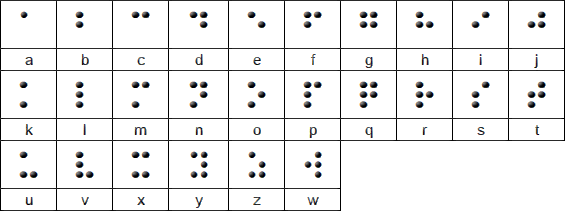
These letters are arranged to show how they are related: the middle row is the same as the top row with an extra dot in the bottom left corner. The bottom row is the same as the middle row with extra dot in the bottom right corner. W was an afterthought and doesn't fit this scheme, as Braille was invented for French and W is rarely used in French.
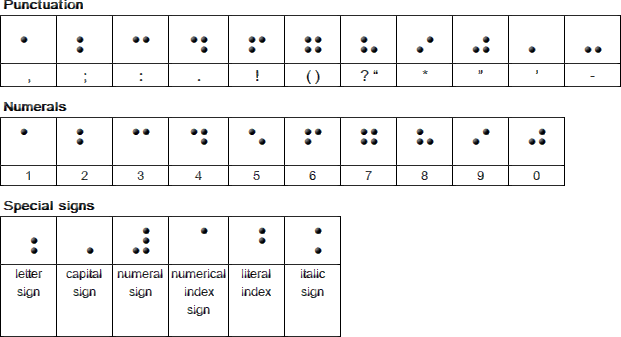
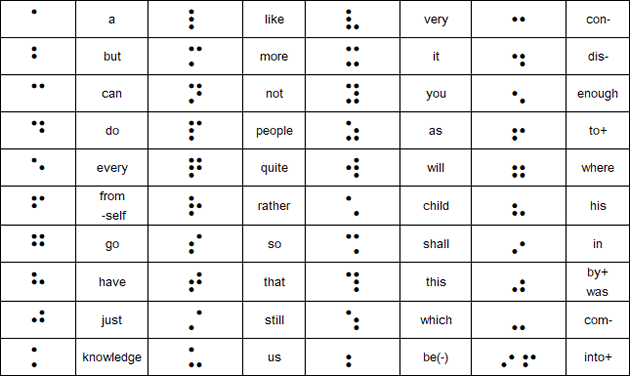
More Braille contractions (as used in the USA)
http://www.99main.com/~charlief/brl/brl2.htm

Transliteration: "Be kind to others"
Sample text and some other information provided by Samuel Barnes
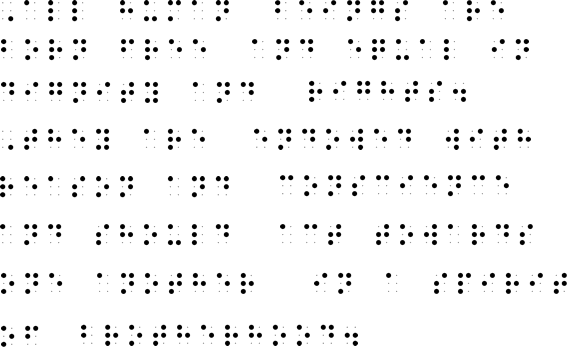
All human beings are born free and equal in dignity and rights. They are endowed with reason and conscience and should act towards one another in a spirit of brotherhood.
(Article 1 of the Universal Declaration of Human Rights)
Text generated by the Braille Translator
Information about Braille and other reading codes for the blind
http://www.rnib.org.uk/livingwithsightloss/readingwriting/braille/Pages/braille.aspx
http://www.brailler.com/braillehx.htm
http://www.nyise.org/blind/
http://www.duxburysystems.com/braille.asp
http://en.wikipedia.org/wiki/Braille
BRL: Braille Through Remote Learning
http://www.brl.org/
You've Got Braille - an introduction to Braille for kids (includes Braille translator)
http://pbskids.org/arthur/print/braille/
Blindness Related Learning - braille tutorials and related services
http://www.brailleschool.com
How Braille is used to represent Japanese, Korean, Russian and other languages
http://homepages.cwi.nl/~dik/english/codes/braille.html
Free Braille fonts
http://www.tsbvi.edu/math/1087-download-braille-and-asl-specialty-fonts
http://www.fontspace.com/category/braille
Export and emboss Braille documents using OpenOffice.org
http://odt2braille.sourceforge.net/
Your name in Braille
http://www.afb.org/braillebug/thenamegame.asp
http://www.gamehouse.com/blog/braille/
Braille Signage
http://www.eriecustomsigns.com
http://adacentral.com
https://www.cushingco.com/ada-signage/
Organisations that support blind and partially sighted people
http://www.nfb.org
http://www.rnib.org.uk
http://www.afb.org
http://www.brailleinstitute.org
http://www.nbp.org
Braille for Chinese, Braille for English, Braille for Latin & Greek, Braille for Welsh, Moon, Fakoo, Quadoo, Siekoo
Page last modified: 27.04.22
[top]

Note: all links on this site to Amazon.com


You can support this site by Buying Me A Coffee, via PayPal or Patreon, or by contributing in other ways.
If you find all the adverts annoying, there is now an Ad-free version of Omniglot which you can access for a small monthly or annual donation.

This website and its content is copyright of Simon Ager - © Simon Ager 1998-2026. All rights reserved. All images were created by me, unless otherwise indicated. More details

[top]


