
The Modern Aljamiado is a contemporary revival and reconstruction of the historical Aljamiado writing tradition of medieval and early modern Iberia developed by Javier A. Hernández Maldonado. The Modern Aljamiado adapts the Arabic script into a clear, phonetic, and pedagogical system for writing modern Spanish - and potentially other Iberian Romance languages such as Portuguese, Galician, Catalan, and Asturian.
The project seeks not only to revive a forgotten writing tradition, but also to reconnect the Hispanic world with its Mozarabic, Andalusi, Morisco, and Hispano-Arabic cultural heritage. It combines historical inspiration with modern linguistic standardization and educational accessibility. The system and its methodology are presented in the book Aljamiado Moderno: Manual básico para una escritura hispano-árabe del siglo XXI (2025).
The term Aljamiado derives from the Arabic word al-ʿajamiyyah (العجمية), meaning “foreign” or “non-Arabic language.” Historically, it referred to the practice of writing Romance languages such as Castilian, Aragonese, Mozarabic, and Portuguese using the Arabic alphabet.
During the Middle Ages and the early modern period, Muslims, Moriscos, Mozarabs, and some Sephardic communities in Iberia used Arabic script to write vernacular Romance speech. This practice became especially important after the fall of Al-Andalus and the forced conversions and persecutions that followed the Christian Reconquista.
Aljamiado manuscripts preserved: religious texts, poetry, legal manuals, folk tales, mystical literature, travel narratives, and linguistic records of medieval Iberian Romance.
Many texts were hidden inside walls, caves, and private homes to avoid confiscation during anti-Muslim persecution in Spain. Hundreds of manuscripts survive today in libraries in Spain, France, the Vatican, and elsewhere.
The origins of Aljamiado can be traced to Al-Andalus, where Romance-speaking Christians (Mozarabs) lived alongside Arabic-speaking Muslims and Jewish communities. Over centuries, linguistic and cultural interaction produced hybrid literary traditions in which Romance languages were written using Arabic script.
One of the earliest examples of this tradition appears in the kharjas (jarchas), short Romance lyric refrains embedded in Arabic and Hebrew poetry.
After the Christian conquest of Muslim territories, many Iberian Muslims became Mudéjars (Muslims living under Christian rule) and later Moriscos (Muslims forcibly converted to Christianity). As Arabic language use became restricted and eventually criminalized under the 1567 Pragmatic Sanction of Philip II, Aljamiado became a clandestine means of preserving religious, linguistic, and cultural identity.
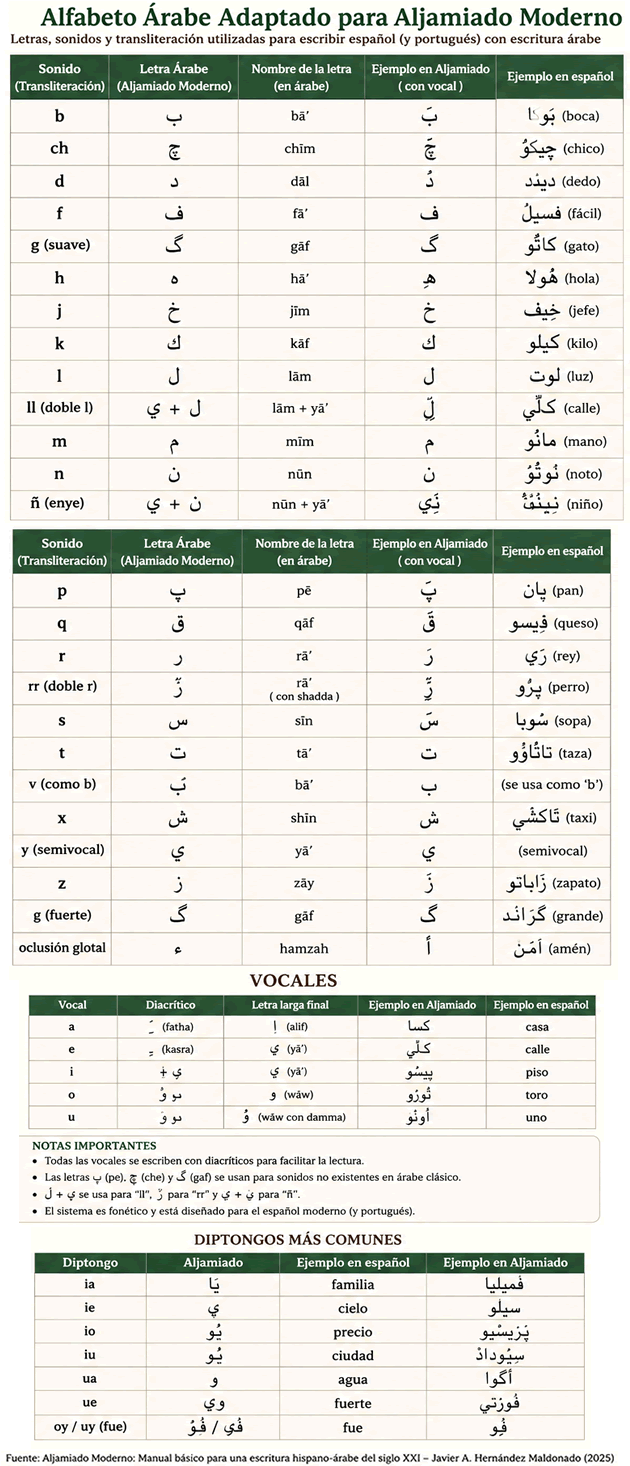
Modern Aljamiado was created as a reconstructed and standardized adaptation of the historical script for the needs of the 21st century. According to Hernández Maldonado, the goal was to create a system that:
Unlike many historical Arabic-script adaptations, Modern Aljamiado emphasizes: full vowel marking, phonetic transparency,pedagogical consistency, simplified orthographic rules, and compatibility with modern digital typography.
The system incorporates adapted Persian and Maghrebi-derived letters for sounds absent in Arabic, including: پ (p), چ (ch) , گ (g), and modified forms for ñ, ll, and rr. It is written from right to left, like Arabic.

España es una nación con una herencia cultural y lingüística muy diversa.
Spain is a nation with a very diverse cultural and linguistic heritage.
Information about Spanish | Useful Phrases | Silly Phrases | Numbers | Colours | Idioms | Family words | Time | Weather | Tongue twisters | Tower of Babel | Articles | Links | My Spanish learning adventures | My podcast about Spanish | Books about Spanish on: Amazon.com and Amazoncouk | Learn Spanish through stories
Constructed scripts for: Ainu | Arabic | Chinese languages | Dutch | English | French | Hawaiian | Hungarian | Japanese | Kadazandusun | Korean | Lingala | Malay & Indonesian | Persian | Tagalog / Filipino | Russian | Sanskrit | Spanish | Taino | Turkish | Vietnamese | Welsh | Other natural languages | Colour-based scripts | Tactile scripts | Phonetic/universal scripts | Constructed scripts for constructed languages | Adaptations of existing alphabets | Fictional alphabets | Magical alphabets | A-Z index | How to submit a constructed script
[top]

Note: all links on this site to Amazon.com


You can support this site by Buying Me A Coffee, via PayPal or Patreon, or by contributing in other ways.
If you find all the adverts annoying, there is now an Ad-free version of Omniglot which you can access for a small monthly or annual donation.

This website and its content is copyright of Simon Ager - © Simon Ager 1998-2026. All rights reserved. All images were created by me, unless otherwise indicated. More details

[top]


