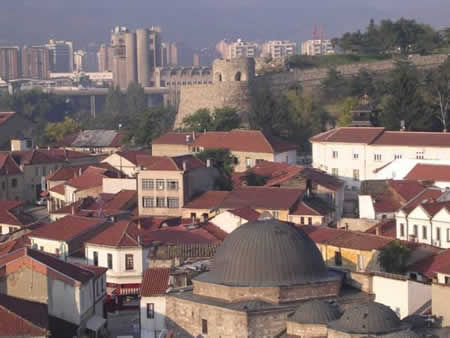
Here is a recording of a mystery language. Can you work out which one if is?
This is not a language you’re likely to hear very often.
Here is a recording of a mystery language. Can you work out which one if is?
This is not a language you’re likely to hear very often.
According to an study at Miami University in Ohio, we tend to associate particular names with particular face types. If a name ‘matches’ a face, we tend to find it easier to remember, while face and names that are not perceived as ‘matching’ are more difficult to remember.
In the study, 150 college students were asked to construct faces for 15 common male names using facial construction software. A second group was asked to rate how well these constructed faces seemed to fit their names. This group thought that there was a good match between many of the names and faces, with the best matches for the names Bob, Bill, Brian and Jason. The name Bob, for example, was associated with round faces. Perhaps this has something to do with sounds of the name.
To test whether names that fit faces are easier to remember, a third group of students was shown the constructed faces with their names. Later they were asked which names they could recall, and it was found that the better the match between name and face, the better they could remember the names.
Another study is planned to try to discover why there are such associations between names and faces. One possible reason is apparently that parents may name their babies to fit their general features, including the shapes of their faces.
The other day, someone mentioned that large chunks of French dialogue appear in War and Peace without any translation into Russian. In the 19th century, when the novel was written, knowledge of French was widespread among the Russian aristocracy and they tended to speak French to each other. So they would have been able to follow the French in the book without difficulty.
This got me thinking whether there are many other bilingual novels. In regions where two or more languages are a part of everyday live, you’d think that some writers might use a mixture of those languages in their stories. However, apart from a few Welsh and Irish novels which include bits of English dialogue, I haven’t come across any bilingual novels. Have you?
isogram, noun – a word in which the letters turn up an equal number of times.
There are different types of isograms depending on how many times each letter appears:
In a first-order isogram, each letter appears just once, as in dialogue, lexicography, ambidextrously and uncopyrightable.
In a second-order isogram, each letter appears twice, as in deed, Vivienne, Caucasus and intestines.
In a third-order isogram, each letter appears three times. These are rare, unusual words such as deeded (“conveyed by deed”) and geggee (“victim of a hoax”).
I came across this term in an article by David Crystal about his new book By Hook or By Crook: A Journey in Search of English.
This post was inspired by an email I received today from someone who wanted to know why the f sound in Māori is written wh, as in Whangarei.
According to a number of sites I found, Māori was first written down by missionaries who had little or no training in phonetics or phonology, and there was considerable variation in the spelling systems they came up with. The sound represented by wh was originally a voiceless bilabial fricative /ɸ/ (p\), though in some dialects, particularly in the North Shore area, it was a voiceless labial-velar fricative /ʍ/ (W). It was written w by some, and wh, f or v by others.
These days, many people pronounce wh as /f/, or sometimes /h/, /w/ or /ʍ/ (W).
Sources:
http://www.qi.com/talk/viewtopic.php?p=107120
http://www.nzetc.org/tm/scholarly/tei-RogEarl-t1-back-d2.html
http://www.nzetc.org/tm/scholarly/tei-KohStor-t1-back-d3.html
http://www.faqs.org/faqs/cultures/new-zealand-faq/part2/section-10.html
Here’s an interesting and useful site for you that I came across the other day: SmartPhrase. It contains phrasebooks for Dutch, French, German, Greek, Italian, Portuguese and Spanish, though unfortunately there are no audio recordings.
There is also a random phrase generator which gives you either serious or humerous phrases in a variety of languages.
Here are a few examples of the humorous phrases:
Discúlpame ¿te importa si te miro un rato? Quiero recordar tu cara en mis sueños.
Excuse me, do you mind if I stare at you for a minute? I want to remember your face for my dreams.
Da-me los cables puente de batería, los pollos se han escapados.
Hand me the jump leads, the chickens have escaped.
Für so einen kleinen Mann hast Du aber sehr grosse Nasenlöcher!
You have very large nostrils for such a small gentleman.
Keine Elephanten in der Bar nach 8 Uhr!
Elephants are not permitted in the bar after eight o’clock.
Se devi tagliarti le unghie dei piedi, vai via dalla cucina, per favore.
If you must clip your toenails now, kindly leave the kitchen.
Ο δρακος επιμενει να θγσιασογμε μια κοπελα αλλιως θα καψει το χωριο.
The dragon insists we sacrifice a maiden otherwise he will burn the village to the ground.
Dat is de derde keer deze week dat één van de patienten spontaan is gaan uitbarsten.
That is the third time this week that one of the patients has spontaneously combusted.
A cama do meu marido está cheia de areia preta. Porquê?
My husband’s bed is full of black sand. Why?
The other day I found some useful sites: one that contains all from the lessons and other material from Practical Chinese Reader with sound files; another which includes tests from that same textbook; and an online version of the New Practical Chinese Reader (Books 1, 2 and 3).
In my first year at university, the textbook I used was the Practical Chinese Reader, which is quite a good introduction to spoken and written Chinese. A big box of character flashcards is also available to accompany the course and I had them stuck all over my walls at one stage. The textbook follows the adventures of Gǔbō (古波) and Pàlánkǎ (帕兰卡), who are from an unnamed Eastern European country and who go to China to study Chinese. It was first published during the communist era when that sort of thing was more common.
I think using stories in language courses can be quite helpful – it makes them more interesting and can motivate you to continue studying so that you can find out what happens. What do you think?
One idea I have is to write a story which starts in English, then gradually introduces words and phrases in another language until by the end, it’s entirely in the second language. The Power Glide language courses do something like this that they call a ‘diglot weave’.
The other day I found a site called Nobukaze which contains some interesting information about Japanese history, samurai, pop culture, language and a variety of other weird and wonderful Japan-related topics. There’s also some information about the Indonesian and Javanese languages and writing systems, and a guide to “Java for the Absolutely Clueless“.
The Indonesian language section mentions that there is very little mutual intelligibility between Malaysian and Indonesian, mainly because of differences in pronunciation and vocabulary. Indonesian has apparently borrowed numerous words from Javanese, which are unfamiliar to speakers of Malaysian. Does anyone speak Malaysian? Can you understand Indonesian? Or vice-versa.
Another interesting page on this site explains the origins of Japanese names. Did you know that the Japanese didn’t have individual names for their rivers and other geographical features? People might have called the stretch of a river that flowed by them by one name, while their neighbours further downstream had a different name for their stretch of river. There were no names that applied to rivers as a whole, at least until the 16th century, when Portuguese missionaries apparently forced the Japanese to adopt overall names for rivers, seas, etc, so that a map of Japan could be produced for the Pope.