Chinese names

The Chinese versions of candidates’ names in some Massachusetts ballots apparently have some unfortunately comical or negative meanings, according to an article I came across today. For example, one candidate’s name could be translated as “Sticky Rice” or “Uncooked Rice”, another’s as “High Prominent Noble Educated” or “Stick Mosquito”.

I’m trying to work out what character were used for these names. Any ideas?

Mixing languages

According to an article I found today, the government of Malaysia is worried about the way young Malays are mixing Malay with other languages. This is known as “rojak” language and the most common combination of languages is Malay and English. The Minister of Culture, Youth and Sports has called on the authorities to “to implement and monitor the use of proper Malay language”.

The article also talks of the Malay language being “eroded” and “polluted” and of the need to “save the dignity of the Malay language”. The Minister also said:

“We know that language, community and culture are always evolving with the time, […] Conversing in ‘rojak’ language is now regarded by society as modern and advanced without realising that it is tearing apart the very fabric of our values and culture, […].”

This is an example of the age old complaint about language often made by older generations about younger generations. The idea that a particular language is going downhill has been around possibly as long as language has existed.

Aberystwyth

As I have no classes this weekend, I decided to go to Aberystwyth today. The bus took about an hour and a half to get there and went through some nice scenery and some pretty villages and towns along the way. I particuarly liked Aberaeron, a small town by the sea with attractive Victorian houses painted in many different colours.
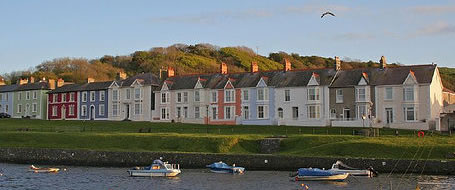
Photo of Aberaeron

Er nad oedd dosbarthiadau heddiw, penderfynais i i fynd i Aberystwyth. Treuliodd y daith ar y bws tua awr a hanner ac aethon ni’n trwy gefngwlad hyfryd ac trwy nifer o drefi a phentrefi pert. Mae Aberaeron yn arbennig o ddeniadol, gyda llawer o dai Fictoraidd lliwgar.

In Aberystwyth I spent quite a bit of time wandering around the town and bought some Welsh CDs, a new Irish course, and another book of tin whistle tunes to add to my collection. There are some good bookshops in Aber, including one with French-Welsh and German-Welsh dictionaries, and courses for learning Breton and Irish through the medium of Welsh. They also had a Cornish course and dictionary.
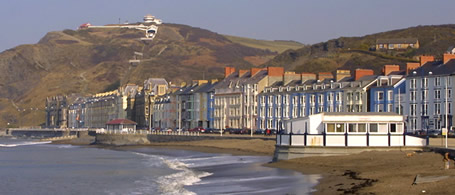
Photo of Aberystwyth seafront

Treuliais i maith o amser yn grwydro o gwmpas y dre a brynais i gryno ddisgiau gan Siân James, Gwenan Gibbard a Swci Boscawen, Cwrs Gwyddeleg newydd, a llyfr o diwniau ar gyfer y chwiban. Mae nifer o siopau llyfrau da yn Aber, yn gynnwys un sy’n gwerthu geiriaduron Cymraeg-Ffrangeg a Chymraeg-Almaeneg, a chyrsiau Llydaweg a Gwyddeleg trwy gyfryng y Gymraeg. Mae cwrs a geiriadur Cernyweg da nhw hefyd.

After having a look around the castle, I walked along the prom, and then went up Constitution Hill on the cliff railway. The views from the top were amazing – I could see more or less the whole of Cardigan Bay from the Llŷn Peninsula in the north to the Pembrokeshire Peninsula in the south. The sun even came out for a while and the clouds cleared making the view even better.
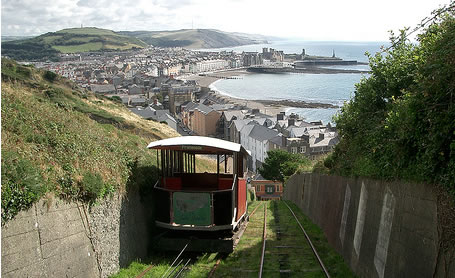
Photo of Aberystwyth from the Cliff Railway

Ar ôl i mi gael cipolwg ar y castell, cerddais i ar hyd y promenâd ac es i i lân y Graiglais ar y rheilffordd y graig. Oedd y golygon i lawr y bryn yn ardderchog – o’n i’n gallu gweld Bae Ceredigion braidd i gyd o’r Llŷn yn y gogledd i’r penrhyn Sir Benfro yn y de. Disgleiriodd y haul am sbel a gwasgarodd y cymylau hefyd ac felly, oedd y golygon yn well.

On a semi-related matter, I received an email today from Steafan MacRisnidh, a speaker of Scottish Gaelic who is currently working in Japan. He has set up a new blog with some Gaelic lessons in Japanese. He also has a number of other blogs in Gaelic. Just though I’d mention it here.

As we usually have a quiz at the weekend, I don’t want to disappoint you today, so here it is:

Which of the following places is the odd one out?
Caerhirfryn, Caerliwelydd, Caerlŷr, Caernarfon, Caerfaddon, Caergrawnt, Caergaint, Caerwysg, Caerwrangon
This is your captain speaking

According to an article I found today, from next March pilots who fly overseas will be required to pass an English language competency test, The Test of English for Aviation. The article suggests that this test will present quite a challange for the many Chinese pilots who speak little or no English.

Some Chinese airlines, China Southern Airlines, are requiring their pilots to take English classes for six days each month.

Apparently there is also a shortage of examiners who speak both English and Mandarin, and who are familiar with civil aviation.

Word of the day – treiglad

Today’s word, treiglad (pl. treigladau) is the Welsh word for mutation, the process of changing the initial consonants of words – something we were practising in class today. This is a characteristic of all the Celtic languages and takes quite a bit of getting used to.

The most common mutation in Welsh is the soft mutation or treiglad meddal, which changes t to d, p to b, c to g, and so on. It’s quite hard to keep track of all the occasions when this mutation is needed, but I think I’m getting better at it. I haven’t tried to memorise all the rules because there are so many of them. Instead I notice where mutations are used in the Welsh texts I read and when I hear Welsh spoken. This gives me a good feel for when to use them.

If you practise reading and listening to a language as much as possible, you get a lot of exposure to grammatical patterns like mutations. This helps you to develop instincts for the grammar and seems to me to be the best way to learn it. I think this method works better than trying to memorise all the grammatical rules first. Once you have developed a feel for how a language works, then learning the rules might be helpful and certainly will be easier.

Blogs

I’ve been thinking for a while about starting a new blog to practise my languages. What I can’t decide is whether to have one new blog on which I post in various languages, or to have one for each language I want to practise. Another thing I can’t decide is what to call the blogs. Any ideas?

The course is going well, we’re speaking plenty of Welsh and we don’t have so much homework tonight.

Glaw

We were practising questions and answers in class today. There are no exact equivalents of yes and no in Welsh. Instead when answering a question, you repeat the verb in the appropriate form, or in some cases you use other words. For example, responses to the question Wyt ti’n mywnhau’r cwrs ma? (Are you enjoying this course?), could be Ydw (I am) or Nag ydw (I’m not).  It often takes me a few moments to work out the correct answer.

O’n ni’n ymarfer cwestiynau ac atebion yn y dosbarth heddiw, ac ddoe hefyd. Yn aml mae rhaid i mi feddwl am ychydig eiliadau i ddewis yr ateb cywir. 

This morning we also attended a local cyd – an informal get together of local Welsh speakers and Welsh learners. It took place in the one of the pubs in town, and we heard and spoke quite a lot of Welsh, so it was very useful.

Y bore ma, aethon ni i’r tafarn yn y dre i gymryd rhan mewn cyd – cyfarfod anffurfiol bobl leol sy’n siarad neu sy’n dysgu Cymraeg. O’n ni’n siarad llawer o Gymraeg gyda nhw, felly oedd hi’n defnyddiol iawn.

It started absolutely tipping it down after dinner and I thought there might be floods like there were here last week. Fortunately the rain didn’t last more than about half an hour.

Ar ôl cinio, cychwnodd hi’n bwrw glaw trwm iawn. Ond oedd hi’n gorffen cyn hanner awr ac nag oedd llifogydd fel yr wythnos diwethaf.

I have some more homework to do for tomorrow, so I’d better go now.

Rhaid i mi mynd nawr, achos mae gen i mwy o waith cartref i wneud cyn yfory.

Lampeter

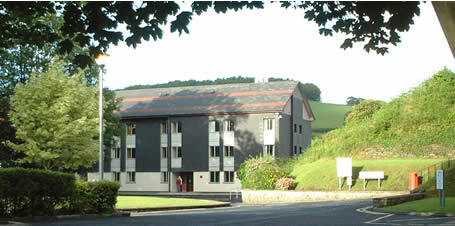
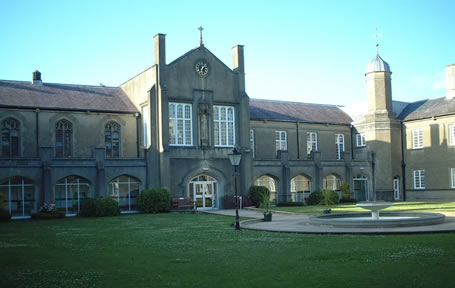
I arrived in Lampeter yesterday evening after a long train and bus journey. After dumping my bags in my room – I’m staying in one of the university residences – I had wander around the town. There wasn’t many people about and only a few of the pubs and restaurants were open. I eventually found a fish and chip place that was open and had dinner there.

Photo of the hall of residence where I'm staying during the course

Cyraeddais i yn Lambed neithiwr ar ôl taith hir ar y trên ac ar y bws. Rhoddais magiau yn fy ystafell – dw i’n aros yn lety y brifysgol – ac yna es i am dro o gwmpas y dre. Doedd dim llawer o bobl ar y strydoedd ac oedd mwyafrif y siopau a bwyty ar gau. Or diwedd o’n i dod âr hyd o fwyty pysgod a sglods a ches fy swper yno.

This morning I meet the other people on the course – there’s about 25 of us, I think – and registered, which invovled filling in loads of forms. I was initially put in the intermediate class, but moved up to the advanced class in the afternoon.

Photo of the oldest part of the university - our classroom in in the corner of this building

Y bore ma, cwrddais i’r pobl eraill ar y gwrs – mae tua 25 ohonon ni i gyd, dw i’n meddwl – ac gofrhestriais i – oedd llawer o ffurflenau i lenwi. Yn gynta, o’n i yn y lefel canolbarth, ond yn y prynhawn, symudais i i’r lefel uwch.

Name the language

Here is a recording of a mystery language. Any ideas which language it is?

This language is spoken mainly on an island, and is related to languages spoken on a nearby continent.

By the way, I’ll be away for the next two weeks on the Summer Welsh course at the University of Wales Lampeter. During that time, I probably won’t be able to answer all your emails and I’m not sure how often I’ll be able to post stuff on this blog. I’ll be back on 1st July.

Yn ystod y pythefnos nesa, bydda i’n dysgu mwy o Gymraeg ar y Cwrs Haf Cymraeg yn y Prifysgol Cymru, Llanbedr Pont Steffan. Bydda i’n ôl 1 Gorffenaf.