Back to Brighton

I arrived back in Brighton yesterday afternoon after a week in the Czech Republic and Germany, which was great fun.

Prague was stunning and well worth another visit – the day and a bit I had there wasn’t really enough to take it all in. August is apparently a better time to visit, as it tends to get really busy in September and October.

During the first few days of cycling it rained quite a bit and was also quite windy. We also went along some busy roads through areas with a fair amount of heavy industry. Fortunately the weather and scenery improved later on during the week and we had a very enjoyable ride along the Elbe, mainly on well-maintained cycle paths. The towns we passed through or stayed in were attractive and picturesque; the food was plentiful, quite tasty and reasonably priced; and the people we met were generally friendly and welcoming.
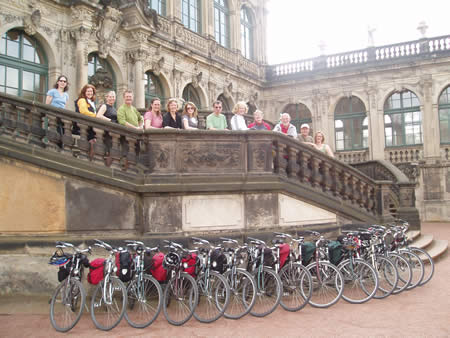
Explore cycling group at the Zwinger Palace in Dresden, Germany, September 2007

There were 12 others in the group I travelled with, most from the UK, but also a couple of Canadians and an Australian. We ranged in age from 30something to 60something and got on well together. We also had a Polish tour leader, who rode with us, and a Polish driver, who took our luggage from hotel to hotel. Our tour leader spoke good English and a bit of German. He managed to communicate with people in the Czech Republic mainly in Polish with bits of Czech mixed in. The driver spoke Polish and some English, and while he couldn’t understand much Czech, he could understand Slovak quite well.

I used my Czech at every opportunity. Only one Czech person commented on this, asking if I was Czech. Everybody else just talked Czech to me and I did my best to understand them. I also tried out the few Polish phrases I know on our tour leader, and learned a bit more from him. In Germany I tried to speak German to people and found that those who could speak English often did so with me, even if I continued speaking German to them.

I picked up quite a few new Czech words from signs and menus – when you come across them in context every day, they soon sink in. The sight, feel, smell and taste of the food also helps me remember the menu words.

There were two native Welsh speakers in the group and I talked to them a bit in Welsh. They told me that I speak Welsh well with a good accent, and were impressed that my Welsh is self-taught. In 2003 while I was on holiday in northern Portugal, I met some Welsh speakers, but at that time I couldn’t have more than a very limited conversation. Since then I’ve been determined to become fluent in Welsh, and seem to be making good progress.
Bohemia and Saxony by bike

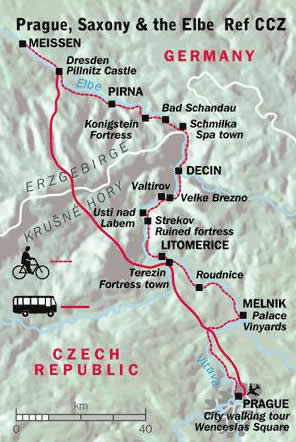
Map of the route of my cycling trip from Prague to Meissen

Tomorrow I’m off for week’s holiday in the Czech Republic and Germany with Explore Worldwide. I’ll be flying to Prague early tomorrow morning, then cycling north along the Vltava and Elbe rivers to Meissen in Germany, via Mělník, Litoměřice, Děčín, Pirna, Dresden, and quite a few castles, churches, cathedrals and palaces. After that I’ll go back to Prague by coach, spend a day there, and then return home.

The tour involves five days of actual cycling covering about 30 miles / 45 km a day. Most of the route is along rivers and is apparently flat or downhill, with only occasional uphill sections. So though I haven’t been doing much cycling since I moved to Brighton, apart from some semi-regular unicycling, I’m sure I’ll be able to cope.

I’m also looking forward to having a chance to try out my Czech, and to speaking some German as well.

Saxony a Bohemia

Yfory dw i’n mynd i’r Weriniaeth Tsiec a’r Almaen am wythnos o wyliau gydag Explore Worldwide. Bydda i’n hedfan i Brag yn gynnar bore fory, ac yna yn beicio i’r gogledd ar hyd yr afonydd Vltava ac Elbe i Meissen yn yr Almaen, trwy Mělník, Litoměřice, Děčín, Pirna, Dresden, a cryn dipyn o gestyll, eglwysi a phalasau. Yna es i yn ôl i Brag ar bws, treulia i dydd fan ‘na, ac wedyn des i adref.
Rothaíocht i mPoblacht na Seice agus an Ghearmáin

Amárach beidh mé ag dul go dtí Poblacht na Seice agus an Ghearmáin ar feadh seachtaine. Déanfaidh mé turas rothaíocht le Explore Worldwide. Beidh an turas ag tosú i mPrág, agus ansin beidh mé ag rothaigh ó thuaidh le taobh na abhann Vltava agus Elbe go Meissen sa Ghearmáin, trí chuid mhaith caisleáin, eaglaisí agus páláis. I ndiaidh sin, rachaidh mé ar ais go Prág ar an mbus, caithfidh mé lá amháin ansin, agus abhaile liom i ndiaidh sin.

LingDoku

LingDoku

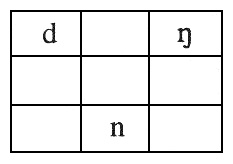
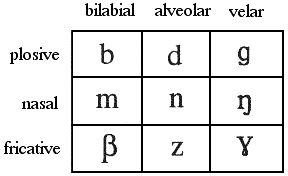
Here’s a game similar to sudoku called LingDoku (illustration top right), which is designed for linguists. According to the Speculative Grammarian, the site where I came across it, “LingDoku simplifies the logical components of SuDoku, and introduces a thin veneer of linguistics which confuses outsiders while making linguists feel superior.”.

The rules of LingDoku are straightforward. Using the nine IPA symbols in the table above, complete the unfinished table below. Each symbol occurs exactly once in the box, and no row or column may contain more than one symbol with either the same place or same manner of articulation. If this one is too easy, there’s a more challenging version called Samurai LingDoku here.
LingDoku

The Speculative Grammarian is well worth a thorough browse, packed as it is with “twisted ramblings, academic parody [and] satirical linguistics”, including The Lingo – A car designed for linguists… by linguists, The European Dialects of Cheese, and crosswords for linguists.

Degrammaticalization

Degrammaticalization, a word I stumbled across on this blog today, is the process through which grammatical affixes become independent words.

A good example is ish, which started off as a suffix on words like longish, shortish, etc. Then became an enclitic – an affix that can be detached from the words it would normally be attached to, and stuck on to other words – and finally started to be used on its own. More examples of degrammaticalization include esque, ism, pro, con, anti, ette.

In Esperanto, quite a few affixes can be used as independent words. The suffix -ig, for example, indicates the cause or bringing about of action or state, e.g. blankigi, to whiten, from blanka, white. When used on its own as the verb igi, it means ‘to cause’. This appears to be a kind of deliberate, planned degrammaticalization.

Can you think of any other examples of degrammaticalization in English or other languages?

Free the bound morphemes!

New Cantonese phrases

The Cantonese phrases page on Omniglot now includes quite a lot of new phrases with sound files. If you’re able to make recordings of any of the other phrases, do let me know.

I also have new phrases and sounds files for Mandarin, Japanese and Thai, which I’ll be adding to the site soon.

These new phrases and sound files were all provided by the good people at HNHSoft, who make talking phrase books for PDAs and mobile phones.

Is Russian losing ground?

Since the break up of the Soveit Union, Russian has been losing ground in many of the former Soviet Republics, according to an article I found the other day. The “Year of the Russian Language”, which was officially opened in Paris in August, is an effort to address this trend by promoting the Russian language and culture outside Russia.

Belarus, Kazakhstan, Kyrgyzstan, Tajikistan, and Uzbekistan are the only former Soviet Republics where Russian is still has official status, alongside their own languages. Even in these countries Russian remains a contentious issue and there have been calls to make Belarusian to sole official language in Belarus. In Turkmenistan many Russian schools have been closed, and in Uzbekistan the number of Russian speakers has decreased significantly.

In the Czech Republic and Slovakia, English has replaced Russian as the most widely taught foreign language. The same is possibly true in other countries in Eastern Europe, though it has gained ground in Poland recently.

Esperanto in Ukraine

According to a report I came across today, the Ukrainian Department of Education has recommended that Esperanto be taught in all schools in Ukraine. It is currently taught as an optional subject in some schools, but the Minister of Education believes that “Esperanto can help to make Ukraine the centre of Europe”.

A Ukrainian teacher of Esperanto interviewed for the report claims that you can learn Esperanto in just 7 days if you know no other foreign languages, or 3-5 days if you know a couple of European languages.

If you know Esperanto, how long did it take you to learn it?

Laŭ raporto, kiun mi trovis hodiaŭ, la Edukado Fako de Ukrainio estas rekomendinta, ke Esperanto instruiĝis en ĉiuj lernejoj en Ukrainio. Nuntempe ĝi estas instruiĝis nedevige en kelkaj lernejoj, sed la Edukada Ministro kredas, ke “Esperanto povas helpi fari Ukrainion la centron de Eŭropo”.

Ukrainia Esperanto-instruisto intervjuita por la raporto pretendas, ke vi povas lerni Esperanton dum nur 7 tagoj, se vi ne konas aliajn fremdlingvjon, aŭ 3-5 tagoj, se vi konas kelkajn Eŭropajn lingvojn.

Si vi konas Esperanton, kiom daŭris vian studojn?