Duvet day

It rained heavily on and off most of yesterday and I overheard someone on the bus commenting that it was a “duvet day”. I don’t remember hearing this expression before, but from the context I thought she meant that because the weather was so unpleasant, she would prefer to spend the day under her duvet rather than going to work.

According to Wikipedia, a duvet day is a day off from work you take when you’re not sick and don’t have other reasons for staying at home, but just feel like a break. Some people apparently have the right to such days in their contracts. The Phrase Finder adds that this practice dates back to the 1960s and that the phrase first appeared in print in 1996.

Does this concept exist in your country? Are you allowed to take duvet days?

Manx language

I’m on the Isle of Man at the moment doing some research for my dissertation on the revival of the Manx (Gaelic) language. I’m staying in Douglas (Doolish), the island’s capital, and plan to explore other parts of the island – it’s partly a holiday for me as well as a way to collect data.

One of the things I’m investigating is the use of Manx in public. On the ferry from Liverpool they used the Manx for good morning, moghrey mie, a few times in announcements, though that was the only Manx I heard yesterday. I also found some leaflets with collections of useful Manx phrases at the ferry terminal, including some with translations in French, German and Spanish.

When exploring Douglas today I noticed quite a few English/Manx bilingual street signs, and that most government departments, and some shops and other businesses have English and Manx names. So the public visibility of the language is quite high, but you only hear it spoken at certain times and in certain places, which is similar to the situation with Irish in Dublin. For example, today I sat in on a Manx conversation class that takes place every Tuesday lunchtime in a local pub. It was the first time I’d heard live Manx conversation, and somewhat to my surprise, I could understand almost everything they said, which is encouraging. My knowledge of Irish and Scottish Gaelic certainly helps.

Tomorrow I’ll be visiting the Manx medium primary school and talking to some of the teachers. I discovered today that most of the kids there only speak Manx in the school – outside school and at home the speak mainly or entirely in English, except in a few Manx-speaking families. I’ll find out more about this tomorrow.

Ynys Manaw

Mi gyrhaeddais yn Ynys Manaw y prynhawn ‘ma, a dw i’n aros yn Douglas, prif dref yr ynys. Roedd hi’n braf heddiw, ac roedd y môr yn dawel. Does dim llawer o Fanaweg i glywed neu i weld yma, heblaw ar rhyw arwyddion ac ar amserlen y bysiau. Bydda i’n cwrdd â pobl sy’n siarad Manaweg yfory.

Oileán Mhanann

Tháinig mé go dtí an Oileán Mhanann an tráthnóna seo, agus tá mé fanacht i nDubh Lios, príomhbhaile an oileáin. Bhí lá breá ann inniu agus bhí an fharraige ciúin. Níl go leor Manainnis a chluinstin nó a fheiceáil an seo, ach amháin ar roinnt comharthaí agus ar amchlár na busanna. Casfaidh mé le daoine atá Manainnis acu amárach.

Ellan Vannin

Raink mee ayns Mannin fastyr jiu, as ta mee tannaghtyn ayns Doolish. Va laa braew ayn jiu as va’n keayn lane rea. Cha nel mooarane Gaelg ry akin ny ry clashtyn ayns shoh, agh er chooid veg nyn cowrey as er earroo claare-traa nyn barrooseyn. Bee’m meeiteil ry Gaelgeyryn mairagh.

Isle of Man

I arrived in the Isle of Man this afternoon, and I’m staying in Douglas, the island’s capital. It was fine today, and the sea was flat calm so the voyage over from Liverpool went smoothly. I haven’t heard or seen much Manx here, except on some signs and on the bus timetable. I’m be meeting some Manx speakers tomorrow.

Newyddion

Dw i wedi bod yn brysur yn ddiweddar -es i i’r Bala efo ffrindiau prifysgol ddoe, a neithiwr roedd parti yn nhŷ un o fy ffrindiau o gôr cymunedol. Nos Wener ymunais â’r Côr Dysgwyr Cymraeg, ac roedden nhw’n dathlu eu llwyddiant yn Eisteddfod Môn. Nos Iau roedd ginio efo ffrindiau o fy nghwrs, ac y penwythnos diwethaf es i i Abermaw efo ffrindiau prifysgol. Dw i wedi sgwennu chwe mil o eiriau ar gyfer fy nhraethawd hir hefyd. Yfory a i i Ynys Manaw am bythefnos, a dw i’n edrych ymlaen yn fawr ato.

Eeee ee

The title of this post is not a typo, but is in fact the third person singular feminine form of the future tense of the verb to eat (ee [i:]) in Manx, or in other words means “She will eat”. I came across it while reading about the Manx language the other day and as well as grabbing my attention, it also made me wonder whether there are many other words or phrases with so many vowels in sequence in Manx or other languages.

Here are few other Manx phrases I put together containing many e’s:

  • Eeee ee eeym – She will eat butter
  • T’ee gee eeym bwee – She’s eating yellow butter
  • Eeee ee nhee erbee – she’ll eat anything
  • O Yee! Eeee ee eeym bwee eeagh lhee – Oh God! She’ll eat edible yellow butter with her
  • Dee mee eeym bwee – I ate yellow butter
  • Eeym eeym bwee – I’ll eat yellow butter
  • Bee’m gee ee bwee lhee – I’ll be eating yellow butter with her

As double letters are quite common in Manx, I’m sure other sentences containing lots of o’s or a’s could be constructed, for example: Soo coo doo lhoo (The black dog sucked a pole).

Can you think of any similarly vowel-rich sentences in other languages?

Mysterious inscription

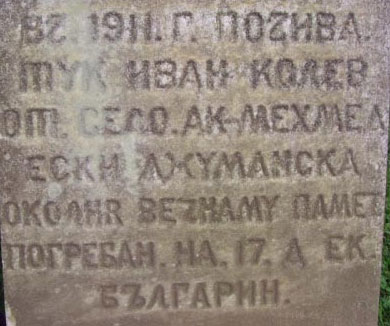
This photo was sent in by a visitor to Omniglot who is curious to know what the inscription means. The inscription, which he thinks might be in Russian or Bulgarian, appears on a gravestone in a cemetry in Rhinebeck, NY.

Mysterious inscription

Can any of you help?

Polishing off your Polish

There’s apparently been a significant increase in the numbers of people learning Polish in recent years, especially since 2004, according to this article, and many of them come from the UK or Ireland.

Many language schools that used to teach mainly English and German to Poles are now offering courses in Polish as a foreign language. Such courses are popular with people from the UK and Germany who have been going to teach in Poland since the 1990s, and also with people with Polish partners, and people of Polish origin wanting to get in touch with their roots. Translators and interpreters are studying Polish as there is a great demand for Polish speakers in EU institutions.

Polish is described as a notoriously difficult language that starts out fiendishly difficult and then gets harder, and it’s apparently quite common for students to quit after a few lessons. Some do continue studying later after getting their courage back though. Not surprisingly speakers of other Slavic language find Polish least difficult to learn, Germans find the grammar relatively easy as it has much in common with German grammar, and speakers of Romance languages don’t find the grammar too hard. It’s English speakers who usually find Polish hardest, and Australians are apparently dreaded by Polish teachers.

Are any of you learning Polish?