Puzzle

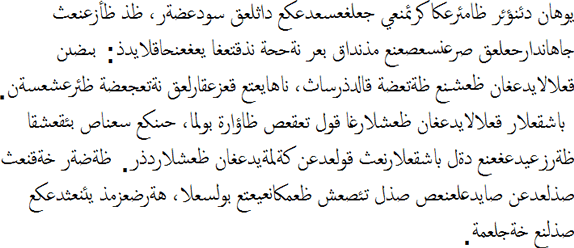
Here’s some mysterious writing from a napkin ring.

Mysterious writing from napkin ring

Can any of you identify the script or decipher it?

This writing comes from a puzzle that appeared in the Puzzle Museum in 2005 and since then no-one has been able to identify the script or decipher it.

Some of the letters look like Thai or Lao, while others look like Tagalog to me.

The person who sent in the puzzle thinks the writing might be in a magical alphabet like the ones here.

Mysterious inscription

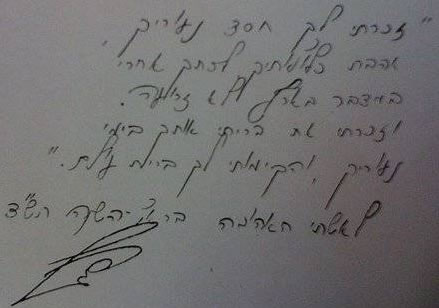
This mysterious inscription was sent in by an editor at the Arizona Republic newspaper in Phoenix, Arizona. One of their reporters is working on a story about a book that was donated to a local library there. It’s a portfolio of prints apparently related to the Hermitage Museum in Leningrad that was compiled for the 1939 World’s Fair.

The inscription below is on the flyleaf, and they’ve been trying to determine what language it’s in in the hopes of getting it translated.

Mysterious inscription

The writing appears to be in a cursive form of the Hebrew script, and the language might be Hebrew or Yiddish.

Noel, genes and genius

When singing the Christmas carol The First Noel the other day I started wondering where the word noel comes from. I knew noël was French for Christmas, but wasn’t sure where that came from.

According to the Online Etymology Dictionary, noel comes from the Latin natalis (birth) via the Old French noel (the Christmas season), and the Middle English nowel.

Quite a few other words for Christmas probably come from the same root – Natale (Italian), Navidad (Spanish), Natal (Portuguese), Nadal (Catalan/Galician/Occitan/Romansh), Nadolig (Welsh), Nedeleg (Breton), Nadelik (Cornish), Nollaig (Irish/Scottish Gaelic), and Nollick (Manx).

natalis comes from natus, the past participle of nasci (to be born), which comes from the Old Latin gnasci (to be born), which is cognate with the Latin genus (race, stock, kind), and the Greek γένος [genos] (race, kind) and γόνος [gonos] (birth, offspring, stock), the reconstructed Proto-Indo-European root of which is *gen-/*gon-/*gn- (to produce, beget, be born).

Other words derived from that PIE root include genius, gene, king and kin in English, gentis (Lithuanian – kinsman), Kind (German – child), geni (Welsh – to be born), and I’m sure there are plenty of others.

Nolllick

Nollick Ghennal as Blein Vie Noa

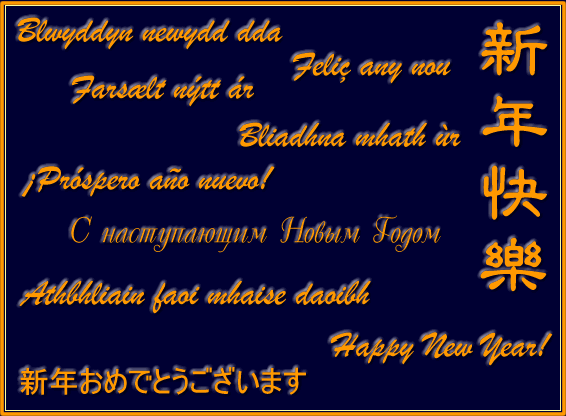
Nollaig shona agus athbhliain faoi mhaise duit

Nollaig chridheil agus bliadhna mhath ùr

Nadelik Lowen ha Blydhen Nowydh Da

Nedeleg laouen ha bloavezh mat

The land of rabbits

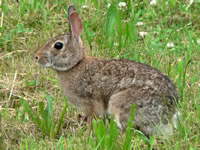
Photo of a rabbit

When adding more animals to the Celtic Connections section on Omniglot the other day, I started wondering about the origins of the Celtic words for rabbit – connín (Irish), coinean (Scottish Gaelic), conning (Manx), cwningen (Welsh), conyn (Cornwell), c’honikl (Breton). They appear to be related to each other, and also to the English word coney, which was used for rabbit until the 18th century, while rabbit was used for the young of the coney from about the 14th century.

Rabbit apparently comes from the Walloon robète, which is a diminutive of the Flemish or Middle Dutch robbe.

Coney comes from the Anglo-Norman conis, the plural of conil “long-eared rabbit” (Lepus cunicula) from the Latin cuniculus, which means burrow and comes from the Greek κύνικλος (kýniklos), which is thought to come from an Iberian word for burrow. Related words in other languages include kanin (Danish), konijn (Dutch), bunny (English), Kaninchen (German), coniglio (Italian).

There’s a popular theory that the Roman name for Spain, Hispania, which became España and Spain, comes from the Phoenician name for Iberia i-shepan-im, the land or coast of rabbits. When the Phoenicians first visited Iberia in around 500 BC they saw lots of rabbits there which they named after a similar animal, the hyrax of North Africa.