| français | English | Cymraeg |
|---|---|---|
| ADN (L’acide désoxyribonucléique) | DNA (Deoxyribonucleic acid) | DNA (asid deocsiriboniwcleig) |
| la salive | saliva | poer |
| roux; roquin | red-haired | pengoch |
| noisette | hazel (eye colour) | gwinau; brown golau |
| l’œil au beurre noir; l’œil poché | black eye | llygad du |
| aux yeux troubles | bleary-eyed | â llygaid molog/molglafaidd |
Category: Welsh (Cymraeg)
Carrying coals to Newcastle
An idiomatic way to say a task is pointless is to say it’s like carrying coals to Newcastle – Newcastle, in the north east of England, used to be a major coal mining area.
In French the equivalent is porter de l’eau à la rivière (to carry water to the river).
In German they say Eulen nach Athen bringen/tragen (to take/bring owls to Athens).
In Welsh there are quite a few equivalent expressions:
– cario glo i Fflint = to carry coal to Flint (a former coal mining area)
– cario dŵr dros afon = to carry water across a river
– bwrw heli yn y môr = to throw salt in the sea
– iro blonegen = to grease fat
– iro hwch â bloneg = to grease a sow with fat
– gwerthu mêl i berchen gwenyn = to sell honey to a bee keeper
– mynd i ‘ngheg i chwilio am fy nhafod = to go to my mouth and look for my tongue
– gyrru halen i’r Heledd = to send salt to a salt pit
– golchi traed alarch = to wash a swan’s feet
– taflu ‘fale i’r berllan = to throw apples into an orchard
What about in other languages?
Les mots de la semaine
| français | English | Cymraeg |
|---|---|---|
| la honte | shame | cywilydd; gwarth |
| avoir honte de qch | to be ashamed of sth | cywiliddio; teimlo cywilydd; bod â chywilydd |
| faire honte à qn | to make sb feel ashamed | codi cywilydd ar rywun; cywilyddio rhywun |
| honte à vous ! | shame on you! | rhag cywilydd ichi! |
| shameless | éhonté, effronté (without shame); impudique (immodest) | digywilydd; hy |
| le mineur | (coal) miner | cloddiwr; mwynwr; glöwr |
| porter de l’eau à la rivière | to carry coals to Newcastle | cario dŵr dros afon |
Llap y dwndwr – the drink of prattle
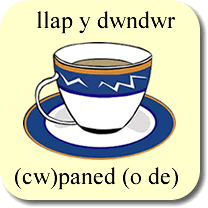
I discovered last night that an old Welsh expression for tea is llap y dwndwr [ɬap ə ˈdʊndʊr], which could be translated as meaning “the drink that makes one talkative” or “the drink of chatter”. It is also the name of a tune.
The word llap means soft and wet, and appears in the expression bwyd llap (soft and wet food), which can refer to soup (cawl) or rice pudding (bwdin reis).
The word dwndwr means noise; to make a noise; to bluster, prattle or babble; or to daunt, hector or bully. A related word is dwndrio = to babble or talk too much. It appears in the expressions cap y dwndwr = rattlepate (a frivolous, talkative person), and rhap y dwndwr = a gossip, or loud-mouthed person.
Other poetic/slang names for tea include dail y dwndwr (“the leaves of chatter”) and llysiau’r dwndwr (“the herbs of chatter”).
In colloquial Welsh tea is te [tɛ] and a cup of tea is panad or paned in North Wales – this comes from cwpaned o de (cup of tea), and it’s disgled (o de) in South Wales.
Does tea have any interesting names in other languages?
Source: Geiriadur Prifysgol Cymru
Multilingual conversations
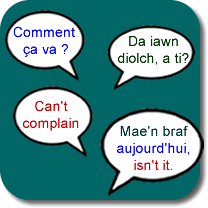
At the French conversation group I go to most weeks we usually stick to French most of the time, however when the leader of the group isn’t there or leaves early, as she did last week and the week before, we often switch to English and/or Welsh. Most members of the group speak Welsh, as well as English and French, so we quite often have trilingual conversations mixing all three languages in a wonderful way. I really enjoy such conversations, and it feels great being able to understand and use these languages in this way.
With other friends I may have one, two, or more languages in common, but it’s relatively unusual for a group people to have three or more languages in common, like in the French group.
Do you know groups of people with whom you can have multilingual conversations?
In how many different languages are your multilingual conversations?
One Person One Language (OPOL)
This post is based largely on an article by Francois Grosjean: https://www.psychologytoday.com/blog/life-bilingual/201504/one-person-one-language-and-bilingual-children
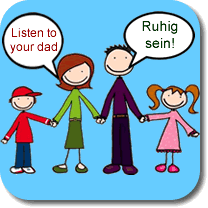
One popular way to raise bilingual children is for each parent to speak only their native language with their children. For example the father will speak English and the mother will speak Spanish, and the children will acquire both languages. At first the children might mix the languages, but they will soon come to associate one language with each parent. There is also a belief that if the parents mix languages, e.g. the Spanish-speaking parent sometimes speaks English, and the English-speaking parent sometimes speaks Spanish, the children will get confused.
Problems with the OPOL approach
There are problems with the OPOL approach – children is likely get more exposure to one language then to the other, and one language is likely to become dominant. The children may come to prefer that language, especially if both parents speak it, and the children may be able to understand but not speak the non-dominant language. This is quite often the case with minority languages like Welsh and Irish.
It can also be difficult to stick to OPOL when other people are around who only speak one of the languages. For example, if a Spanish/English family is with Spanish-speaking friends, does the parent who only speaks English with the children stick to English, even though the friends might not understand, or do they switch to Spanish? Parents can find such situations stressful and might adapt their approach to context and be more flexible rather than sticking rigidly to OPOL.
Does the OPOL approach actually work?
There are have been a number of the OPOL approach, including a notable one of 2,000 families by Annick De Houwer, which found that children in a quarter of the families did not become bilingual, and that in families where parents mixed languages, as many children became bilingual as in OPOL families.
What is the OPOL approach based on?
Given the popularity of the OPOL approach, you might think that it’s based on sound foundations of research and testing. This is not the case. It has probably been around for a long time, but the first reference to it in modern linguistic literature is in a book from 1913 by Jules Ronjat, a French linguist with a German wife. In 1908, when his son was born, Ronjat asked his colleague, Maurice Grammont, for advice on raising his son bilingually. In a letter Grammont advised Ronjat to speak only French to his son, and for his wife to speak only German. Since then many other people have discussed the OPOL approach, and often cite a book by Grammont, Observations sur le langage des enfants (Observations on Children’s Language) which was supposedly published in 1902, however does not in fact exist, according to François Grosjean. So the OPOL approach is based on the opinion of Maurice Grammont, who published nothing on language acquisition, as expressed in a letter to his colleague Jules Ronjat.
Have you tried or are you trying the OPOL approach?
Did it work / is it working for you?
What problems have you had with it?
Links
Life as a Bilingual: The reality of living with two (or more) languages (by Francois Grosjean, and Aneta Pavlenko)
https://www.psychologytoday.com/blog/life-bilingual
Links to websites with information and advice about raising children bilingually
http://www.omniglot.com/links/bilingual.htm#kids
Articles about bilingualism
http://www.omniglot.com/language/articles/index.htm#bc
Les mots de la semaine
| français | English | Cymraeg |
|---|---|---|
| la plate-forme électorale | hustings | llwyfan etholiad; hustyngau |
| défraîchi; en mauvais état; écorné | tatty | aflêr |
| être en lambeaux | to be in tatters | bod yn llarpiau / yn garpiau / yn gareiau |
| le champ de force | force field | maes grym |
| le groupe de réflexion | think thank | seiat ddoethion |
| revendiquer | to claim (land, right, title) | hawlio; honni |
Sun dribbles
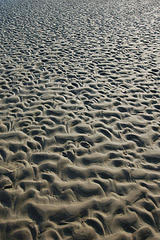
While walking along by estuary of the River Dwyryd at Portmeirion yesterday, the Czech friend I was with asked me the name of the patterns in the sand and mud made by water. I wasn’t sure and suggested ripples or sand ripples. She misheard the latter and thought I said sun dribbles, which I really like the sound of.
I checked today and discovered that the marks in sand and mud left by flowing water are known, rather boringly, as ripple marks, or wave-formed ripples, according to Wikipedia.
Do they have more poetic names in other languages?
Les mots de la semaine
| français | English | Cymraeg |
|---|---|---|
| braiser; cuire à l’étouffée | to braise | mudstiwio; brwysio |
| bœuf braisé/mode/en daube | braised beef | cig eidion wedi ei frwysiedig |
| faire une purée de (pommes de terre) | to mash (potatoes) | mwtro/stwnsio/stompio (tatws) |
| une purée de pommes de terre | mashed potatoes | tatws stwmp/stwmsh; stwnsh tatws |
| le joint de culasse | gasket | gasged |
| casser/griller un joint de culasse | to blow a gasket (car) | chwythu gasged |
| péter un fusible; se mettre en colère | to blow a fuse | chwythu/llosgi ffiws |
| péter les plombs | to blow one’s top | gwylltio’n lân/ulw; colli’ch tymer; mynd ar gefn eich ceffyl |
| faire un bruit de pet | to blow a raspberry | hisian; hwtio; wfftio |
Les mots de le semaine
| français | English | Cymraeg |
|---|---|---|
| appuyer sur le champignon; mettre les gaz |
to put one’s foot down (to accelerate) | rhoi dy droed ar y sbardyn; cyflymu |
| mettre les pieds dans le plat | to put one’s foot in it | rhoi’ch troed ynddi; cael caff gwag |
| faire de son mieux | to put one’s best foot forward | rhoi’r troed gorau ymlaenaf; prysuro; brasgamu; estyn camau |
| se détendre | to put one’s feet up | cael (pum) munud; cael hoe fach; cael seibiant; cael sbel, gorffwys |
| la grille | railings | rheiliau; barrau; rheilin |
| un accident | (car) crash | trawiad; gwrthdrawiad |
| avoir un accident de voiture | to crash one’s car | dryllio’ch ar; malu’ch car |
| emprunter (qch à qn) | to borrow (sth from sb) | benthyca (rhywbeth gan rywun); cael benthyg (rhywbeth gan rywun) |
| prêter (qch à qn) | to lend (sb sth) | benthyca (rhywbeth i rwyun); rhoi benthyg (rhywbeth i rwyun) |
| trembler | to quake | crynu |
| les régions sauvages (fpl) | wilderness | diffeithwch; anialwch; anialdir; gwylltir |
| l’espace (m) naturel | wilderness area | ardal wyllt/naturiol |
| en pleine traversée du désert | in the wilderness (not prominent/active) | yn y diffeitwch/anialwch; allan o rym; heb rym |
| le chien courant; le chien de meute | (hunting) hound | bytheiad; helgi; ci hela |
| la meute | the hounds; a pack (of hounds) | cŵn; helgwn; haid o gŵn |