| français | English | Cymraeg |
|---|---|---|
| la taupinière | molehill | prid y wadd; priddwal; twmpath gwadd |
| le taupin | click beetle; maths student | chwilen clic (?); myfyriwr mathemateg |
| noir comme une taupe | pitch-black | pygddy; purddu |
| myopes comme une taupe | blind as a bat | yn ddall bost; mor ddall â’r nos/garreg/thwrch daear |
| le tableau (d’affichage) | scoreboard | bwrdd sgorio; bwrdd cadw sgôr |
| la cible (de jeu de fléchettes) | dartboard | bwrdd darts |
| le centre (de la cible) | bullseye | llygad (tarw); canol y nod; bwl |
| mettre dans le mille; faire mouche | to hit the bull’s-eye | ei tharo hi yn y canol; sgorio/cael bwl |
| faire un carton | to hit the mark | bwrw’r nod, taro’r nod |
Category: English
Breadcrumbs & Scotch Eggs
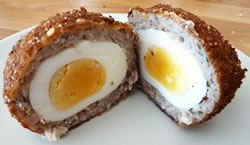
Yesterday I discovered an interesting French word: paner, which means to coat with breadcrumbs or to bread.
So a Scotch Egg, which is a hard boiled egg wrapped in sausage meat, breaded and deep fried, can be described as a œuf dur enrobé de chair à saucisse et pané in French – it sounds better in French, although it’s not something you’d find in France or other French-speaking regions, as far as I know.
Restaurants in the UK often use French names and descriptions for dishes as they sound better and more sophisticated than their English equivalents. Do restaurants in other countries do this?
Would you rather have toad-in-the-hole or saucisses cuites au four dans de la pâte à crêpes?
Or how about pudding aux raisins instead of spotted dick?
Les mots de la semaine
| français | English | Cymraeg |
|---|---|---|
| l’anneau (m) | ring | modrwy |
| le rond de serviette | napkin ring | cylch napcyn; modrwy napcyn |
| la bague de fiançailles | engagement ring | modrwy ddyweddïo |
| une vague de froid (de courte durée) | cold snap | pwl/sbel o dywydd oer |
| le craquement | snap (sound of something breaking) | clec |
| céder | to snap (break) | torri (‘n glec/gratsh) |
| (sorte de jeu de) bataille | snap (game) | |
| la brume | mist | niwl; niwliach; tarth; tawch |
| la bruine | Scotish mist | smwc; smwcan; smwclaw; ffwgen |
| le brouillard; la brime | fog | niwl; twach; niwlen; tarth |
| des nappes de brouillard | patchy fog | niwl ysbeidiol/bylchog (?) |
| brouillard à couper au couteau | thick fog | niwl trwchus |
| la miette | crumb | briwsionyn |
| la miette/mie de pain | breadcrumb | briwsionyn bara |
| les chapelure (fpl) | (dried) breadcrumbs | briwsion bara |
| œuf dur enrobé de chair à saucisse et pané |
Scotch egg | ŵy selsig; ŵy mewn sosej |
| paner | to coat with breadcrumbs | taenu briwsion |
| pané | (coated) in breadcrumbs; breaded | wedi ei daenu briwsion |
Publishing Children’s Books in Endangered Writing Systems
Today we have a guest post by Tim Brookes
—————————————————-
I knew next to nothing about writing systems until five years ago, when more or less by accident I began carving endangered alphabets.
I’d spent my life as a nonfiction writer, with no pretensions to be a visual artist, when one Christmas I decided to make gifts for my family by carving their names in boards of Vermont maple, with the bark still on and a beautiful ripple in the grain.
These came out surprisingly well, and in casting around for something else to carve, I stumbled on Omniglot.com.
The range and variety of writing systems, many of which I’d never heard of, was amazing. Doing a little mental arithmetic, though, I realized that fully a third are in danger of dwindling out of existence.
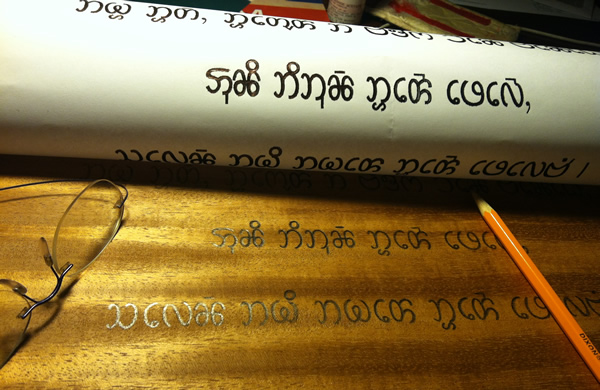
A Chakma carving in progress
I decided to carve some of the scripts to draw attention to the problem of language loss and cultural erosion. Working with a set of gouges and a paintbrush, I created an initial exhibition of thirteen carvings, which have since been exhibited in schools, libraries, and universities across the United States and Europe.
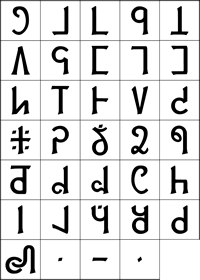
Then I expanded my range, creating several dozen pieces depicting words, phrases, sentences, or poems in vanishing alphabets from all over the world, including three scripts of indigenous peoples in Bangladesh: the Mro, Marma, and Chakma.
At the time I had no idea I would meet a member of the Marma people, a remarkable man named Maung Nyeu, and that we would collaborate on a preservation project that may become a model of how to reverse linguistic decline and the cultural collapse that goes with it.
I must confess that when I started my project, my interest in carving and exhibiting scripts was a little theoretical—after all, I couldn’t actually read or write what I was carving, and I had never seen language or script endangerment up close.
All that changed in June 2012, when I first met Maung Nyeu, in Boston.
He had stumbled on my website and seen, to his amazement, that someone not only knew about the threatened languages of the Hill Tracts but had actually carved them.
The Hill Tracts, a forested upland area in southeastern Bangladesh, are home to more than a dozen indigenous peoples who are distinct from the majority Bengali population in language, culture, and religion.
The region suffers from a wide range of difficulties, but Maung’s primary interest, he told me, is in the linked issues of education and language endangerment.
Virtually all schools in the Chittagong Hill Tracts teach classes in Bangla (Bengali), the country’s official national language. However, Bangla is not a language spoken in the Hill Tracts, and as a result the children’s education is difficult, confusing, frustrating, and often futile. By second grade, 35% of students drop out, and that number jumps to 65% by fifth grade. Fewer than 2% finish their education.
Adding injury to insult, indigenous children are often abused by teachers and students from the country’s largest ethnic group, Bengalis. Maung himself suffered mistreatment.
In a single generation, Maung said, he has seen his people go from living as self-sufficient farmers on ancestral lands to being vagrant day laborers scattered across Bangladesh and into India and Myanmar.
Remarkably, Maung managed to acquire enough of an education at home from his mother to get into boarding school, then earn a degree in engineering at the University of Hawaii, then an MBA from the University of Southern California.
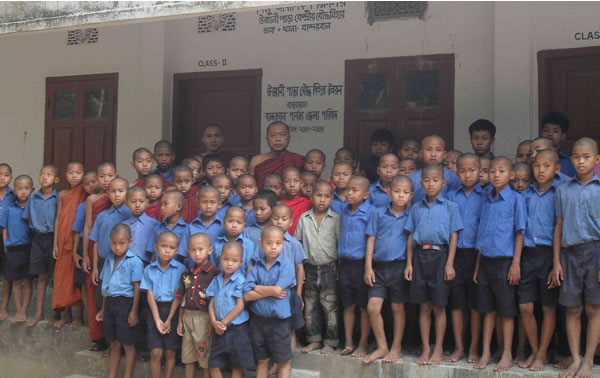
The children at Padamu Residential Education Center
He returned to the Hill Tracts to work with community members to build the Padamu Residential Education Center, a school on the grounds of a Buddhist temple, so the children of the Hill Tracts could be educated in their own languages.
Classes began in 2008. Change was immediately apparent: Children who had seemed destined to be unskilled laborers announced their intention to be doctors and teachers. Since then, two more indigenous-language schools have been built by the local communities.
But most of the students could no longer read or write their own ethnic language.
So Maung came back to the U.S., to the Harvard Graduate School of Education, to learn how to create a culturally relevant curriculum that would revive the dying languages of the Hill Tracts.
At the nearby Massachusetts Institute of Technology, he sought out the advice of the philosopher and linguist Noam Chomsky.
“He was very kind and very attentive,” Maung said. “His recommendation was that it is possible to preserve a language, but it needs to start with the children, preferably as part of their curriculum.”
For Maung, a culturally relevant curriculum must be taught in the language the child speaks at home—the language the child is already learning and is using to find out about the world.
Also, the material being taught must be familiar. Maung remembered that at school he had to learn by heart William Wordsworth’s poem “Daffodils.”
“I had never seen a daffodil!” he laughed. “I had no idea what it looked like. We have all sorts of plants and flowers, but I never saw a daffodil until I came to the United States!”
In order to create culturally relevant materials—and to reconnect children with their elders, and their cultural heritage—the children at Padamu collected more than 40 stories passed down in the villages of the Hill Tracts. The stories involve mountains and trees and animals the children already know—tales they may have heard from their parents and grandparents.
Maung is in the process of having them translated into Mro, Marma, and Chakma, writing them out, getting them illustrated in a visual idiom familiar to the children, and getting them published.
He faces an additional challenge. Most people in these groups still speak their traditional languages, but very few can now read and write their unique scripts.
That’s where I came in.
In June 2012 Maung and I set up a partnership to publish children’s books and other educational materials and, we hope, to help save the languages that sustain the cultures of the Hill Tracts.
I first hand-carved texts in each of the three languages, then recruited Jamie Kutner, a calligrapher in the M.F.A. program at Louisiana State University to take the handwritten forms of the scripts and turn them into works of art. Tom Sanalitro, a typographer at Anglia University in England, created specimen Mro and Marma font books, and Pooja Saxena, a typographer in India, is working to create child-friendly digital typefaces for the indigenous scripts.
Paul Ledak, a friend who owns a computer-controlled laser, burned texts into mahogany boards, and created rubber stamps so children can stamp out their letters.
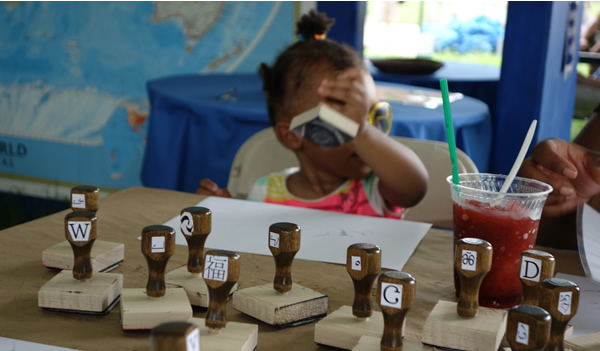
Our rubber Endangered Alphabet stamps at the Smithsonian Folklife Festival, June 2013
This spring, publishing students of mine from Champlain College, in Burlington, Vermont, are helping to help edit, design, and illustrate the next four books bound for Padamu, and have them printed and shipped to Bangladesh.
Reversing the decline of a language is a Herculean task, and there are no guarantees that Maung will succeed.
“In medicine,” Maung explained, “there is a window of time—maybe a few minutes to two hours, called the golden hour—where if the person can get to the ER, the chance of survival increases. For our children, their golden hour is between the ages of four or five and twelve. If we don’t get them in school during this time, we won’t get them at all.”
To support our efforts to publish children’s books in the indigenous languages of the Hill Tracts, please visit https://www.kickstarter.com/projects/1388900883/our-golden-hour.
A Snell Wind
The Scots phrase, a snell wind, appears in one of the books I’m reading at the moment, and as I hadn’t come across it before it mystified me a bit. It’s some kind of wind, but what kind?
According to the OED, snell is a Scots and Northern English word meaning:
1. (of a person) quick in movement or action; prompt, smart, active, strenuous
2. keen-witted, clever, sharp, acute, smart
3. severe, sharp, unsparing
4. (of weather) keen, bitter, severe
5. grievous, heavy, stinging; rigorous; painful
6. shrill, clear-sounding
So it seems that the most likely meaning for a snell wind is a bitter one.
Snell comes from the Middle English snell (quick, fast) from the Old English snel(l), from the Proto-Germanic *snellaz (active, swift, brisk). It is cognate with the German schnell (quick, swift, active), the Italian snello (quick, nimble), the Old French esnel/isnel (snell), and the Occitan isnel/irnel (snell), the Old Norse snjallr (skilful, excellent), the Swedish snäll (nice, kind, kind-hearted, decent, clever, benignant) and the Danish snild (clever) [source].
A related word is snellness (sharpness, keenness).
Les mots de la semaine
| français | English | Cymraeg |
|---|---|---|
| encombrant | bulky; inconvenient; inhibiting; cumbersome | swmpus; trwchus; praff; trafferthus; anhwylus |
| sans encombre | without mishap/incident/hinderance | heb anffawd |
| encombrer | to block; obstruct | atal; rhwystro |
| s’encombrer | to burden oneself; weigh oneself down | llwytho/llethu eich hunain |
| tricher | to cheat | twyllo; cafflo |
| la feuille de référence; antisèche | cheat sheet | dalen dwyllo (?) |
| penser tout haut | to think aloud | lleisio’ch meddyliau; siarad â chi eich hun; meddwl yn uchel |
| dans un monde à part | in a world of one’s own | mewn byd ar wahân, yn ei fyd bach ei hun |
When I haver
In the Proclaimers song I’m Gonna Be (500 Miles), which we often sing in the Bangor ukulele club, the Scots word haver makes several appearances (see the lyrics here), and none of us know what it means. I thought it meant something like to shout, like holler, or to cry.
According to The Online Scots Dictionary, haver [‘he:vər] means:
– n. Nonsense, foolish talk, gossip, chatter.
– v. To talk in a foolish or trivial manner, speak nonsense, to babble, gossip. To make a fuss about nothing, to make a pretence of being busy, to dawdle, to potter about, to saunter, lounge. pt. pp. haivert, haivered. adj. Half-witted.
The OED defines haver as:
1. to talk garrulously and foolishly; to talk nonsense. (Chiefly Sc. and north. dial.)
2. to hesitate, to be slow in deciding. (Orig. Sc. dial. but now in general English use)
Related words include haiverin = babbling chatter; nonsensical gossiping, and haiverel = halfwit; wittless.
There’s another haver, which is listed separately in dictionaries, which means oats and comes from the Middle English haver, from Old Norse hafri (oats), from the Proto-Germanic *habrô (oats), from the Proto-Indo-European *kapro- (goat) [source].
Related words include:
– havermeal = oatmeal, half-ground meal
– haverpoke = a horse’s nosebag
Have you ever havered? Do you have any other words with a similar meaning?
Bidie in
This week I discovered the Scots expression bidie in, which refers to someone you live with and are not married to. It is also written bidey-in and bide in, and the plural is bidie ins or bidies in, or similar. The DSL defines bide in as “A person who lives with another without marriage”. The word bide means to remain, stay, live.
English equivalents of this word include cohabitee, cohabiter, common-law spouse/husband/wife and live-in lover. Do you know any others?
If you live with your partner and are not married, how do you refer to them?
I think the equivalent in Swedish, Danish and Norwegian is samboer or sambo, which also means roommate or flatmate [source].
Les mots de la semaine
| français | English | Cymraeg |
|---|---|---|
| l’hémorragie (f) | haemorrhage | gwaedlif; gwaedlin |
| faire une hémorragie | to haemorrhage; to have a haemorrhage | cael gwaedlif; colli gwaed |
| le bouclier | (soldier’s) shield | tarian; bwcled |
| le bouclier antiémeute | riot shield | tarian rhag terfysg |
| la protection; l’écran (m) | shield (protection) | sgrîn; giard; gorchudd |
| l’écran de protection | heat shield | tarian wres |
| le protège-dents | gum shield | gorchudd dannedd; arbedwr |
| l’écu (m); l’écusson (m) | shield (heraldry) | tarian |
| l’héraldique (f) | heraldry | herodraeth |
| le blason | coat of arms; blazon | arfbais; pais; arfau |
| protéger | to shield | gwarchod |
| le piment (rouge) | chilli (spice) | chilli; tsili |
| le poudre de piment | chilli powder | powdr chilli |
Uitsmijter
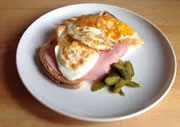
The other day I came across the wonderful Dutch word uitsmijter, which means bouncer or doorman, and also a type of food consisting of toast, egg(s), ham, bacon or other meat, cheese and pickles is various combinations.
Apparently this is the kind of thing that some Dutch people like to eat after the bars close and the uitsmijters throw them out, which one possible way the dish got its name. Another explanation for the name is that it’s something that easily made and ‘thrown out’ of the kitchen [source]. It’s also popular as a breakfast and lunch dish.
The word uitsmijter comes from uit (out) and smijten (to fling, throw, hurl, smite, heave), so an uitsmijter is a thrower/flinger out. Smijten comes from the Middle Dutch smiten, from the Old Dutch *smītan, from the Proto-Germanic *smītaną (to cast, hurl, hit, strike, smear, dirty), from the Proto-Indo-European *smeyd- (to smear, whick, strike, rub), which is also the root of the Low German smieten (to throw, cast, chuck), the West Frisian smite (to throw), the German schmeißen (to throw, fling, slam), the English smite, and the Danish smide (to toss) [source].
Are there dishes with similarly interesting names in your country?