
Kam is a Tai-Kadai language spoken by about 1.5 million people in Guizhou, Hunan and Guangxi provinces of China. It is a member of the Kam-Sui branch of the Tai-Kadai language family, and is also known as Gam, or 侗语 (dòngyǔ) in Chinese.
There are two mutually unintelligible dialects of Kam, which are classified as separate languages by some linguists. The northern dialect includes more loanwords from Chinese, and many speakers are bilingual in Kam and Chinese. The southern dialect has more speakers, and more of them are monolingual.
The Kam spelling system was devised by Chinese government researchers in 1958. It is used mainly by those researchers and by a few hundred Kam speakers. Other Kam speakers read and write in Chinese.
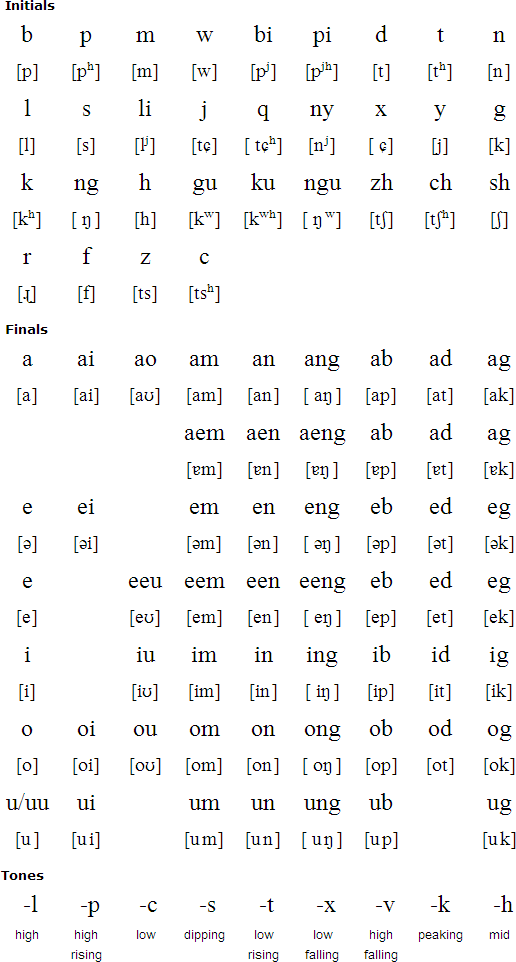
Kam has nine tones: open syllables (those ending in a vowel) can have nine different tones, and closed syllables (those ending in a consonant) can have six different tones. Tones are indicated by final consonants, for example bal (fish) and bedl (duck) have a high tone, while bas (aunt) and bads (can) have a dipping tone.
The last three tones are only used with open syllables.
Download an alphabet chart for Kam (Excel)
This Orthography is for Southern Kam as spoken in Rongjiang and was developed by the native speaker Ngo Van Lyong because he felt dissatisfied with the current system that can only be understood by a few hundred speakers and Chinese linguists. This system was also developed to represent his dialect of the language better which is why it doesn't have an exact 1 to 1 match with the Chinese official system. It is greatly inspired by the Vietnamese writing system but not all the same letters correlate to the same Vietnamese sounds.

More details (Excel)
Information supplied by Levi Maasen
Information about Kam | Phrases | Tower of Babel
Information about the Kam language and people
http://en.wikipedia.org/wiki/Kam_language
http://www.dongteam.org/info.html
http://www.omf.org/omf/us/peoples_and_places/people_groups/dong_of_china
Ahom, Aiton, Bouyei, Isan, Kam, Khamti, (Tai) Khün, Lao, Lue, Northern Thai (Kam Mueang), Nùng, Shan, Sui, Tai Dam, Tai Dón, Tai Hongjin, Tai Laing, Tai Nuea, Tai Phake, Tai Ya, Tai Yo, Thai, Thai Song, Yang Zhuang, Zhuang
Languages written with the Latin alphabet
Page last modified: 23.04.21
[top]

You can support this site by Buying Me A Coffee, and if you like what you see on this page, you can use the buttons below to share it with people you know.

If you like this site and find it useful, you can support it by making a donation via PayPal or Patreon, or by contributing in other ways. Omniglot is how I make my living.
Note: all links on this site to Amazon.com


[top]


